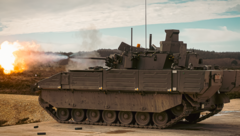
The British Army is finally getting back into the dirt with the Ajax armored vehicle. After a series of delays that would make a seasoned logistics officer weep, the Ministry of Defence (MoD) has confirmed that trials are resuming. This isn't just another routine update. It's a high-stakes attempt to salvage a £5.5 billion project that has, quite literally, made soldiers sick.
For months, the Ajax program was the poster child for procurement disasters. We saw reports of crews suffering from hearing loss and vibration injuries. It wasn't just a mechanical glitch. It was a fundamental failure in the design that turned a scout vehicle into a shaker at high speeds. If you're wondering why the Army is persisting with a platform that has caused physical harm to its operators, the answer is simple. There is no Plan B. The British Army needs the Ajax to form the backbone of its "deep reconnaissance" capability, and they’ve already spent too much money to walk away now.
Why the vibration issues almost killed the program
The core of the Ajax trouble stems from excessive noise and vibration. When you're inside a tracked vehicle, you expect it to be loud and bumpy. That's the nature of the beast. But Ajax was different. During earlier testing, soldiers reported a level of vibration that caused nausea, swollen joints, and tinnitus. General Dynamics Land Systems (GDLS), the manufacturer, found themselves in a corner. The MoD had to halt trials in 2021 because the risk to personnel was simply too high.
The "fix" involved a massive engineering overhaul. Engineers focused on the internal seating and the way the suspension interacted with the hull. They also looked at the headsets used by the crews. It’s hard to do your job when the very machine meant to protect you is rattling your teeth loose. The resumption of trials means the MoD is confident—or at least hopeful—that these structural modifications actually work. They've fitted the vehicles with better noise-canceling tech and vibration-dampening mounts. Now, the Army has to prove these changes hold up under combat conditions.
Taking a closer look at the new testing phase
The Army isn't just jumping back into full-scale maneuvers. This is a phased approach. The initial restart focuses on "User Verification Trials." This is where soldiers from the Household Cavalry Regiment get behind the controls again. They aren't just driving around a flat track. They're testing the vehicle's ability to operate in diverse environments, from muddy fields to steep inclines.
The focus is squarely on safety. Every soldier involved in these trials undergoes rigorous medical screening before and after they enter the vehicle. If the vibration levels spike even slightly above the new safety thresholds, the whole thing stops again. This isn't just about PR. It's about ensuring the Army doesn't end up with a fleet of expensive paperweights that nobody is allowed to drive. The goal is to reach "Initial Operating Capability" by 2025. Honestly, that timeline feels optimistic given the history of this project, but it’s the target they’ve set.
The strategic necessity of the Ajax fleet
You might ask why we don't just buy something else. Why not go for the Swedish CV90 or another proven platform? The reality is that the Ajax is designed for a very specific role. It’s a "digital" tank. It’s packed with sensors and communication gear meant to find the enemy and relay that data back to the rest of the brigade instantly. It’s not just a box with a gun. It’s a node in a massive data network.
The different variants being tested
The Ajax family isn't just one vehicle. It’s a suite of platforms built on the same chassis. This commonality is supposed to make maintenance easier, though the vibration issues hit across the board.
- Ajax: The primary scout version with a 40mm cannon.
- Apollo: The armored recovery variant for fixing broken-down gear in the field.
- Atlas: An equipment support vehicle.
- Athena: The command and control hub.
- Ares: The troop carrier for specialized teams.
- Argus: Designed specifically for engineer reconnaissance.
By using the same hull for all these roles, the Army hopes to reduce the logistical footprint. It sounds great on paper. In practice, if the hull has a fundamental vibration flaw, every single one of these roles is compromised. That's why the current trials are so critical. If the fix works for the scout variant, it should, in theory, work for the rest.
Realities of the 40mm Cased Telescoped Cannon
The weaponry on the Ajax is another point of contention. It uses the 40mm Cased Telescoped Armament System (CTAS). This gun is a marvel of modern engineering. The rounds are cylindrical, with the projectile tucked inside the casing, making them compact and easy to store. This allows the Ajax to carry more firepower than traditional 40mm systems.
However, a new gun means a new set of teething problems. Integrating this weapon into a digital turret has been a headache. During the upcoming trials, the Army will be testing the "fire-on-the-move" capability. This is where the stabilized turret has to track a target while the vehicle is bouncing over rough terrain. If the vibration issues haven't been truly solved, the accuracy of this expensive gun goes out the window. You can't hit a target at two kilometers if the optics are vibrating so hard you see double.
What this means for the average soldier
The soldiers on the ground don't care about the politics of procurement. They care about whether the vehicle will keep them alive and whether they can do their jobs without ending up in a medical tent. There’s a lot of skepticism in the ranks. You don't just forget that a vehicle made your colleagues sick.
The MoD is working hard to rebuild that trust. They've implemented a "safety first" culture for these new trials that wasn't as visible in the early stages. This includes real-time monitoring of vibration levels inside the cabin. If a soldier feels uncomfortable, they have the authority to stop the trial immediately. This shift is vital. A vehicle is only as good as the crew's confidence in it.
Comparing Ajax to the competition
When you look at what other nations are doing, the Ajax looks like an outlier. The US Army is moving toward the XM30 Mechanized Infantry Combat Vehicle. The Germans have the Puma. Both have had their share of issues, but none have faced the specific physiological challenges that Ajax has.
The Ajax is heavier than many of its peers, weighing in at around 40 tonnes. Some critics argue this makes it too heavy for rapid deployment. However, that weight comes from high-end modular armor. In a modern battlefield filled with anti-tank guided missiles and drones, you want that protection. The trade-off is mobility and, apparently, a whole lot of vibration.
Managing the massive price tag
The £5.5 billion contract is a fixed-price deal with General Dynamics. This is a double-edged sword. On one hand, it protects the taxpayer from some of the cost overruns. On the other, it puts immense pressure on the manufacturer to deliver, sometimes leading to corners being cut in the development phase.
The MoD has already paid out a significant portion of this money. Walking away would mean losing billions with nothing to show for it. That's why we see such a dogged determination to make this work. It’s a "too big to fail" scenario in the world of military hardware. We are essentially watching a high-stakes gamble play out in real-time.
The path forward for the British Army
The success of these trials will determine the shape of the British Army for the next thirty years. If Ajax fails again, the Army's "Modernising Defence" strategy falls apart. They’ll be left with aging Warrior infantry fighting vehicles that are increasingly difficult to maintain.
The next few months are the most critical in the program's history. We'll see the vehicles pushed to their limits in various climates and terrains. Watch for reports on the "reliability growth" trials. This is the stage where the Army tries to break the vehicle to see how much it can take. If the Ajax comes out the other side without causing more medical issues, the program might just survive.
If you're following this, keep an eye on the official MoD reports regarding "Initial Operating Capability" dates. Any further slippage there is a huge red flag. For now, the engines are running, the crews are in their seats, and the Army is crossing its fingers. The mission is clear: prove the Ajax is a weapon, not a liability.
Start by looking at the upcoming defense select committee hearings. These sessions often reveal the gritty details that don't make it into the press releases. You'll get a much clearer picture of whether the "vibration fix" is a permanent solution or just a temporary patch. Monitor the feedback from the Household Cavalry as they spend more hours in the hulls. Their experience is the only metric that actually matters. If they’re happy, the project stays on track. If they aren't, expect a very loud political fallout by the end of the year.