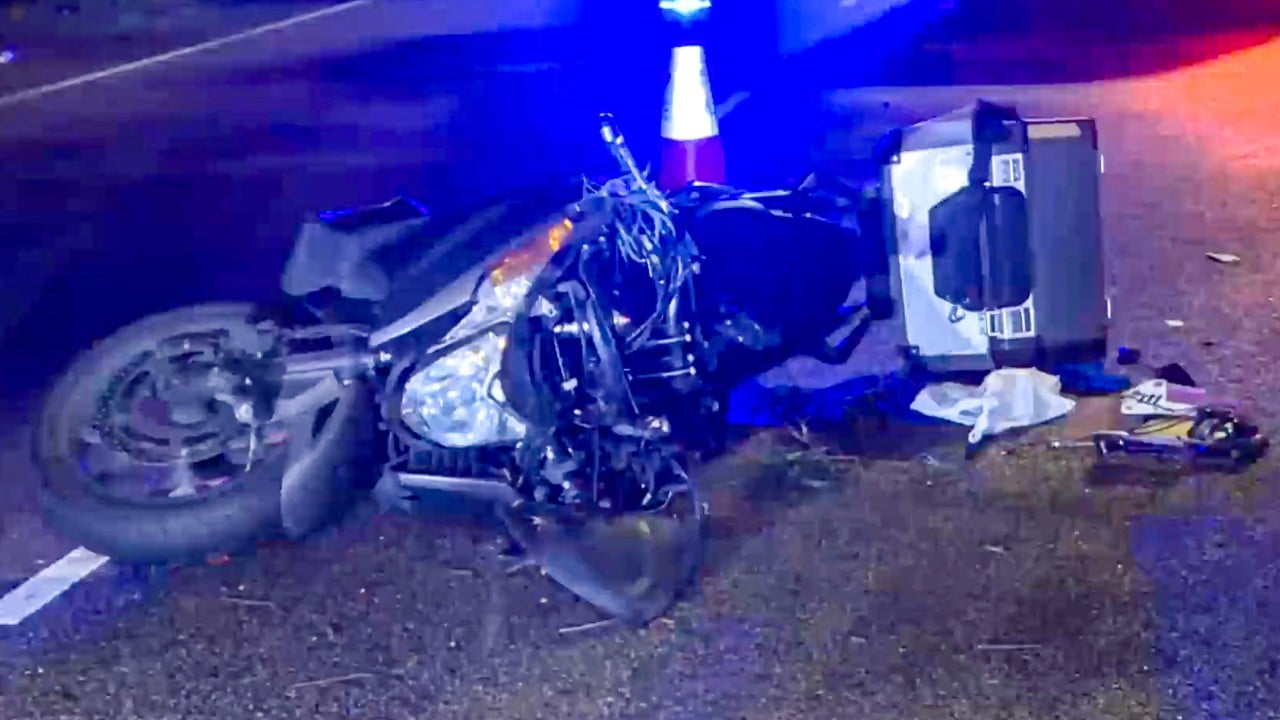
A fatal collision between a 38-year-old motorcyclist and a fallen tree in Hong Kong exposes a critical failure point at the intersection of municipal arboriculture risk management and vehicle kinematics. When a two-wheeled vehicle encounters an unmapped, static obstruction on a roadway, the margin for driver correction approaches zero due to specific constraints in physics and human reaction times. Resolving these systemic vulnerabilities requires moving past standard accident reporting and examining the precise causal mechanisms: the failure function of urban forestry, the physics of single-track vehicle stability, and the structural gaps in real-time hazard transmission.
The Causal Chain of Infrastructure Failure
Urban roadway safety relies on the integrity of the immediate environment. When a tree falls across a transit artery, it represents a breakdown in preventive maintenance frameworks. The lifespans and structural integrity of urban flora are governed by environmental stressors that municipal engineering must account for.
The Vegetation Failure Function
The probability of a tree collapsing onto a public right-of-way is dictated by three primary vectors:
- Root System Compromise: Urban environments restrict root expansion due to concrete containment, utilities, and soil compaction. This limits the mechanical anchoring capacity of the tree.
- Biotic Decay: Internal rot, fungal infections, and pest infestations hollow out the structural core of the trunk, drastically lowering the maximum wind load or gravitational shear the tree can withstand before snapping.
- Environmental Triggers: High winds, saturated soil from heavy rainfall, or sudden temperature shifts act as immediate catalysts, forcing a structurally degraded tree past its tipping point.
When municipal monitoring protocols rely on visual, surface-level inspections rather than deep structural testing (such as sonic tomography), internal decay remains hidden. The asset changes from a managed environmental feature to an unquantified kinetic hazard.
The Kinematics of Obstruction Engagement
A motorcyclist's capacity to avoid a sudden obstacle is severely restricted compared to a four-wheeled vehicle. The physics of a single-track vehicle dictate that steering and stability are intrinsically linked, meaning any sudden evasive maneuver introduces significant destabilizing forces.
The Perception-Reaction Time Bottleneck
Before mechanical braking or steering occurs, the rider must navigate human cognitive processing limits. Perception-Reaction Time (PRT) is generally calculated as a baseline of 1.5 seconds under standard conditions.
PRT Phase 1: Detection (Sensing the object)
PRT Phase 2: Identification (Recognizing the object as a fallen tree)
PRT Phase 3: Decision (Choosing between emergency braking or swerving)
PRT Phase 4: Execution (Applying physical input to the handlebar and brakes)
At a standard urban transit speed of 50 km/h (approximately 13.9 meters per second), a rider travels roughly 20.8 meters during a 1.5-second PRT window before the vehicle's brakes are even engaged. If the fallen tree lies around a blind curve or is obscured by poor lighting, the available sight distance falls well below this baseline threshold, making a collision mathematically inevitable.
Braking versus Swerving Dynamics
Once the PRT window closes, the rider faces a binary tactical choice, with both options governed by strict friction limits.
The first option is emergency straight-line braking. The stopping distance is governed by the available coefficient of friction between the tire rubber and the road surface. If the road is wet or contaminated with organic debris from the fallen tree, the friction coefficient drops significantly, extending the braking distance far beyond the geometric layout of the scene.
The second option is countersteering to swerve around the hazard. This requires the rider to intentionally force the motorcycle to lean in the direction of the turn by pushing the handlebar in the opposite direction. Initiating a rapid lean requires lateral tire traction. If the rider attempts to brake and swerve simultaneously, the tire exceeds its combined traction circle limit, resulting in an immediate low-side crash before the vehicle even reaches the obstruction.
Kinetic Energy Transfer in Impact
If avoidance fails, the severity of the trauma is a direct function of kinetic energy dissipation. Kinetic energy ($E_k$) increases exponentially with velocity, represented by the formula:
$$E_k = \frac{1}{2}mv^2$$
Where $m$ is the combined mass of the motorcycle and rider, and $v$ is the velocity at impact. Because a motorcycle lacks a protective crumple zone or cabin enclosure, this kinetic energy is absorbed directly by the rider's body and the protective gear worn. When colliding with an unyielding object like a tree trunk, the deceleration occurs over a near-zero time interval, generating extreme G-forces that cause fatal internal deceleration injuries and catastrophic structural trauma.
Data Gaps in Real-Time Hazard Mitigation
The fatal gap between a tree falling and a vehicle colliding with it represents a failure of information routing. In many municipal frameworks, the discovery of a roadway obstruction relies entirely on ad-hoc reporting by citizens or passing emergency units.
This introduces a dangerous latency period:
- The Event: The tree falls, completely blocking the lane.
- The Detection Delay: The hazard exists in a data vacuum until an observer spots it.
- The Communication Lag: The observer calls emergency services, and the information is processed by a dispatcher.
- The Interception Deficit: Emergency crews or road maintenance teams are dispatched to secure the perimeter, but during this transit window, oncoming motorists approach the hazard with zero advance warning.
This latency period can last from several minutes to hours, particularly during off-peak transit times or on secondary routes. The lack of automated, sensor-driven hazard detection on critical transport corridors ensures that the first indication of a failure for an oncoming motorist is the physical sight of the obstruction itself.
Infrastructure Optimization and Risk Mitigation Framework
Preventing future fatalities of this nature requires shifting municipal strategy from reactive clean-up to predictive, automated intervention. Municipalities must treat urban forestry as critical infrastructure subject to rigorous engineering tolerances.
Predictive Arboriculture and Asset Management
Cities must transition from static visual tree assessments to a dynamic, data-driven management model. This involves deploying non-destructive testing methods across high-risk corridors. Sonic tomography and resistance drilling must be integrated into routine maintenance schedules for all trees within a striking distance of public roads.
Trees identified with internal structural voids exceeding specific safety thresholds must be proactively removed or stabilized. This approach replaces arbitrary pruning schedules with risk-adjusted intervention protocols based on quantifiable structural degradation.
Sensor-Driven Hazard Detection Systems
To eliminate the dangerous information routing latency, transport networks should integrate automated detection mechanisms into existing smart city infrastructure.
- Computer Vision Overlays: Utilizing existing traffic monitoring cameras paired with edge-computed machine learning models trained to recognize lane blockages, static anomalies, or unexpected roadway debris.
- Acoustic Sensor Arrays: Installing localized acoustic monitoring systems capable of identifying the distinct frequency signatures of breaking wood and heavy ground impacts along heavily forested transit corridors.
- Vehicle-to-Infrastructure (V2I) Transmissions: When an anomaly or obstruction is detected by automated systems, a digital warning signal should broadcast instantly to smart infrastructure nodes. This telemetry can feed directly into navigation applications and in-vehicle displays, alerting approaching drivers well before they enter the physical perception-reaction zone.
Upgrading Roadway Geometric Design
Where dense vegetation runs alongside high-speed or medium-speed transit routes, the physical layout of the roadway must act as a secondary safety net. This means establishing minimum clear zones—areas free of major obstacles—proportional to the design speed of the road.
Where geography prevents a clear zone, structural barriers such as high-containment flexible netting or specific guardrail configurations must be engineered to deflect falling debris away from the driving lanes, keeping the asphalt clear for vehicle transit.
Advanced Rider Assistance Systems
Vehicle-side technologies provide the final line of defense when infrastructure measures fail. The widespread implementation of Motorcycle Stability Control (MSC) systems helps mitigate the traction circle failures that occur during panic maneuvers.
By utilizing inertial measurement units that track lean angle, pitch, and roll in real time, modern cornering ABS and traction control systems can optimize braking force distribution during an emergency swerve. This keeps the tires within their traction limits and allows the rider to maximize deceleration even while leaning, shifting the physical boundaries of obstacle avoidance.


_Biopsy.png?branch=uat_release_3)
