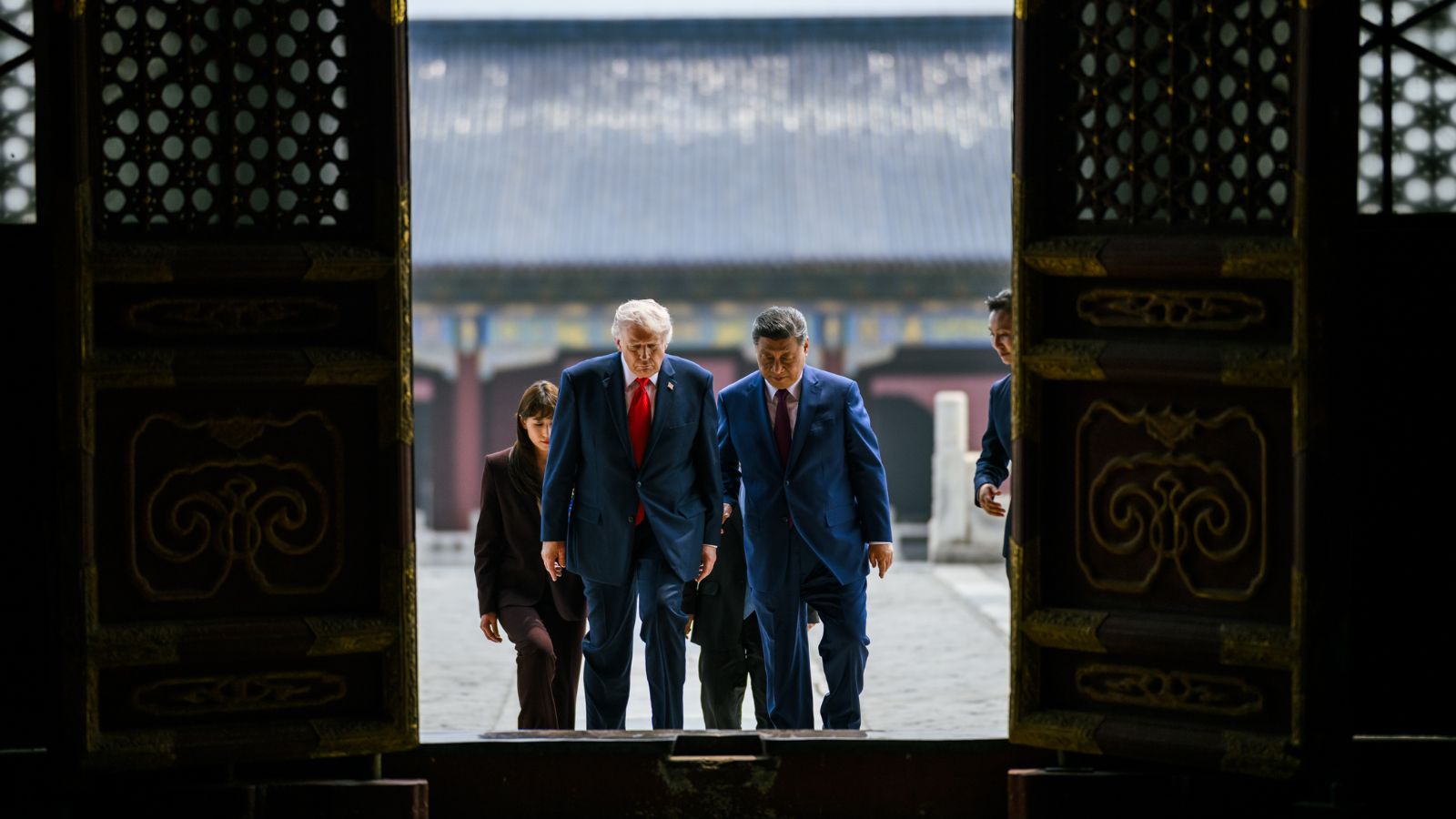
The bilateral summit in Beijing between the United States and the People’s Republic of China exposes the structural divergence between transactional economic optics and deep-seated geopolitical architecture. While headlines focus on multi-billion-dollar procurement commitments for aircraft and agricultural commodities, a cold analytical evaluation reveals a stark asymmetric trade-off. The United States has accepted unverified, long-dated purchase intents in exchange for immediate strategic concession space on Taiwan and regional security issues.
Understanding this diplomatic outcome requires bypassing political rhetoric and evaluating the summit through three structural vectors: the macro-economic mechanics of the commodity and aviation agreements, the strategic leverage functions governing the Indo-Pacific theatre, and the boundaries of human rights advocacy within high-stakes economic negotiation.
The Economic Optic: Monetizing the Trade Truce
The headline deliverables of the summit—commitments to purchase American commercial aircraft, soybeans, and crude oil—function as financial mechanisms to stabilize the one-year tariff truce established in late 2025. These agreements represent a managed-trade framework designed to artificially alter bilateral trade balances without addressing the structural distortions of industrial policy.
The Aviation Procurement Function
The announced purchase intention of 200 Boeing commercial aircraft, with a conditional option to scale to 750 units, represents an optimization strategy for both capitals. For the United States, routing these orders through domestic manufacturing centers utilizing General Electric engines delivers a concentrated injection of capital into high-value export manufacturing.
For Beijing, the transaction operates on a dual-utility function:
- Fleet Modernization Timelines: Chinese state carriers possess long-term fleet capacity deficits. Securing production slots aligns with structural domestic transportation growth.
- Asymmetric Contractual Optionality: The expansion from 200 to 750 aircraft remains strictly contingent on performance metrics and political alignment. This creates a multi-year leverage mechanism where Beijing can throttle execution based on Washington's compliance with broader strategic understandings.
The structural limitation of this deal lies in the long-lead production cycles of aerospace manufacturing. These agreements cannot immediately reduce the bilateral trade deficit; they are options contracts rather than realized capital inflows.
Agricultural and Energy Commodity Mechanics
The commitment to purchase billions of dollars in American soybeans and crude oil serves as an immediate liquidity injection into the U.S. agrarian and energy sectors. However, the economic impact must be evaluated against global supply chain re-routing costs.
[Global Soybean Trade Flow Realignment]
US Agriculture ----(Sustained Purchases)----> China Market
Brazil/LatAm  ----(Alternative Routing)----> European/Global Markets
When China commits to large-scale soybean procurement from the United States, it alters the global marginal pricing structure. Brazilian and Argentine exporters, displaced from the Chinese market, shift supply to fill vacancies in European and Asian markets previously serviced by U.S. producers. The net result is a geographic shuffling of trade flows rather than a structural expansion of total global demand. It satisfies short-term domestic political metrics in Washington while leaving the fundamental balance of payments unchanged.
Geopolitical Asymmetry: The Taiwan Lever and Security Concessions
The structural imbalance of the summit becomes apparent when comparing tangible economic commitments with shifts in geostrategic posturing. The data indicates that China utilized its centralized purchasing power to extract significant rhetorical and policy concessions from the United States regarding the Indo-Pacific security architecture.
The Taiwan Conflict-Avoidance Discount
During the proceedings, Beijing delivered explicit warnings via state media that policy missteps regarding Taiwan would escalate directly into kinetic conflict. The subsequent U.S. response signals an analytical shift from deterrence to risk-mitigation:
- Strategic Ambiguity Modification: Assertions that the United States made "no commitment either way" on Taiwan, paired with statements minimizing the probability of conflict, indicate a tactical retreat from explicit deterrence.
- Capital Allotment Bottlenecks: The delay and potential reassessment of the planned $14 billion defensive arms package for Taiwan represents an immediate material concession. By withholding hardware deliveries under the auspices of a "fairly short period" determination, Washington has traded hard deterrence assets for diplomatic goodwill.
This creates a dangerous strategic asymmetry. Beijing's concessions (unconfirmed purchase intents) are reversible and non-binding. Washington's concessions (stalling military procurement and softening deterrence rhetoric) generate immediate windows of vulnerability in the cross-strait balance of power.
The Middle Eastern Sanctions Arbitrage
A secondary geopolitical dimension emerged regarding energy security and international sanctions enforcement. The declaration of shared intent to maintain open transit through the Strait of Hormuz was leveraged by Beijing to secure a major policy review from Washington.
The U.S. announcement that it is actively considering lifting sanctions on Chinese oil companies accused of purchasing Iranian crude highlights the operational cost of this summit. Beijing successfully framed its routine compliance with maritime security as a concession worthy of sanctions relief. If implemented, this mechanism unlocks significant compliance-free energy imports for the Chinese industrial sector while eroding the institutional integrity of the U.S. unilateral sanctions regime.
The Boundary of Human Rights Advocacy
The treatment of high-profile political cases during the summit provides a definitive benchmark for the priority hierarchy of U.S. foreign policy within a transactional framework. The categorization of human rights concerns into negotiable and non-negotiable tranches reveals the limitations of soft-power leverage when juxtaposed with hard economic transactions.
| Case / Issue Category | Stated Diplomatic Progress | Operational Realignment |
|---|---|---|
| Fentanyl Trafficking Supply Chains | Bilateral discussion on enforcement mechanisms | High prioritization due to direct domestic socio-economic costs within the United States. |
| Detained Institutional Pastors | Described as under "serious consideration" | Moderate tractability; functions as a low-cost reputational exit ramp for Beijing. |
| Jimmy Lai / Hong Kong National Security Law | Characterized formally as a "tough one" | Zero structural progress; recognized as a hard sovereign red line for the Chinese state. |
The characterization of the imprisonment of media tycoon Jimmy Lai as a "tough one" marks the functional boundary of Western leverage. By conceding that certain domestic political crackdowns are too structurally integrated into Beijing's core security architecture to influence, Washington explicitly decouples systemic human rights advocacy from the core bilateral trade relationship. This signals to international observers that structural political crackdowns within China’s perceived sovereign sphere will not derail economic normalization if the trade transactional volume is sufficiently high.
The Strategic Path Forward
The outputs of the Beijing summit demand an immediate reassessment of corporate and state strategy for entities operating in the US-China corridor. The illusion of structural stabilization must be discarded in favor of a dual-track strategy designed to navigate a managed-trade environment.
Organizations must recalibrate their supply chains and capital allocation based on the following tactical imperatives:
- De-risk Aviation and Advanced Manufacturing Portfolios: Aerospace and heavy industrial firms must treat the announced 750-plane procurement target as a variable political instrument rather than a baseline demand projection. Capital expenditures should be decoupled from these commitments until definitive, non-refundable letters of credit are executed by Chinese state-backed purchasing entities.
- Priced-in Cross-Strait Regulatory Volatility: Despite the summit’s pacifying rhetoric, the structural friction over Taiwan has not changed; it has merely been financialized. Multinational firms must continue to build operational redundancies outside the Taiwan Strait, treating the current tariff truce as a temporary operational window rather than a permanent settlement.
- Exploit Sanctions Exemptions Windows: Energy sectors and logistics firms should prepare for immediate regulatory adjustments. If Washington executes the planned sanctions relief for Chinese oil entities, it will create short-term arbitrage opportunities in energy shipping and compliance-free trade flows that must be capitalized upon before the next cyclical downturn in bilateral relations.
The fundamental architecture of strategic competition between Washington and Beijing remains unaltered. The summit did not resolve structural systemic rivalries; it merely established a transactional price tag for managing them over the current fiscal cycle.
The video Trump To Discuss Taiwan, Jimmy Lai With Xi at Summit offers deep analytical context into the strategic priorities and delegation dynamics that set the stage for these asymmetric diplomatic trade-offs.