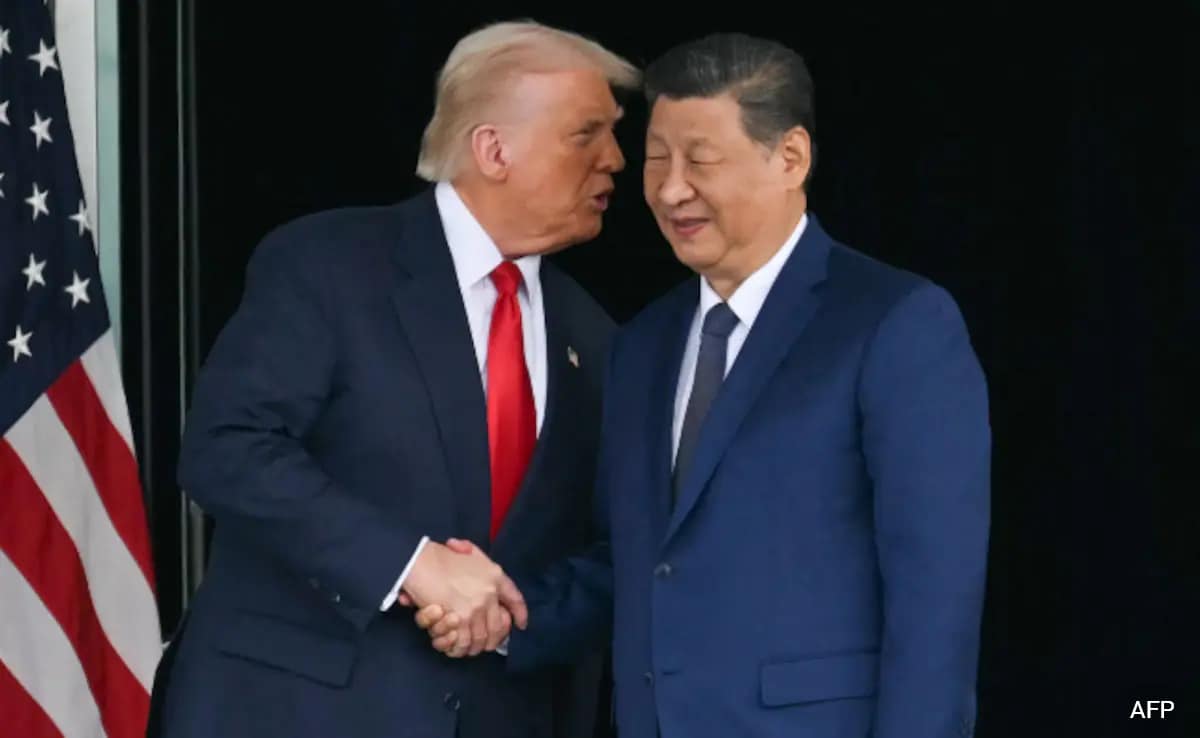
Donald Trump did not fly to Beijing this week to talk about old friendships or the "great chemistry" he often touts during campaign rallies. He is there because the walls are closing in on his administration's ability to manage a two-front crisis that threatens to derail the American economy before the November midterms. On one side, a stagnant war in Iran has choked the Strait of Hormuz, sending energy costs into a vertical climb; on the other, a domestic manufacturing sector is shivering under the weight of 145% surtaxes that have failed to bring the "rebalanced" trade utopia promised a year ago.
The high-stakes summit beginning May 14 is not a victory lap. It is a calculated, high-risk attempt to secure a lifeline from the only man capable of providing it: Xi Jinping.
The Energy Trap and the Iranian Lever
The primary catalyst for this sudden pivot is the escalating conflict in the Middle East. While the Trump administration has maintained a hard line against Tehran, the blockade of Iranian oil shipments has backfired on the global supply chain. China, the world's largest buyer of Iranian crude, has successfully insulated itself through massive coal reserves and a dominant position in renewable energy.
The United States has no such luxury. Trump needs Xi to act as the ultimate backchannel. The goal is simple but incredibly difficult to execute: convince Beijing to use its significant diplomatic and economic leverage over Tehran to reopen the Strait of Hormuz. In exchange, Xi is demanding a price that would have been unthinkable six months ago.
For Beijing, the Iranian crisis is a convenient tool. By framing their appeals as coming from the "international community" rather than a direct favor to Washington, Chinese diplomats are signaling that American desperation has a market price. That price starts with the dismantling of the very tariffs Trump spent the last year building.
The Five Bs vs The Three Ts
The negotiation table in the Great Hall of the People is divided by two fundamentally different sets of priorities. The American delegation, led by a desperate need for a "win" to show voters, is pushing what analysts call the Five Bs:
- Boeing: A massive order for 500 aircraft to revive the flagging aerospace giant.
- Beef and Beans: Immediate, large-scale purchases of American agricultural products to pacify the Midwestern base.
- Board of Trade and Board of Investment: New institutional mechanisms designed to give the appearance of "fairness and reciprocity" while bypassing traditional bureaucratic hurdles.
However, Xi Jinping is playing a longer game, focusing on the Three Ts: Taiwan, Tariffs, and Technology.
The Chinese leadership has watched as the U.S. domestic mining industry struggled to scale up rare earth production. Despite agreements with Australia and Japan, the global supply chain for critical minerals remains firmly under Beijing’s thumb. Xi knows that without Chinese rare earths, the American tech and defense sectors grind to a halt. He is using this monopoly to demand that the U.S. "oppose" rather than merely "not support" Taiwanese independence—a subtle but seismic shift in diplomatic language that could redefine the Pacific power balance for decades.
The Board of Trade Smoke and Mirrors
To sell a potential climbdown to the American public, Trump is readying the announcement of a "Board of Trade." This is a rebranding exercise of the highest order. By creating a joint committee of senior officials to oversee trade implementation, the administration can claim it has "tamed" the deficit without actually resolving the underlying industrial overcapacity in China.
It is a managed trade approach that mimics the 2020 Phase One deal, which many economists agree was a failure of execution. The difference now is the level of American vulnerability. China’s 15th Five-Year Plan (2026-2030) has already pivoted toward non-U.S. markets, with exports to emerging economies growing by over 20% this year. China doesn't need the American market as much as it used to; Trump, however, desperately needs a headline-grabbing purchase of $50 billion in soybeans to keep his political coalition intact.
The Silicon Stalemate
The most dangerous theater of this visit is the technological one. While the public talks about "beans and beef," the real war is being fought over Artificial Intelligence and semiconductor export controls.
Xi Jinping wants a ceasefire on the tech front. He is pushing for the relaxation of investment restrictions on Chinese firms in the U.S., specifically in the automotive sector. The irony is sharp: as the U.S. pushes for a "clean" supply chain, it may be forced to allow Chinese EV manufacturers back into the American market just to secure the minerals needed to build competing American cars.
Domestic lawmakers are already revolting. A bipartisan group has warned that any easing of restrictions on Chinese cars would be a death sentence for the Detroit legacy brands. Trump is caught between a geopolitical rock and a domestic hard place. To get the Iranian oil flowing and the Midwest farmers paid, he may have to sacrifice the long-term competitiveness of the U.S. auto and tech industries.
A Fragile Stability
The pageantry of the Temple of Heaven and the state banquets cannot hide the reality that this is a marriage of convenience between two leaders who no longer trust each other's word. The "Busan Truce" of late 2025 was supposed to provide a floor for the relationship, but the Iran war has blown through that floor.
Expect the joint statements to be filled with platitudes about "people-to-people ties" and "strategic stability." Ignore them. The real metric of success for this visit is whether the Strait of Hormuz reopens and whether the 145% tariffs begin to quietly evaporate under the guise of "Board of Trade recommendations."
Trump is betting that he can trade a piece of American long-term strategic dominance in the Pacific for a short-term economic reprieve at home. It is a gamble that assumes Xi Jinping wants a stable United States more than he wants a weakened one. In the cold corridors of Beijing, that is a very dangerous assumption to make.