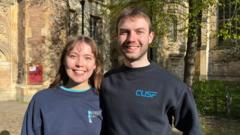
NASA isn't just sending four people around the Moon. It’s sparking a weird, wonderful, and chaotic explosion of amateur rocketry in classrooms across the country. If you think student rocket projects are still about gluing balsa wood fins to cardboard tubes, you're living in the past. Artemis II is the first crewed mission of the Artemis program, and its influence is hitting high school labs and university workshops harder than any space mission since the Apollo era.
The goal for these students isn't just "getting it to go up." They're trying to solve the same brutal physics problems NASA engineers face daily. They're looking at the Orion spacecraft and the Space Launch System (SLS) and saying, "We can do a version of that." This isn't just a hobby anymore. It's a high-stakes pipeline for the next generation of aerospace talent.
The Artemis Effect on Student Design
Student teams used to be happy with a successful recovery. Now, they're obsessed with "mission profiles." When NASA announced the specific trajectory for Artemis II—a lunar free-return trajectory—it gave student rocketeers a specific blueprint to study. They aren't just building rockets; they're building systems.
I’ve seen university teams move away from simple altimeter readings. They're now integrating active drag systems—small flaps that deploy to control the rocket's ascent so it hits a precise target altitude. That’s exactly the kind of precision flight control needed for a crewed capsule. The complexity has shifted from "can we launch it?" to "can we control every second of the flight?"
Artemis II uses the SLS, a massive beast of a rocket. Students can’t build something that big, but they’re mimicking the modular nature of the SLS design. They’re using carbon fiber layups and 3D-printed engine components. In many cases, these students are using the same CAD software and simulation tools as the pros at Lockheed Martin or Boeing.
Real Rockets vs Classroom Kits
Let’s get real about the difference between a "science project" and what’s happening in programs like NASA’s Student Launch or the American Rocketry Challenge. A science project is a volcano made of baking soda. This is actual engineering.
Most people don't realize that a high-power student rocket can reach speeds of Mach 1 or higher. We’re talking about breaking the sound barrier in a vehicle designed and built by nineteen-year-olds. They have to deal with aerodynamic heating and structural integrity issues that would make a civil engineer sweat.
The Artemis II crew—Reid Wiseman, Victor Glover, Christina Koch, and Jeremy Hansen—have become literal icons in these shops. Students track their training schedules. They look at the life support systems being tested for the Orion capsule and try to scale down those concepts for their payloads. It’s not rare to find a student team trying to design a biological payload that simulates how yeast or small seeds react to the vibration of a launch, mimicking the biological experiments planned for deep space missions.
Why the Tech Gap is Shrinking
The barrier to entry for high-level rocketry has cratered. Ten years ago, if you wanted a telemetry system that could transmit live data from a rocket in flight, you had to build it from scratch or pay thousands. Now, you can buy a flight computer the size of a credit card for fifty bucks that has more processing power than the Apollo Guidance Computer.
This tech shift means students spend less time worrying about basic electronics and more time on complex problems like:
- Active Stabilization: Using cold-gas thrusters or gimbaled engines to keep the rocket vertical.
- Recovery Systems: Designing dual-deployment parachutes that fire at specific GPS coordinates.
- Payload Integration: Creating scientific experiments that function autonomously in high-G environments.
NASA’s Artemis II mission acts as the ultimate North Star here. When NASA talks about "Moon to Mars," students see a career path, not just a headline. The agency’s focus on the Moon has revitalized the NASA Student Launch competition, which challenges teams to design, build, and fly a high-altitude rocket with a scientific payload. These aren't just toys; they’re testbeds for ideas that might actually end up on a lunar lander someday.
The Brutal Reality of Rocketry
It’s not all sleek launches and slow-motion videos. Rocketry is a hobby—and a career—defined by failure. You spend eight months and five thousand dollars on a carbon fiber airframe, and it zigs when it should have zagged. It becomes a "land shark" or a "lawn dart."
I’ve watched teams work forty-hour weeks on top of their actual schoolwork, only to have a five-cent nylon bolt shear off, causing the whole thing to disintegrate at three thousand feet. That’s the real lesson Artemis II teaches. Space is hard. It’s unforgiving. If you mess up a decimal point in your center of pressure calculation, the laws of physics will punish you instantly.
This teaches a kind of resilience you can't get from a textbook. When a student team’s rocket explodes on the pad, they don’t just quit. They look at the high-speed footage, find the failure point, and start over. That is the exact mindset NASA needs for the Artemis missions. We’re going back to the Moon to stay, and that requires people who aren’t afraid of a "rapid unscheduled disassembly."
Scaling Down Giant Ideas
One of the coolest trends is "model scale" testing of Artemis components. Some student groups are obsessed with the SLS Solid Rocket Boosters (SRBs). They try to replicate the thrust curve of an SRB using different chemical compositions in their own solid motors.
Others focus on the Orion capsule's heat shield. While they aren't hitting the atmosphere at 25,000 miles per hour, they use wind tunnels and thermal imaging to see how different shapes shed heat during high-speed descent. They’re taking the macro problems of the Artemis program and turning them into micro problems they can solve in a garage.
The New Workforce Pipeline
If you want to work at SpaceX, Blue Origin, or NASA, having a degree isn't enough anymore. You need "dirt under your fingernails" experience. Hiring managers look for the kids who spent their weekends at a dry lake bed in the desert chasing a rocket that fell three miles away.
The Artemis II mission has given these students a common language. They talk about "TRL" (Technology Readiness Levels) and "LOX" (Liquid Oxygen) like they’re discussing a football game. This cultural shift is massive. It’s moving aerospace from a niche interest into a mainstream competitive sport for the brain.
Where to Start if You’re Inspired
Don’t just sit there and watch the Artemis II launch on a screen. If this mission gets your heart racing, get involved. You don't need a PhD to start.
- Find a Local Club: Look for NAR (National Association of Rocketry) or Tripoli Rocketry Association chapters. They have the equipment, the launch sites, and the mentors to keep you from blowing yourself up.
- Learn Simulation: Download OpenRocket. It’s free, open-source software that lets you design and "fly" rockets on your computer. It’s the industry standard for hobbyists and many student teams.
- Start Small: Don’t try to build a Mach 2 monster on day one. Buy a basic kit, understand the relationship between the center of gravity and the center of pressure, and get a feel for the build process.
- Follow the Mission: Watch the NASA Artemis updates. Not just the PR videos, but the technical briefings. Pay attention to how they talk about risk management and system redundancy.
The road to the Moon doesn't just start in Cape Canaveral. It starts in high school metal shops and university labs where students are pushing the limits of what a "model" can do. Artemis II is the spark, but the fire is being built by the people who aren't afraid to get their hands dirty and build something that touches the sky.