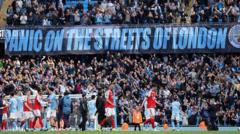
The trajectory of Mikel Arteta’s Arsenal is currently defined by a diminishing rate of return on tactical refinement. While the club has successfully transitioned from a state of structural decay to one of elite-level consistency, they have reached the "90th percentile plateau"—a phase where standard incremental improvements no longer yield trophy-winning outcomes. To avoid the historical classification of a "nearly man," Arteta must solve for the remaining 10% of performance variance that separates high-ceiling contenders from serial winners. This deficit is not a product of effort or luck; it is a mechanical failure in squad depth utilization, offensive variance, and psychological load management.
The Three Pillars of the Arsenal Performance Architecture
Arsenal’s resurgence rests on a rigid tactical framework that prioritizes control over chaos. This system is designed to minimize the impact of individual error by automating ball progression and defensive transitions. However, this same rigidity creates the primary bottleneck in high-stakes environments.
1. Positional Extremism
Arteta utilizes a strictly defined 3-2-5 or 2-3-5 attacking shape. The objective is to stretch the opponent’s defensive block horizontally while maintaining a rest-defense structure that prevents counter-attacks. While this has effectively eliminated "cheap" losses against mid-table opposition, it lacks the biological unpredictability required to break down elite low blocks (e.g., Manchester City or Inter Milan). The system prioritizes the "correct" pass over the "disruptive" action.
2. High-Frequency Pressing and Energy Depreciation
Arsenal’s defensive efficiency is predicated on a high-intensity press. The data indicates a direct correlation between Arsenal’s physical output and their point-per-game (PPG) metric. When the squad's physical metrics drop by even 5-8% during the congested winter schedule or late-season run-ins, the defensive line drops deeper, the distances between lines increase, and the entire tactical integrity of the team begins to fracture.
3. The Centralized Creative Burden
The reliance on Martin Ødegaard as the primary creative engine creates a single point of failure. When Ødegaard is neutralized via man-marking or injury, the team’s chance creation metrics drop disproportionately. This lack of creative redundancy is the hallmark of a team that is built for efficiency rather than resilience.
The Cost Function of Tactical Inflexibility
The "nearly man" narrative is driven by a failure to adapt when the primary plan encounters friction. In economic terms, Arteta has invested heavily in a high-efficiency model that suffers from extreme sunk cost bias during matches.
The refusal to deviate from the established buildup play often leads to a phenomenon known as "tactical paralysis." In matches where the opponent has successfully mapped Arsenal’s passing lanes, Arteta’s substitutions and mid-game adjustments often remain within the same tactical paradigm. Replacing a winger with a winger of similar profile does not alter the mathematical probability of a breakthrough if the defensive structure remains unchallenged by a different physical or technical stimulus.
This creates a bottleneck in "Game State Management." A championship-winning manager must possess the ability to transition from a control-based system to a high-variance, high-risk system when trailing in the final 20 minutes. Arsenal’s historical lack of a "Plan B"—a physical target man or a secondary creative pivot—suggests a strategic preference for system-loyalty over situational pragmatism.
Structural Depth and the Fatigue Threshold
A critical oversight in the current Arsenal strategy is the mismanagement of the squad’s "Fatigue Threshold." While Manchester City utilizes a rotation policy that keeps key players under a specific minute count (typically 2,500–3,000 minutes in the league), Arteta has historically over-indexed on his "Reliable Eleven."
The physical cost of this strategy is cumulative.
- The Muscle Load Factor: Key players like William Saliba, Bukayo Saka, and Declan Rice are frequently pushed to the limit of their aerobic capacity. This increases the probability of soft-tissue injuries during the crucial March–May window.
- Cognitive Diminishment: High-intensity tactical systems require constant split-second decision-making. Physical exhaustion leads to cognitive lag, resulting in the defensive lapses or missed clinical opportunities that have defined Arsenal’s late-season "bottle" scenarios.
The inability to trust the second string—the "drop-off" between the starters and the bench—indicates a failure in squad construction or player development. If a manager cannot rotate 3-4 players without a significant drop in XG (Expected Goals) or XGA (Expected Goals Against), the squad is not built for a 50-match season. It is built for a 20-match sprint.
Psychological Load and the Weight of 'Progress'
The label of "nearly man" is as much a psychological constraint as it is a tactical one. There is a diminishing psychological return on "competitive losses." While finishing second twice in a row signals progress, a third consecutive failure to secure the title transitions from "development" to "psychological scarring."
The current squad is experiencing a "Confidence Loop."
- Positive Phase: Success in the early season validates the system.
- Friction Phase: Late-season pressure introduces doubt.
- Failure Phase: Strategic rigidity prevents recovery.
To break this loop, Arteta must move beyond being a "systems manager" and become a "moments manager." The most successful managers in Premier League history—Ferguson, Mourinho, Guardiola—share a common trait: the ability to win when the system fails. They find ways to extract 1-0 wins from 0.05 XG performances. Arsenal, conversely, often looks like a team that only knows how to win when they are playing well. True championship DNA is defined by the ability to win when playing poorly.
The Transfer Market Paradox
Arsenal's recruitment has been lauded for its precision, yet it has failed to address the "Variability Deficit." Every signing under Arteta has been a profile that fits the system. However, winning a league requires players who break the system.
The recruitment of Kai Havertz was an attempt to introduce a different physical profile, but his role has largely been subsumed into the existing tactical machinery. To avoid the "nearly man" fate, the club needs an "Agent of Chaos"—a player whose output is not dependent on the team’s collective rhythm. This is typically a world-class "9" who can create a goal from a situation that has a zero-percent probability according to the tactical manual.
Without this outlier talent, Arsenal remains a "high-floor, capped-ceiling" team. They will rarely lose to poor teams, but they will struggle to definitively beat elite ones when the stakes are highest.
Strategic Pivot: The Requirements for the Next Cycle
To transition from a perennial runner-up to a champion, the following structural adjustments are non-negotiable:
- Redundancy Engineering: The squad must be built so that the absence of Martin Ødegaard or Bukayo Saka results in a tactical shift, not a performance collapse. This requires recruiting a secondary playmaker with a different technical profile—someone capable of vertical, direct play rather than horizontal circulation.
- The Substitution Overhaul: Arteta must improve his proactive game management. Waiting until the 70th minute to make changes when the XG trend is flat is a reactive strategy. Proactive managers make changes based on the trend of the game, not the time on the clock.
- Physical Load Distribution: A hard cap on minutes for core players must be implemented. This may result in dropped points in the short term but ensures a 100% physical capacity in the final eight weeks of the season. The data suggests that a 100% fit "Tier B" player is often more effective than an 80% fit "Tier A" player in a high-intensity system.
- Mental Resilience Training for Elite Variance: The team must be coached to thrive in "broken games." Training sessions should include scenarios where the system is intentionally sabotaged (e.g., playing with 10 men, playing without a recognized midfield) to build the cognitive flexibility required for Champions League and title-deciding fixtures.
The risk for Mikel Arteta is that he becomes the most sophisticated architect in the league who never actually finishes the building. He has proven he can build a machine that works perfectly under laboratory conditions. The final test is whether that machine can survive the heat, the pressure, and the unpredictability of the real world. If he remains wedded to his current level of tactical dogmatism, he will indeed be remembered as the man who perfected the art of the runner-up.
Success now depends on the willingness to sacrifice the "purity" of the system for the "messiness" of a result. The transition from "nearly" to "now" is not a tactical evolution; it is a philosophical surrender to the necessity of winning at any cost.