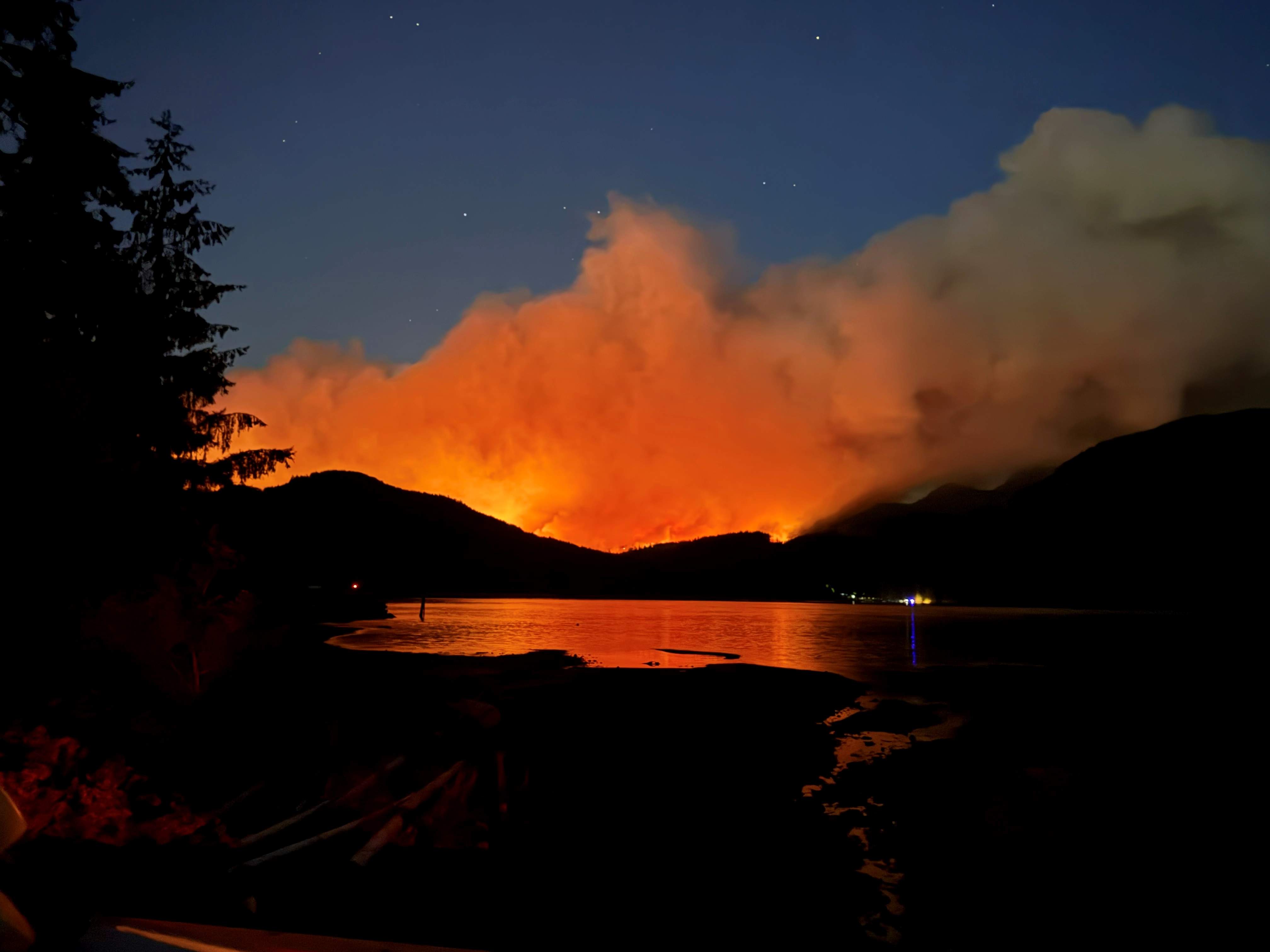
The air in Northeast British Columbia doesn’t smell like pine anymore. It smells like an old campfire that someone forgot to douse, a scent that clings to the back of your throat and settles into the fabric of your curtains.
In the spring of 2026, the silence in the Peace River Valley is heavy. It is the kind of quiet that precedes a breaking point. For those living in Fort St. John, Dawson Creek, and the scattered farmsteads in between, the sky isn’t just a backdrop for the weather. It is a ticking clock.
While the rest of the province watches the rain fall in Vancouver or the snow melt in the Okanagan, the Northeast is staring at a different reality. The ground here is thirsty. Deeply, unnervingly thirsty.
The Ghost of a Winter That Never Arrived
To understand why 2026 is the year the map turned red, you have to look at the dirt.
Consider a farmer named Elias. He is a hypothetical composite of the men and women I’ve spoken to along the Alaska Highway, people whose livelihoods depend on the moisture held in the top six inches of soil. Elias digs a heel into his field in April. Instead of the damp, heavy clods of earth that usually signal the start of the season, the ground shatters into a fine, gray powder.
This is the legacy of a "snow drought."
Throughout the winter of 2025 and the early months of 2026, the Great White North was more brown than white. The snowpack—the natural water tower that British Columbia relies on to keep the forests hydrated through the summer—is at record lows. In some parts of the Northeast, it is less than half of its historical average.
When the snow is gone, the insulation is gone. The frost goes deeper, and when the sun finally returns, it doesn't find a reservoir of meltwater. It finds a tinderbox.
The BC Wildfire Service isn't using hyperbole when they point to this region as the primary "area of concern." They are looking at the math. Low snowpack plus an early spring heat pulse equals a landscape where a single discarded cigarette or a stray lightning strike becomes a catastrophe.
The Holdovers in the Deep
There is a monster living under the ground in the Northeast. Firefighters call them "zombie fires," but the technical term is overwintering fires.
Imagine a fire so stubborn it refuses to die. Last summer’s blazes—the ones that dominated the headlines in 2025—didn't all go out when the first frost hit. Instead, they burrowed. They ate their way into the thick layers of peat and duff, smoldering in the oxygen-poor soil beneath the snow.
They breathed through the winter.
As the ground thaws in April 2026, these fires are waking up. They poke their heads through the surface like ghosts, reigniting before the official fire season has even begun. It is a psychological weight that is hard to describe to someone who hasn't lived it. It means the enemy never actually left your backyard. It just went into hiding.
The sheer number of these holdover fires in the Prince George Fire Centre—which oversees the Northeast—is staggering. We aren't starting the 2026 season from zero. We are starting with a deficit. We are starting already on fire.
The Invisible Stake of the Boreal
Why should someone in Toronto or even Victoria care about a forest fire in a remote corner of the Peace River region?
The answer is written in the wind. The Northeast is home to the Boreal forest, a massive, carbon-dense ecosystem that acts as the planet’s lungs. When this forest burns, it doesn't just clear brush. It releases centuries of stored carbon into the atmosphere, creating a feedback loop that makes the next summer even hotter and the next winter even drier.
But the stakes are also more immediate and mechanical.
This region is the engine room of the province. It is where the power comes from. Site C, the massive hydroelectric project on the Peace River, sits right in the crosshairs of this year’s most volatile zone. The natural gas infrastructure that heats homes across the continent is threaded through these woods like veins.
If the Northeast burns, the lights don't just go out in Fort St. John. The economic ripples move southward, hitting the pockets of people who couldn't find Taylor, BC, on a map.
The Anatomy of a Threat
Let's break down the physics of the 2026 risk. Fire behavior is dictated by a triangle: fuel, weather, and topography.
- The Fuel: Because of the multi-year drought, the trees aren't just dry; they are stressed. Stressed trees produce more volatile oils. The needles on the black spruce are brittle. They don't need a massive flame to ignite; they need a spark.
- The Weather: 2026 is grappling with the tail end of shifting global cycles. We are seeing "blocking patterns" where high-pressure ridges sit over the Northeast for weeks, baking the moisture out of every leaf and twig.
- The Topography: The rolling hills and deep river valleys of the Peace create natural wind tunnels. A fire that starts at the bottom of a coulee can race up a slope faster than a person can run.
This isn't a scenario where we can just "wait for the rain." In the Northeast, spring rain is often accompanied by "dry lightning"—bolts that strike the ground without enough precipitation to douse the resulting spark. It is a cruel irony. The very thing the land needs brings the very thing that destroys it.
The Human Cost of Constant Vigilance
Walk into a grocery store in Dawson Creek today and you will see it. It’s in the way people look at the horizon. It’s in the "Go Bags" packed by the front doors of houses in Charlie Lake.
Chronic stress is the silent companion of the 2026 season. When you live in the "biggest area of concern," every windy day is a threat. Every haze on the horizon is a potential evacuation order.
I remember talking to a mother who had to evacuate her children twice in three years. She spoke about the "evacuation smell"—the scent of smoke that gets into the kids' stuffed animals, a smell they now associate with fear. She talked about the exhaustion of deciding what to save. Do you take the photo albums or the backup hard drives? Do you grab the heirloom quilts or the extra jugs of water?
This is the reality of the 2026 forecast. It isn't just a bar chart in a government briefing. It is thousands of families living in a state of suspended animation, waiting for the wind to shift.
The Strategy of the Stand
We are not helpless, but the 2026 season requires a shift in how we think about the "wild" in wildfire.
The BC Wildfire Service has shifted its stance. They are no longer just reacting; they are pre-positioning. They are moving crews into the Northeast earlier than ever before. They are using satellite technology to track those "zombie fires" before they break the surface.
But the real work happens at the fence line.
"FireSmart" is a term that gets thrown around a lot in policy papers, but on the ground, it looks like sweat. It looks like thinning out the tinder-dry trees around a farmhouse. It looks like replacing wood-shake roofs with metal. It looks like a community realizing that the forest is no longer a distant neighbor, but a guest that has overstayed its welcome and brought a match.
The challenge is the scale. The Northeast is vast. You can fit several European countries into this corner of the province. Protecting every acre is impossible. The strategy in 2026 is about triage—protecting the people, the critical infrastructure, and the most sensitive habitats, while acknowledging that the map is going to burn.
A Landscape in Transition
We have to be honest: the Northeast we knew twenty years ago is gone.
The climate has shifted the boundaries. The boreal forest is moving, retreating, and being reshaped by fire. What we are seeing in 2026 is the acceleration of a new normal. We are living through a period where the "unprecedented" has become the seasonal baseline.
It is a hard truth to swallow. It feels like a loss. There is a grief in watching a landscape you love become a source of anxiety.
But there is also a rugged resilience here. The people of the Northeast are not easily rattled. They are used to harsh winters and isolation. They are used to relying on each other when the road gets cut off.
As the sun sets over the Peace River, turning the sky a bruised purple, the heat of the day lingers longer than it should. The residents watch the smoke-tintered horizon, looking for the first glow of a new fire or the first wisp of a re-emerging one.
They know what is coming. They have felt the dry earth under their boots. They have smelled the old smoke in their clothes.
The 2026 season isn't a prediction anymore. It is a presence. It is the shadow of a cloud that refuses to bring rain, hanging over a land that has forgotten what it feels like to be truly damp.
The only thing left to do is wait, watch, and keep the bags packed by the door.