The international press loves a "David vs. Goliath" narrative. When the results for the West Bengal assembly elections trickled out, the global media machine pivoted instantly to a pre-written script: the unstoppable juggernaut of Narendra Modi’s Bharatiya Janata Party (BJP) had finally hit a wall. They painted Mamata Banerjee’s victory as the definitive blueprint for "resistance."
They are wrong. Dead wrong.
The consensus view—that Bengal represents a terminal decline for the BJP or a foolproof shield for the opposition—is a lazy reading of Indian demographics and power dynamics. If you look at the raw mechanics of the shift, the BJP didn't just "lose." They effectively terraformed the political soil of a state that was previously impenetrable to them. To call this a failure of the "Modi Wave" is to misunderstand how waves actually work.
The Arithmetic of an "Invisible" Victory
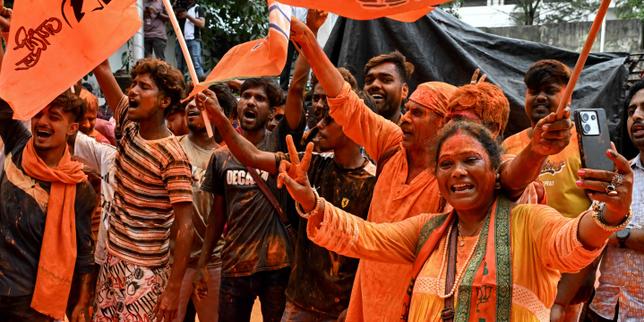
In 2011, the BJP was a ghost in West Bengal. They had zero seats. In 2016, they managed three. Fast forward to the recent cycle, and they vaulted to 77 seats.
Western observers see 77 versus 213 and call it a rout. Experienced analysts see a 38% vote share and call it an occupation. You don't go from a rounding error to nearly 40% of the electorate in a decade without fundamentally breaking the existing political culture.
The "resistance" didn't stop the BJP; it just retreated into its last remaining fortress. The BJP successfully cannibalized the entire Left Front and the Congress party. The hammer and sickle, which ruled Bengal for 34 years, has been erased from the legislative map. By "losing" the state, the BJP has achieved its primary strategic goal: the total polarization of the electorate into a two-pole system where they are the only alternative.
The Trap of Professional Secularism
The competitor’s narrative suggests that Bengal rejected the BJP's "communal" rhetoric in favor of "inclusive" regionalism. This is a fairy tale.
Bengal’s politics is not about inclusivity; it is about who controls the "Didi" patronage network. The Trinamool Congress (TMC) didn't win because of a sudden surge in liberal values. They won because they perfected a system of grassroots enforcement that makes Tammany Hall look like a Sunday school.
I have watched political consultants burn through millions trying to replicate "The Bengal Model" in other states. It fails every time because they miss the core ingredient: structural violence. Bengal is one of the few places in India where political affiliation is a matter of physical survival. The BJP’s "loss" was actually a stress test. They proved that even under extreme duress, they could hold a third of the population. That isn't a defeat; it's a beachhead.
Why the "National Blueprint" is a Myth
Pundits are currently asking: "Can the opposition use the Bengal strategy to defeat Modi in the next general election?"
The answer is a brutal no.
The TMC’s victory is hyper-local. It relies on a specific linguistic identity—Bengali sub-nationalism—that does not translate to the Hindi heartland, the Deccan plateau, or the Northeast. You cannot defeat a national narrative with a regional dialect.
- Scalability: Regional parties cannot scale. Their strength is their weakness.
- The Leader Problem: Mamata Banerjee is a unique phenomenon. The rest of the opposition is a collection of dynasts with the charisma of damp cardboard.
- The Resource Gap: While the media focuses on the "spirit" of the Bengal voter, they ignore the fact that the BJP’s organizational machinery is now active in every single village in a state where they used to be hunted.
Stop Asking if Modi is Weak
The question isn't whether Modi lost Bengal. The question is: why was he even competitive there to begin with?
West Bengal was the intellectual capital of Indian Communism. It was the bastion of the secular elite. For the BJP to become the primary opposition there is an ideological coup. They have shifted the "Overton Window" of Bengali discourse. Issues that were once taboo—illegal migration, border security, and religious demographics—are now the central themes of the state's conversation.
Even when the TMC wins, they are now forced to play on the BJP’s pitch. We saw Mamata Banerjee reciting Sanskrit hymns on stage to prove her Hindu credentials. That is what a "loss" for the BJP looks like: the winner imitating the loser's philosophy just to stay relevant.
The High Cost of the Counter-Intuitive Truth
The downside of this analysis? It's ugly. It means that the "resistance" celebrated by the international press is actually a consolidation of two radicalized camps. It means that the middle ground in Indian politics hasn't just shrunk—it has been paved over.
The BJP understands a principle that the "intellectual" class refuses to acknowledge: In a democracy, losing a territory while capturing the narrative is often a better long-term investment than winning the seat while losing the argument.
They have captured the argument. Bengal is no longer "different." It has been integrated into the national binary. The fortress has walls, but the foundation is already theirs.
Stop looking at the scoreboard and start looking at the map. The BJP didn't lose Bengal; they simply finished the first phase of an acquisition. If you’re waiting for the "Bengal Model" to save the national opposition, you’re not watching a comeback—you’re watching a funeral.
Move your pieces or get off the board.