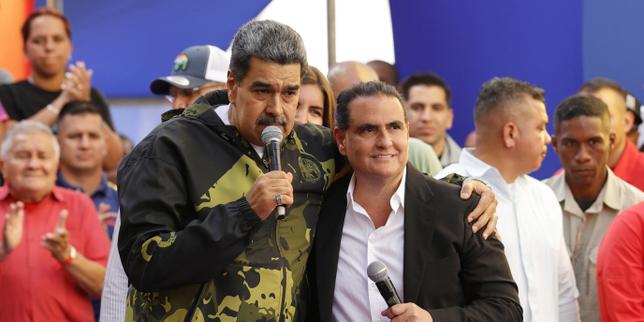
The Caracas regime spent years insisting that Alex Saab was an untouchable diplomat, a humanitarian hero, and the financial savior of a besieged nation. Yet on Saturday, the Venezuelan migration authority reduced the billionaire power broker to a single, transactional phrase: a "Colombian citizen."
With that bureaucratic stroke, Venezuela deported Saab directly to the United States. It is a stunning reversal that ends his short-lived freedom, less than three years after a controversial U.S. presidential pardon returned him to Caracas as a triumphant symbol of anti-imperialist resistance.
Saab is now in American custody. The man who designed the sanctions-evasion architecture for the Venezuelan state finds himself isolated, stripped of power, and transformed into the ultimate bargaining chip.
This second transfer to the United States represents much more than a routine extradition. It signals a tectonic shift in the geopolitical realities of South America. Following a dramatic military raid this past January that captured former President Nicolás Maduro, Venezuela’s interim leadership under Delcy Rodríguez is systematically dismantling the old guard.
By turning over the keys to Maduro’s international financial empire, the new administration is signaling a total capitulation to Washington in exchange for political survival and economic relief.
The Loophole in Caracas
To understand the sheer scale of this betrayal, one must look at how the deportation was executed. The Venezuelan constitution explicitly forbids the extradition of its own nationals. When Saab was first arrested in Cape Verde in 2020 and subsequently flown to Miami in 2021, Caracas went to extraordinary lengths to manufacture a Venezuelan identity for him, granting him retroactive diplomatic status and demanding his release.
This time, the state machinery worked in reverse.
The Venezuelan migration authority, SAIME, released a terse statement confirming Saab’s expulsion. It pointedly omitted his claimed Venezuelan citizenship, identifying him solely by his country of birth, Colombia. This legal sleight of hand allowed the Rodríguez government to bypass constitutional protections, ordering a deportation rather than an extradition.
SAIME noted that the decision was based on "various crimes in the United States of America, as is public, well-known and reported."
The arrest that preceded this deportation was not an unexpected raid by hostile forces. It was a joint operation executed in February, quietly coordinated between American federal agents and Venezuelan law enforcement on the streets of Caracas. It occurred just weeks after Maduro and his wife, Cilia Flores, were flown to New York to face criminal charges of narcoterrorism conspiracy.
The Disintegration of an Empire
For nearly a decade, Saab functioned as a financial architect. When the United States choked off Venezuela’s access to the traditional banking system, Saab built an alternative. He established a shadow network of shell companies spanning Turkey, Mexico, Hong Kong, and Iran to move Venezuelan gold and oil in exchange for food, fuel, and hard currency.
His most lucrative enterprise was the local food distribution system known as CLAP. Ostensibly a humanitarian program designed to provide basic staples to starving citizens during a hyperinflation crisis, federal prosecutors in Florida paint a far darker picture. They allege Saab and his longtime business partner, Alvaro Pulido, converted the program into a massive bribery and money-laundering machine.
The mechanism was simple but devastatingly effective:
- Inflated Contracts: Saab allegedly secured no-bid contracts from regional governors to import low-grade food from Mexico at vastly inflated prices.
- Phantom Deliveries: Substantial portions of the promised food supplies never arrived, or consisted of substandard products unfit for consumption.
- Shell Integration: The resulting profits were funneled through a labyrinth of shell operations, including Group Grand Limited, to bribe senior officials and secure future state favors.
When former President Joe Biden pardoned Saab in late 2023, the clemency was remarkably narrow. It applied only to a 2019 indictment concerning a money-laundering scheme involving unbuilt public housing contracts.
The deal was an agonizing trade for Washington, which secured the release of several detained Americans and the return of fugitive defense contractor Leonard Francis, the infamous "Fat Leonard." But federal prosecutors never stopped digging.
A fresh, ongoing grand jury investigation into the CLAP food bribery conspiracy provided the U.S. Department of Justice with the necessary leverage. This new legal vulnerability made it remarkably easy for the interim government in Caracas to hand him over without violating the terms of his previous pardon.
The Ultimate Witness in New York
Saab’s return to American custody represents an existential threat to what remains of the old regime. He is no longer just a defendant facing corruption charges; he is potentially the star witness in the upcoming Manhattan trial of his former protector.
Few people understand the precise flow of Maduro’s personal wealth better than Saab. He managed the secret ledger lines that linked Miraflores Palace to foreign banks. He coordinated the gold-for-fuel swaps with Tehran. He knew which international banks looked the other way, which maritime shippers falsified their transponders to move sanctioned crude, and which regional politicians took cutouts from the state food supply.
This is not the first time Saab has weighed his options. Court filings and transcript entries from sealed hearings previously revealed a closely guarded secret: prior to his 2020 arrest in Cape Verde, Saab had spent months operating as a confidential source for the U.S. Drug Enforcement Administration.
During that period of cooperation, he met secretly with federal agents and forfeited more than $12 million in illicit assets, providing a roadmap of the very corruption he helped construct.
With Maduro awaiting trial in New York, Saab’s calculus has shifted entirely. The interim government in Caracas has already stripped him of his short-lived title as Industry Minister, removed him from all cabinet positions, and shut him out of foreign investment networks.
He has no institutional protection left. His choices are stark: face decades in an American maximum-security prison or cooperate fully to ensure he does not spend the rest of his life behind bars.
A New Era of Transactional Diplomacy
The ease with which Delcy Rodríguez’s administration sacrificed Saab exposes the hollow nature of the political alliances inside the ruling Chavista movement. For years, the regime used Saab’s face on billboards, organized state rallies demanding his freedom, and treated his imprisonment as a violation of national sovereignty.
That narrative is dead.
The interim presidency is playing a far more pragmatic game. Facing a collapsed domestic infrastructure and an economy hollowed out by years of mismanagement, the new leadership has recognized that its path to legitimacy depends on Washington. By cooperating directly with American law enforcement—first by allowing the capture of Maduro, and now by executing the joint arrest and deportation of his primary financier—the current administration is systematically clearing the board.
The strategy appears to be working. Following recent legislative changes in Caracas that opened the state-dominated oil industry to greater private investment, Washington has already begun easing specific sanctions on Venezuelan crude oil trade. The deportation of Saab acts as a grand gesture of goodwill, proving that the new government is willing to liquidate the assets and confidants of the old guard in exchange for a clean slate on the global stage.
Saab’s second journey to a U.S. federal courtroom marks the definitive end of the era he helped create. The sophisticated networks of shell companies, front banks, and falsified shipping manifests are collapsing because the state that authorized them has decided to trade them away.
In the high-stakes theater of international relations, the most dangerous position to occupy is that of the man who knows too much when the regime he served decides it is time to reform.


_Biopsy.png?branch=uat_release_3)
