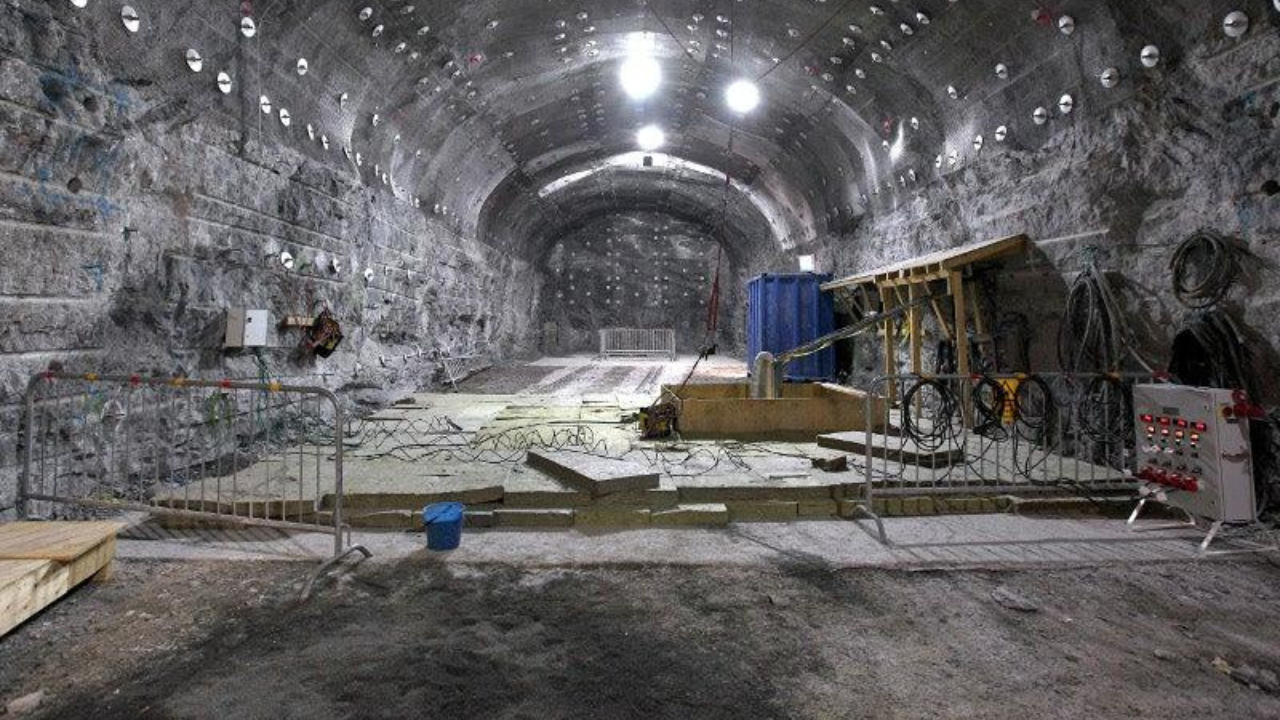
Finland is currently doing what every other nuclear nation has spent seventy years avoiding. On the island of Olkiluoto, a final resting place for the most toxic byproduct of the atomic age is being sealed within the earth's crust. This is not a storage facility or a temporary warehouse. It is a tomb designed to hold fast for 100,000 years, a timeframe that renders human history, language, and civilization irrelevant. The facility, known as Onkalo, represents the first time a country has moved beyond political debate into the cold, hard physics of permanent geological disposal.
The project is a necessary gamble. For decades, the global nuclear industry has relied on "interim" solutions—pools of water and concrete dry casks sitting on the surface, vulnerable to everything from societal collapse to simple neglect. Onkalo ends that era of procrastination by burying 6,500 tons of spent fuel nearly half a kilometer beneath the surface in 1.9-billion-year-old bedrock. If you liked this piece, you should check out: this related article.
The Multi Barrier Myth and the Physics of Decay
The engineering behind Onkalo relies on the KBS-3 method, a triple-shielding strategy designed to prevent radionuclides from reaching the biosphere. It begins with the spent fuel rods themselves, which are placed into cast-iron inserts. These inserts are then slid into massive copper canisters, five centimeters thick and five meters long. Copper is the primary hero of this narrative because it does not rust in the traditional sense when deprived of oxygen.
However, the "eternal" nature of these canisters is the subject of fierce academic debate. While the Finnish operator, Posiva, maintains the copper will hold for a hundred millennia, independent researchers in Sweden have raised alarms about stress corrosion cracking and sulfide-induced degradation. They argue that even in an oxygen-free environment, the presence of certain minerals in groundwater could eat through the copper faster than anticipated. For another perspective on this event, check out the recent coverage from Ars Technica.
To mitigate this, the canisters are swaddled in blocks of bentonite clay. This specific volcanic clay expands when it contacts water, creating a tight seal that prevents groundwater from flowing around the canister. If the rock cracks, the clay is supposed to absorb the movement. If the canister eventually fails, the clay is supposed to trap the radioactive particles. It is a system of redundant failures. Each layer is a backup for the last, acknowledging that nothing built by man is truly permanent.
Deep Time and the Semiotic Trap
One of the most profound challenges at Onkalo isn't the engineering, but the communication. How do you warn a future being about a danger they cannot see, smell, or understand? In 10,000 years, the Finnish language will likely be extinct. The symbols we use today—the skull and crossbones or the radiation trefoil—may mean nothing, or worse, they may look like invitations to hidden treasure.
This has birthed the field of nuclear semiotics. While some nations have proposed "landscapes of thorns" or massive granite monoliths to scare away future archaeologists, Finland has opted for a different strategy: total erasure.
Once the tunnels are filled in the early 2100s, the facility will be backfilled with crushed rock and clay. The surface buildings will be dismantled. The goal is to make the site so unremarkable and so difficult to access that only a technologically advanced civilization with its own radiation detection equipment could ever find it. It is a philosophy of hiding in plain sight, betting on the hope that if we don't tell the future where the bodies are buried, they won't go looking for them.
The Cost of Responsibility
The price tag for Onkalo is roughly 1 billion euros for construction, with total life-cycle costs reaching 5 billion euros. This is funded entirely by the nuclear power producers themselves, who have been required by Finnish law since 1994 to set aside funds for every kilowatt-hour generated. It is a rare example of a "polluter pays" model that actually functions.
The financial transparency here stands in stark contrast to the United States, where the Yucca Mountain project became a multi-billion dollar political corpse, or Germany, where the search for a site has been restarted from scratch after decades of protest. Finland’s success isn't just a win for geology; it is a win for social trust. The local community in Eurajoki generally supports the project, largely because the nuclear industry is the region's primary employer and the process has been characterized by radical openness rather than federal mandate.
The Next Ice Age
Geologists warn that within the next 50,000 to 100,000 years, Northern Europe will likely face another glaciation. The weight of a two-kilometer-thick ice sheet will exert immense pressure on the bedrock below Olkiluoto. This is the ultimate stress test. As the ice melts and the land rebounds, the resulting seismic activity could theoretically fracture the repository.
Critics like retired geologist Matti Saarnisto have pointed out that no one can guarantee the stability of the rock under those conditions. The Finnish authorities counter that at a depth of 430 meters, the waste is shielded from the most violent surface changes. They argue that even if a small amount of radiation eventually leaks in the distant future, it will be so diluted by the time it reaches the surface that it will be indistinguishable from natural background radiation.
A Precedent for the Atomic World
Onkalo is no longer a "potential" project. In 2024, Posiva began trial runs with dummy fuel, and full-scale operations are expected to commence by late 2025 or early 2026. This makes Finland the only nation on Earth with a functional answer to the "what about the waste?" question.
The rest of the world is watching. Sweden is following a similar path at Forsmark, while France and Canada are still in the planning and licensing phases. If Onkalo fails—if a canister leaks prematurely or the geology proves more porous than modeled—it will likely end the "Nuclear Renaissance" before it truly begins.
Nuclear energy is often touted as the only way to meet climate goals without sacrificing industrial capacity. But that argument is only ethical if we stop leaving the bill for our children to pay. By burying its waste 400 meters underground, Finland is finally attempting to settle the tab. The success of this silent, dark experiment in the granite of Olkiluoto will determine whether nuclear power remains a viable tool or a permanent liability.
Seal the tunnels. Forget the location. Hope the physics holds. This is the only way forward for a world that cannot stop consuming power but refuses to live with the consequences.