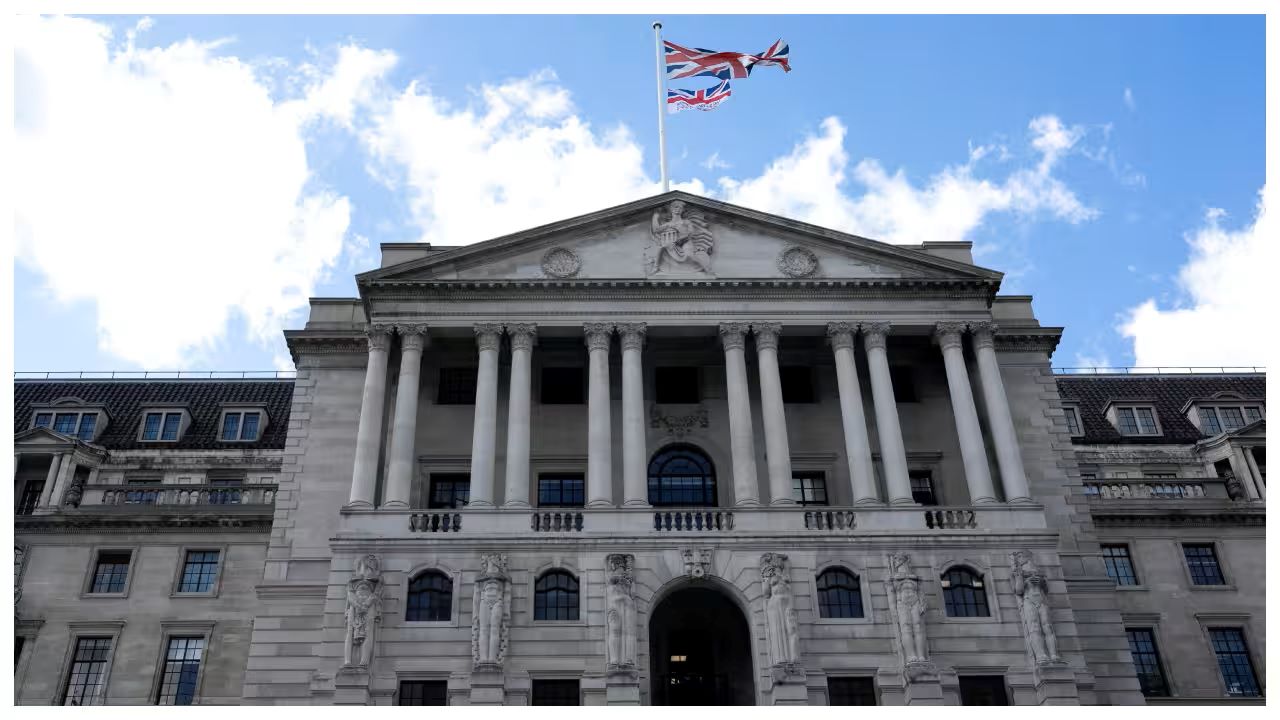
The mahogany table in Threadneedle Street is heavy, polished, and indifferent to the price of a pint of semi-skimmed milk in a Preston corner shop. When the nine members of the Monetary Policy Committee sit down to decide the fate of the British pound, they aren't looking at grocery receipts. They are looking at heat maps, cooling curves, and the jagged, aggressive spikes of the Consumer Price Index.
The verdict was reached with the clinical precision of a surgeon: 3.75%.
They held the line. They didn't move the lever up, and they certainly didn't move it down. To the casual observer, a "hold" sounds like a pause—a moment of stillness. But for Sarah, a hypothetical single mother in Birmingham whose radiator has started making a rhythmic, metallic clicking sound, stillness is a luxury she can no longer afford.
The Invisible Weight of the "Hold"
Inflation is often described as a "hidden tax," but that is too academic a term. It is a ghost. It is a phantom that walks into your kitchen and quietly shaves a half-inch off your loaf of bread while you aren’t looking. When the Bank of England keeps interest rates at 3.75%, they are essentially admitting that the ghost is still in the house.
The logic is a cold math. By keeping rates high, the Bank makes it more expensive for you to borrow money. If it’s expensive to borrow, you spend less. If you spend less, businesses stop raising prices because nobody is buying. Eventually, the ghost leaves.
But there is a flaw in this mechanical view of the world. Some things aren't optional. You can decide not to buy a new television or a designer coat. You cannot decide to stop needing the lights to turn on when you flip the switch.
The Energy Trap
The primary reason the Bank is white-knuckling that 3.75% figure is energy. Global markets are currently twitchy. Gas prices are creeping up again, fueled by geopolitical tensions that feel worlds away from a terraced house in Leicester, yet they dictate the temperature of that house’s living room.
Think of the economy as a massive, ancient steam engine. The Bank of England acts as the governor, trying to keep the wheels spinning at a steady pace. If the engine gets too hot (inflation), they apply the brakes (higher interest rates). But right now, someone is throwing high-grade explosives into the furnace—those rising energy costs.
The Bank is standing on the brakes as hard as they can, but the engine is still screaming.
If they lowered rates now, they fear the engine would simply explode. Borrowing would become cheaper, more money would flood the system, and that extra cash would immediately be swallowed by the energy companies. You wouldn't feel richer; you’d just see the numbers on your bill get larger.
The Human Cost of Finer Margins
Consider the "finer margins." This is a term economists use to describe the small buffer between a household being "all right" and "in trouble."
For a family with a £200,000 tracker mortgage, the decision to hold rates at 3.75% provides a momentary sigh of relief. It isn't going up. Not today. But that relief is tempered by the knowledge that their monthly payment is already hundreds of pounds higher than it was two years ago. They have already cut the Netflix subscription. They have already switched to the "wonky" vegetables. They have already started wearing jumpers inside so they can keep the thermostat at 18 degrees.
When the Bank "holds," they are essentially saying: "We know you are struggling, but we need you to stay in this specific level of pain for a little while longer so the whole system doesn't collapse."
It is a utilitarian sacrifice.
The Psychology of the 2% Target
Why is the Bank so obsessed with 2%? It feels like an arbitrary number, a target painted on a wall by a bureaucrat decades ago. Yet, it is the anchor of our entire reality.
If people believe inflation will stay high, they demand higher wages. If they get higher wages, businesses raise prices to cover the cost of those wages. This is the "wage-price spiral," a feedback loop that can turn a stable nation into a place where people carry suitcases of cash to buy a loaf of bread. We aren't there—not even close—but the Bank’s job is to be the person at the party who smells smoke before anyone else sees a flame.
The 3.75% rate is the fire extinguisher. It’s heavy, it’s awkward, and it’s making everyone in the room uncomfortable, but the Governor is refusing to put it back in the glass case until he is absolutely sure the embers are dead.
The Grocery Store Litmus Test
Walk down the aisle of any supermarket and you will see the Bank’s policy in action, though not in the way you’d expect. You see it in the eyes of the person comparing two brands of pasta for thirty seconds. That thirty-second hesitation is the sound of high interest rates working. It is the sound of a consumer choosing not to spend, or at least, choosing to spend as little as humanly possible.
The Bank wants that hesitation. They need it.
But as energy costs rise, that hesitation turns into desperation. If the price of heating your home goes up by £50 a month, that is £50 that isn't going into the local economy. It isn't going to the barber, the florist, or the local pub. This is how high rates, combined with energy shocks, create a "stagnation" – a grey, quiet world where nothing grows because everyone is too afraid to move.
The Weight of Uncertainty
The most difficult part of a "hold" isn't the number itself. It’s the wait.
Markets hate a vacuum, and humans hate a "maybe." By keeping rates steady, the Bank is effectively saying they are in a "wait and see" mode. They are watching the data. They are waiting for the next set of energy price cap figures. They are waiting for the next jobs report.
But for the small business owner—let’s call him Marcus, who runs a boutique print shop—waiting is expensive. Marcus wants to buy a new digital press. It would make his business more efficient, more competitive. But at 3.75%, the loan to buy that press is too steep. He looks at his energy bill, sees it climbing, and decides to wait.
Multiply Marcus by a million. That is the true cost of a 3.75% hold. It is a million tiny decisions to stay small. It is a million innovations deferred. It is the sound of a country holding its breath.
The Horizon
We are told that the sun will eventually come out. The forecasts suggest that as energy prices stabilize—if they stabilize—inflation will finally drop toward that magical 2% mark. When that happens, the Bank will start to move the lever down. The pressure will ease. Sarah will fix her radiator. Marcus will buy his press.
Until then, we live in the era of the Hold.
It is a time of quiet rooms and calculated risks. It is a period where the most powerful people in the country are betting that they can starve a ghost without starving the people living in the house. They sit at their mahogany table, staring at their jagged lines, while the rest of the country looks at the meter under the stairs, watching the numbers spin, and waiting for the moment they can finally, safely, exhale.