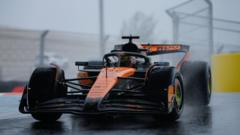
Formula 1 drivers are currently facing a safety crisis hidden behind the veil of "spectacle." When the clouds burst over a Grand Prix circuit, the transition from elite sport to a high-stakes lottery happens in seconds. The modern era of racing has created a paradox where the cars are more advanced than ever, yet their ability to compete in the wet has regressed to a dangerous degree. This isn't just about driver skill. It is a systemic failure of aerodynamics, tire chemistry, and a frantic race calendar that leaves zero room for error.
The current grid finds itself "thrown in the deep end" not because they lack talent, but because the technical regulations have essentially banned meaningful wet-weather testing. When a race director watches the radar and sees a green blob approaching, they aren't just managing a bit of water. They are managing a physics problem that the sport's current infrastructure is ill-equipped to solve.
The Blindness Factor
Visibility is the primary enemy. In decades past, cars were smaller and threw up less "rooster tail" spray. Today’s ground-effect machines are designed to suck the car to the tarmac using underfloor tunnels. While this makes them incredibly fast in the dry, it turns the car into a giant vacuum cleaner in the wet. It sucks every drop of standing water off the asphalt and atomizes it into a thick, impenetrable mist.
A driver trailing another at 200 mph isn't looking for braking markers. They are looking for a tiny, flickering red light through a wall of white. If that light disappears, they are guessing. This "blindness" is the reason we see long delays and repeated laps behind the Safety Car. It isn't that the drivers can't handle the sliding; it's that they cannot see the car five meters in front of them.
The FIA has experimented with "spray guards"—essentially mudguards for open-wheelers—to mitigate this. Early tests at Silverstone and Fuji suggest these are far from a silver bullet. The sheer volume of water displaced by a 798kg car traveling at high speed is too massive for simple plastic cowlings to contain. Until the sport solves the wake turbulence and spray displacement, "racing" in heavy rain remains a euphemism for "surviving."
The Tire Temperature Trap
Pirelli, the sport's sole tire supplier, faces an impossible task. They must create a Full Wet tire that can evacuate 85 liters of water per second at top speed, yet also stay warm enough to provide grip. This is where the chemistry breaks down.
To work, a Formula 1 tire needs heat. If the rubber stays cold, it feels like driving on plastic. In a wet race, the water constantly strips heat away from the tire surface. If a driver isn't pushing at 100%, the tires drop out of their "operating window." This creates a vicious cycle. The driver slows down because they have no grip, which makes the tires colder, which results in even less grip.
The Inter vs Wet Dilemma
The "Intermediate" tire is often the fastest way around a damp track, but it has a shallow tread. The "Full Wet" has deep grooves but is notoriously slow and prone to overheating the moment a dry line appears. This creates a dangerous "crossover point."
Teams often gamble on the Intermediate tire too early to gain a tactical advantage. This forces drivers to navigate rivers of standing water on tires meant for a light drizzle. One centimeter of misplaced car placement leads to aquaplaning. At that point, the tires lose contact with the road entirely and the driver becomes a passenger in a carbon-fiber sled.
The Cost of the Budget Cap
Economics have quietly made wet racing more dangerous. Under the current cost cap, every "shunt" or crashed car represents a significant portion of a team's development budget. In the 1990s, a top team could simply build a new chassis if a driver binned it in the rain. Today, a heavy crash in a wet practice session could mean the team lacks the funds to bring an upgraded front wing to the next three races.
This financial pressure trickles down to the cockpit. Drivers are told to "bring the car home," yet they are expected to fight for points in conditions where the limit is invisible. The risk-reward ratio has been skewed. For a mid-field team, the potential gain of two points is often outweighed by the $2 million cost of a total rebuild.
Evolution of the Modern Circuit
It isn't just the cars that have changed; the tracks have too. Modern "Grade 1" circuits are designed with high-friction asphalt that provides incredible grip in the dry. However, this same smooth surface can become a mirror in the wet.
Older tracks like Spa-Francorchamps or Interlagos have natural undulations. While these create "rivers" that flow across the track, they also allow for drainage. Newer, flatter "street-style" circuits often suffer from "ponding." This is where water sits in stagnant pools because the drainage systems can't keep up with tropical-strength downpours. When a wide, low-profile F1 tire hits a pond at 180 mph, the result is instantaneous.
Training for the Untrainable
How do you prepare for something you aren't allowed to practice? Strictly regulated testing days mean that a rookie driver might enter their first wet Grand Prix having never driven a modern F1 car in the rain.
Simulators are the industry's answer, but they are imperfect. While a simulator can mimic the loss of grip, it cannot replicate the physical sensation of aquaplaning or the terrifying lack of visibility. You cannot "simulate" the fear of hitting a stationary car while traveling at triple-digit speeds through a cloud of gray mist.
This lack of "seat time" in the wet is why we see more mistakes from the younger generation when the heavens open. They are learning the most difficult discipline in motorsports in front of millions of viewers, with no safety net.
The Spectacle vs the Sport
Broadcasters and fans want the drama of a wet race. It is the great equalizer, where the slowest car on the grid has a chance to shine if the driver is brave enough. But there is a point where drama becomes negligence.
The sport currently relies on the "Red Flag" as its primary safety tool. This leads to hours of footage of mechanics sweeping water off the grid while fans sit in the rain. It is a poor product for television and an agonizing experience for the fans in the grandstands.
To fix this, the sport needs more than just better tires. It needs a fundamental rethink of the aerodynamic "dirty air" and spray patterns. If the goal is truly to let the best drivers in the world compete in all conditions, the technical regulations must prioritize visibility over downforce.
The current trend of "waiting for the track to dry" is a symptom of a technical dead end. We have built cars that are too fast to race in the rain and too expensive to crash. Until the balance of power shifts back toward mechanical grip and away from underfloor aero, every wet race will remain a gamble that the drivers are increasingly unwilling to take.
Stop looking at the radar and start looking at the floor of the car. The solution isn't in the clouds; it's in the wind tunnel.