The modern football manager is often portrayed as a cold, calculating data-processor, but Mikel Arteta’s undoing this season suggests a far more human flaw. While the public narrative centers on a simple choice between two shot-stoppers, the reality is a story of internal politics, a misjudged transition, and a refusal to acknowledge that the "evolution" of the goalkeeper role has reached a point of diminishing returns. Arsenal did not just lose points because of a specific error. They lost their defensive identity because the manager prioritized a theoretical tactical advantage over the psychological stability of his back four.
The decision to sideline Aaron Ramsdale for David Raya was never about a clear-cut upgrade in shot-stopping. It was an ideological gamble. Arteta wanted a "11th outfield player," someone whose distribution could bypass a high press with surgical precision. In pursuit of that 5% improvement in passing accuracy, he sacrificed the 20% of intangible confidence that a settled goalkeeper provides to his central defenders. The result was a fractured defensive unit that looked hesitant during the most critical moments of the title race.
The Myth of the Dual Number One
For decades, the hierarchy of a football squad was the one thing players could count on. You had your starter and your deputy. By bringing in David Raya and claiming he wanted "two great keepers in every position," Arteta ignored a century of sporting psychology. Goalkeeping is the most specialized, isolated, and mentally taxing role on the pitch. It thrives on rhythm and the absolute certainty that one mistake will not result in a permanent seat on the bench.
When Arteta began rotating or hinting at mid-game goalkeeper substitutions, he didn't create "healthy competition." He created a vacuum of authority. Defenders like William Saliba and Gabriel Magalhães, who had developed a telepathic understanding with Ramsdale, suddenly had to adjust to a different style of sweeping, a different vocal presence, and a different set of reflexes behind them. This isn't just about who saves more penalties. It is about the subtle, split-second communication that prevents a chance from ever occurring.
The statistics initially seemed to support the change. Raya’s cross-collection and long-range passing metrics are objectively elite. However, data often fails to capture "second-order effects." A goalkeeper who is slightly better at passing but inspires slightly less confidence in his defenders forces those defenders to drop five yards deeper. That shift in the defensive line creates a gap in the midfield, which in turn stretches the entire team. Arsenal’s struggle wasn't just about Raya’s individual errors; it was about how the team’s shape distorted to accommodate a player the manager was desperate to justify.
Tactical Dogma versus Human Reality
Arteta is a disciple of Pep Guardiola, and like all disciples, he occasionally risks becoming more Catholic than the Pope. Guardiola successfully swapped Joe Hart for Claudio Bravo and later Ederson, but he did so at a time when Manchester City’s squad was already dominant. Arteta attempted a similar transition while his squad was still in a fragile growth phase. He tried to fix something that wasn't broken, and in doing so, he broke the spirit of a player who was a dressing-room leader.
Ramsdale wasn't just a goalkeeper; he was the emotional heartbeat of the 2022-23 campaign. Dropping him wasn't seen by the squad as a tactical tweak. It was seen as a cold-blooded execution of a loyal servant. In any high-performance environment, when the leader makes a move that feels "sentimental" in reverse—meaning, a move based on a rigid obsession with a specific profile rather than current form—it breeds resentment.
The Cost of Hesitation
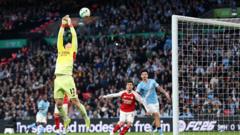
The most glaring issue appeared in the high-stakes matches against direct rivals. When the pressure mounted, Raya’s tendency to get caught under crosses or misjudge his positioning became a recurring nightmare. Because the manager had staked his reputation on the Spaniard, he couldn't easily backtrack. This created a "sunk cost" scenario where the team continued to start a struggling keeper to protect the manager’s ego, rather than the goal line.
Consider the tactical implications of a keeper who lacks physical presence in a league as physical as the Premier League. Raya is technically gifted but lacks the sheer wingspan and intimidation factor of the league’s top-tier icons. When opponents realized Arsenal were committed to a keeper who struggled with high, looping deliveries into a crowded box, the blueprint for beating them became simple. You don't outplay Arsenal; you out-muscle the man between the sticks.
The Hidden Impact on the Back Four
Defending is an exercise in trust. If a center-back knows his keeper will claim a cross, he can focus on marking the striker. If he is unsure, he splits his attention. That split-second hesitation is the difference between a clearance and a goal. Throughout the season, we saw Arsenal’s defenders looking over their shoulders more than they ever had in the previous eighteen months.
The "sweeper-keeper" role is only effective if the sweeping is flawless. If the goalkeeper comes out and misses the ball, or if his distribution is intercepted in the final third, the defensive structure is bypassed entirely. Arsenal's high line, which was their greatest strength, became their greatest vulnerability because the "insurance policy" behind them was constantly flickering.
A Failure of Man Management
There is a fine line between being a visionary and being a contrarian. Arteta’s insistence that he could change the fundamental nature of the goalkeeping position by treating it like any other rotation-heavy role was an act of tactical arrogance. It ignored the human element of the game. Players are not chess pieces. They have egos, anxieties, and social bonds. By fracturing the most stable part of his team, Arteta invited the very chaos he was trying to prevent.
The irony is that Arsenal’s recruitment has been largely stellar. They identified gaps in the squad and filled them with players like Declan Rice, who transformed the midfield. But the goalkeeping situation was a self-inflicted wound. It was a solution in search of a problem.
Rebuilding the Wall
Moving forward, the club faces a dilemma that goes beyond the summer transfer window. They have two starting-caliber goalkeepers, one of whom is disgruntled and another who is under immense scrutiny from a skeptical fanbase. The "sentimental" error wasn't keeping Ramsdale; it was the belief that a tactical theory could override the fundamental need for a settled, confident number one.
To fix this, there must be a return to pragmatism. If Raya is to be the future, the manager must stop experimenting and allow him to build a genuine rapport with the defense without the constant threat of rotation hanging over him. If the experiment has failed—and many in the industry believe it has—then the club must be brave enough to admit the mistake before it costs them another season of progress.
Football history is littered with managers who were undone by their own innovations. The greatest leaders know when to stick to what works. Arsenal’s title charge didn't end because of a lack of talent or a lack of goals. It ended because the foundation was intentionally unsettled by a man who thought he could reinvent the wheel, only to find out that the wheel was the only thing keeping the car on the road.
The next time a manager considers "disrupting" a settled position for the sake of a marginal tactical gain, they should look at the empty trophy cabinet at the Emirates. Performance is not just about expected goals or passing percentages. It is about the collective belief of eleven men that the man behind them is a wall, not a project.
Go and watch the footage of the goals conceded during the winter slump. Pay attention not to the keeper, but to the defenders' body language. That is where the league was lost.