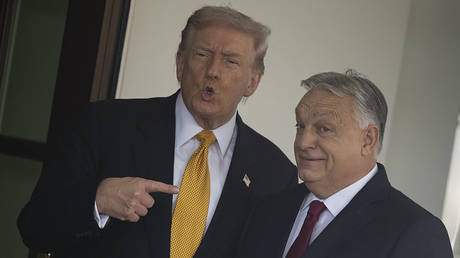
Donald Trump wants Hungarian voters to save Viktor Orbán this Sunday because he views Hungary not as a small Central European nation, but as a successful laboratory for the future of American governance. This is no longer a matter of simple diplomatic courtesy between two right-wing leaders. It is the formalization of a "Budapest Blueprint" that aims to replace the post-war liberal order with a network of illiberal states that prioritize national sovereignty, restricted migration, and state-managed media.
When Trump took to Truth Social and sent Vice President JD Vance to a Budapest rally this week, the message was clear. "He’s a winner, he’s a fighter," Trump told the Hungarian crowds via a phone held to a podium microphone. But the subtext is far more consequential than a campaign endorsement. For the MAGA movement, Orbán has already achieved what Trump is still fighting for: the total capture of the state’s judicial, media, and educational apparatus.
The Laboratory of Illiberalism
For a decade, the American right has treated Budapest as a pilgrimage site. What they see in Orbán is a leader who didn’t just win an election, but who reconfigured the very rules of the game to ensure he would never truly lose. This is why the 2026 Hungarian election is being watched with such intensity in Washington.
Orbán’s "autocratic legalism" is the secret sauce. By using a two-thirds parliamentary majority to rewrite the constitution and gerrymander electoral districts, Fidesz—Orbán’s party—has created a system where the opposition can win the popular vote and still lose the government.
[Image of the Hungarian Parliament building in Budapest]
The stakes for Trump are practical. If Orbán falls to the insurgent Tisza party led by Péter Magyar, the model breaks. The narrative that a "conservative utopia" is sustainable within the framework of Western institutions would be shattered. Trump needs Orbán to win to prove that his own vision for America is not just possible, but inevitable.
The Media Capture Model
One of the most significant exports from Budapest to Washington is the strategy for media dominance. In Hungary, the government didn't ban the opposition press; it simply made it impossible for them to compete. Through a combination of state advertising revenue and friendly oligarch acquisitions, 80 percent of the Hungarian media landscape is now under the control of the Central European Press and Media Foundation (KESMA), a pro-government conglomerate.
At the recent CPAC Hungary, American officials like FCC Chair Brendan Carr openly praised the "Orbanization" of media. They see the defunding of public broadcasters like NPR and PBS, and the shifting ownership of networks like CBS and CNN, as steps toward a Hungarian-style media environment. The goal is a world where the "legacy media" is not just criticized, but replaced by a partisan infrastructure that functions as an extension of the state.
The Transatlantic Populist Network
The relationship between Trump and Orbán has evolved from a mutual admiration society into a sophisticated institutional network. This isn't just about tweets. It’s about money, think tanks, and policy exchange.
- The Mathias Corvinus Collegium (MCC): This state-funded Hungarian college has become a training ground for the next generation of right-wing intellectuals, frequently hosting American conservative speakers and offering fellowships to US students.
- The Danube Institute: This Budapest-based think tank acts as a bridge, translating Orbán’s domestic policies into a language that resonates with the American MAGA base.
- CPAC Hungary: What was once a purely American event is now a recurring global summit in Budapest, signaling that the center of gravity for the global right has shifted.
This network provides the intellectual and logistical support for a new kind of foreign policy. It is a world where "national interests" are defined by the personal survival of the leaders, and where traditional alliances like NATO and the EU are treated with suspicion if they interfere with domestic power consolidation.
The Threat of the Insurgent
For the first time since 2010, the "Budapest Blueprint" is facing a genuine domestic threat. Péter Magyar, a former Fidesz insider, has mobilized a massive "catch-all" party called Tisza. He is attacking Orbán from the right, focusing on the very things the MAGA movement ignores: stagnant wages, systemic corruption, and the isolation of Hungary on the world stage.
If Magyar wins, it won't just be an upset in a small country. It will be a rejection of the illiberal model by the very people who have lived under it for 16 years. This is why the Trump administration has gone "all-in" in the final days of the campaign. They are fighting for the legitimacy of their own future agenda.
The outcome of Sunday's vote will determine if the "Budapest Blueprint" remains a viable roadmap for the American right or if it becomes a cautionary tale of how populist regimes eventually collapse under the weight of their own institutional capture. The world is watching, and the results will be felt far beyond the borders of the Danube.
Go to the polls and vote like the future of the West depends on it, because in the eyes of both Trump and Orbán, it does.