The air in Venice smells of salt, decay, and expensive perfume. It is a city that should not exist, built on mud and stubbornness, a place where the water is always trying to reclaim the stones. Every two years, the art world descends upon these sinking islands for the Biennale, an event often described as the "Olympics of Art." It is a whirlwind of Prosecco, private boat launches, and the desperate hum of the global elite trying to decide what matters.
But this year, the glitter feels like glass shards.
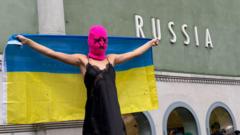
Behind the heavy doors of the national pavilions, where countries showcase their creative soul, a ghost is haunting the Giardini. Russia is back. Not officially, perhaps—the Russian Pavilion itself remains a boarded-up relic of a different era—but its influence, its money, and its artists are leaking through the cracks of the curated facade. The contradiction is nauseating. While the sirens wail over Kyiv and the soil of the Donbas absorbs another generation of youth, the art world is being asked to look at a painting and forget the blood on the hands of the patron.
The Weight of a Ticket
Imagine a young curator named Elena. She isn't real, but she represents a thousand people walking the gravel paths of the Biennale today. She has spent her life believing that art is the ultimate bridge, a universal language that can heal any rift. She stands in front of a stunning installation, the light catching the curve of a sculpture in a way that makes her breath catch.
Then she reads the fine print.
The artist is Russian. The funding traces back to a foundation with ties to the Kremlin. Suddenly, the aesthetic beauty of the piece doesn't just fade; it curdles.
Elena is faced with the central agony of the modern spectator. Can you appreciate the brushstroke while the state that produced the artist is erasing a neighbor from the map? To some, the answer is a cold, hard yes. They argue that art transcends politics, that an individual creator should not be punished for the sins of their dictator. It sounds noble. It sounds sophisticated.
It is also a lie.
The Myth of the Neutral Space
Art has never been neutral. Since the first person blew red ochre over their hand against a cave wall, it has been an assertion of presence. At the Venice Biennale, art is explicitly national. The very structure of the event—national pavilions competing for the Golden Lion—is a relic of 19th-century geopolitics. It is a soft-power battlefield.
When a nation at war is invited to the table, it isn't just about "culture." It is about legitimacy.
The backlash this year isn't just a social media trend or a handful of protestors with cardboard signs. It is a fundamental rift in the bedrock of the creative community. Prominent artists and activists are pointing to the hypocrisy of an institution that claims to celebrate humanity while providing a stage for those currently dismantling it.
The organizers are in a corner. They talk about "dialogue" and "inclusion." They use the language of diplomacy to mask the scent of complicity. But dialogue requires a shared reality. You cannot have a conversation with someone who is currently shouting over the sound of artillery.
The Invisible Stakes
We often treat art as a luxury, a hobby for those with too much time and money. We forget that dictators are obsessed with it. They don't ban books and seize galleries because art is powerless; they do it because they know art defines the narrative of a people.
By allowing Russian representation—even under the guise of "independent" artists—the Biennale provides a shadow for the regime to hide in. It allows the world to say, "Look, they are still civilized. Look, they still value the sublime." It creates a pocket of normalcy in a world that is anything but normal.
Consider the cost of that normalcy.
For a Ukrainian artist, the Biennale is no longer a career milestone. It is a site of trauma. To walk the same halls as the representatives of the culture that seeks your extinction is a specific kind of psychological warfare. It tells the victim that their pain is a secondary concern to the "integrity" of an art show.
The stakes aren't just about who gets a trophy. They are about whether we believe that morality has a place in our cultural institutions, or if we are willing to sell our conscience for a well-placed installation and a glass of champagne.
The Silence in the Giardini
The Russian Pavilion itself sits empty, a grand, stuccod ghost. It was designed by Alexey Shchusev, the same man who designed Lenin’s Tomb. Its emptiness is more powerful than anything that could be put inside it. It is a vacuum of moral authority.
However, the "backdoor" inclusion—artists with Russian ties appearing in the main international exhibition or in collateral events—negates the power of that empty building. It is a sleight of hand. The curators say they are selecting based on merit. They say they are looking for "global perspectives."
But there is no perspective more global than the survival of the human spirit against tyranny.
Critics argue that boycotting Russian artists is a form of "cancel culture." This is a shallow reading of a deep wound. Cancellation is about silencing a voice because you don't like what it says. This isn't about disagreement. This is about the total rejection of a state that has broken the social contract of the civilized world. When a house is on fire, you don't stop to discuss the color of the curtains.
A Lesson from History
This isn't the first time Venice has been a mirror for a fractured world. In the 1930s, the Biennale was a playground for the aesthetic whims of Mussolini and Hitler. The archives show photos of them walking these same paths, admiring "heroic" sculptures while the machinery of the Holocaust was being assembled in the background.
Back then, people also said we should keep art and politics separate. They said that the show must go on.
We look back at those photos now with a sense of horror. We wonder how they could have been so blind, how they could have sipped their wine while the world burned. We are currently creating the photos that future generations will look at with the same chilling detachment.
The choice isn't between "supporting art" and "being political." The choice is between being a witness or being an accomplice.
The Breaking Point
The tension in Venice is reaching a crescendo. There are reports of artists withdrawing their work, of donors pulling their funding, and of heated arguments in the cafes of the Piazza San Marco. The veneer of "business as usual" is cracking.
One artist, speaking off the record, described the atmosphere as "poisonous." They spoke of the guilt of being there, the feeling that by participating, they are helping to maintain a charade. "We are painting the deck chairs on the Titanic," they said. "Except we’re pretending the iceberg is just a particularly avant-garde sculpture."
The Biennale is supposed to be a celebration of what makes us human. Our capacity for empathy, our ability to see the world through another's eyes, our drive to create beauty out of chaos. But when beauty is used as a shield for brutality, it ceases to be art. It becomes propaganda.
The Reality of the "Independent" Artist
We love the story of the lone rebel. We want to believe that the Russian artists included in the show are secret dissidents, using their work to undermine the state from within. In some cases, this might be true. But even the most rebellious art requires a passport. It requires a bank account. It requires the tacit permission of a government that does not give permission for free.
By focusing on the individual, we lose sight of the system.
The system uses these artists as tokens. They are the "good Russians" that the West can point to so we don't have to feel bad about our inaction. They are the human face of a machine that is currently crushing human faces.
If we truly want to support Russian dissidents, we don't do it by giving them a gallery wall in Venice while their country burns their neighbor's libraries. We do it by demanding a world where they can create without the shadow of a tank looming over their shoulder.
The Long Walk Back
As the sun sets over the lagoon, the water turns a deep, bruised purple. The crowds begin to thin, and the sound of the vaporettos becomes a steady, rhythmic thrum. The Biennale will continue. The awards will be given. The reviews will be written.
But the silence of the empty pavilion will remain.
It is a reminder that some things cannot be curated. Some stains do not wash out with a new coat of white paint. The "backlash" isn't a distraction from the art; it is the most important piece of art in the entire city. It is the only thing that is truly honest.
We are at a point in history where the act of looking away is an act of violence. Every time we "ignore the war" to "enjoy the show," we are shrinking the space for humanity. We are saying that our entertainment is more valuable than someone else's existence.
Venice is sinking. It has been sinking for centuries. But the water isn't the greatest threat to these islands. The threat is the apathy of those who walk upon them.
The next time you stand before a piece of art, don't just look at the colors. Don't just admire the technique. Ask yourself where it came from. Ask yourself what it’s hiding. Ask yourself if the beauty you see is worth the silence it requires.
The Biennale wants us to believe that the world is a gallery. But out there, beyond the lagoon, the world is a graveyard. And no amount of art can ever be loud enough to drown out the sound of a shovel hitting the earth.
The show goes on, but the audience is starting to realize they’re sitting in the dark.