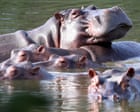
In the sweltering heat of the Magdalena River valley, a legacy of chaos is breeding in the mud. Decades ago, a man whose name became synonymous with global terror imported four exotic animals to his private estate, Hacienda Nápoles. When the empire of Pablo Escobar crumbled under gunfire and law enforcement, the lions and tigers were shipped away to zoos. But the hippopotami stayed. They were too heavy to move, too aggressive to catch, and seemingly too strange to survive in the Colombian wild.
They did more than survive. They thrived.
What began as a quartet of curiosities has ballooned into a population of over 150 massive, territorial invaders. They are effectively the world’s largest invasive species, turning the local ecosystem into a toxic experiment. Their waste chokes the oxygen out of the water, killing native fish and threatening the livelihoods of fishermen who now have to share their riverbanks with three-ton tanks that can run faster than a human.
Enter Anant Ambani.
He is the youngest son of Mukesh Ambani, a man whose wealth is so vast it functions as its own sovereign gravity. While the Colombian government has spent years debating whether to cull the herd or attempt a mass sterilization—a logistical nightmare that costs tens of thousands of dollars per animal—Ambani has offered a different kind of solution. He wants to bring them to Vantara.
The World of Vantara
Vantara is not a zoo in the traditional, Victorian sense of the word. Spread across 3,000 acres in the industrial heart of Jamnagar, Gujarat, it is a sprawling sanctuary that looks more like a high-tech Garden of Eden than a roadside attraction. This is where the Ambani family has funneled billions into a passion project focused on global animal welfare. It is a place where elephants receive hydrotherapy and leopards live in climate-controlled enclosures.
When news broke that Ambani’s Greens Zoological Rescue and Rehabilitation Centre offered to house a significant portion of the "cocaine hippos," the world looked on with a mix of relief and skepticism. On one hand, it is a humanitarian and ecological bypass. On the other, it represents the peculiar reality of the 21st century: when a nation-state is paralyzed by an ecological crisis, a private individual with enough resources can simply step in and rewrite the ending.
Consider the sheer scale of moving sixty hippos across the Atlantic. This isn't a simple freight shipment. It involves custom-built crates, chartered cargo planes, and a team of veterinarians and handlers who must keep the animals sedated yet stable for a journey that spans thousands of miles. The cost is astronomical. The risk is high. Yet, for Colombia, it is an out.
The Invisible Stakes of a Legacy
To understand why this matters, you have to look at the people living in the shadow of Escobar’s ghost. For a fisherman in Puerto Triunfo, a hippo isn't a majestic creature from a nature documentary. It is a monster. It is a creature that destroys crops and flips boats. The local community has developed a bizarre, trauma-bonded relationship with these animals; they are a tourist draw, yes, but they are also a ticking time bomb.
The Colombian government recently declared the hippos an officially invasive species. This was a legal necessity to allow for more drastic measures, including culling. But the public outcry was immediate. Hippos are charismatic. They look like stout, clumsy herbivores until you see them open their mouths. Killing them feels like a sin to many, even if letting them stay is an ecological death sentence for the Magdalena River.
Ambani’s offer provides a moral escape hatch. It allows the Colombian Ministry of Environment to say they saved the animals while simultaneously removing the threat. It is a rare moment where the interests of a billionaire’s legacy and a developing nation’s environmental safety align perfectly.
A Sanctuary or a Gilded Cage?
Critics of private wildlife collections often argue that these sanctuaries are merely "vanity projects" for the ultra-wealthy. They point to the history of private menageries as symbols of power rather than conservation. However, the reality on the ground in Jamnagar suggests something more sophisticated.
The facilities at Vantara include a massive hospital equipped with MRI machines and surgical suites that many human hospitals would envy. They have recruited global experts to manage the diet and social structures of the animals. If the hippos do make the journey to India, they won't be sitting in concrete pits. They will be in a managed environment designed to mimic their natural habitat, but without the risk of destroying a local South American river system.
This isn't just about moving animals from Point A to Point B. It’s about the ethics of cleanup. We are currently living in an era where the mistakes of the past—Escobar’s hubris, in this case—are being rectified by the extreme wealth of the present.
The Cost of a Second Chance
Moving these animals is a logistical feat that borders on the absurd. Each hippo must be lured into a metal container using food over the course of weeks, acclimating them to the confined space so they don't panic during takeoff. The pressure of the flight, the change in humidity, and the sheer physical toll on the animals make this a high-stakes gamble.
But what is the alternative?
Left alone, the population is projected to reach 1,000 by 2035. At that point, the Magdalena River will be functionally dead. The hippos’ waste changes the chemistry of the water, promoting harmful algae blooms that suffocate everything else. It is a slow-motion environmental car crash.
Ambani’s intervention is a reminder that we are moving into a period where private philanthropy is no longer just about building libraries or funding scholarships. It is about geo-engineering and ecological management. It is about a billionaire deciding that a drug lord’s mistake shouldn't result in the extinction of a local ecosystem.
The hippos themselves remain blissfully unaware of the controversy. They wallow in the Colombian mud, unaware that they are the center of a geopolitical and environmental tug-of-war. They don't know that they are "cocaine hippos." They don't know they are "invasive." They are just hungry, heavy, and out of place.
If the plan succeeds, sixty of these giants will trade the humid rivers of Colombia for the specialized care of a Gujarat sanctuary. They will become part of a different kind of legacy—one that focuses on the restoration of what was broken rather than the display of what was conquered.
The image that remains is one of a massive cargo plane climbing into the sky over the Andes, carrying a weight that is both physical and historical. Inside, the descendants of a criminal’s whim are being ferried toward a future that was never supposed to exist. It is a strange, expensive, and deeply human attempt to fix a world that we have spent centuries knocking out of balance.
Whether this is the beginning of a new model for conservation or a one-off miracle for a few lucky animals remains to be seen. But for now, the river might finally get a chance to breathe again.