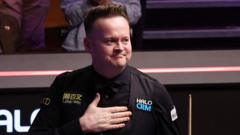
The press box is a vacuum of original thought. Every time a major snooker championship hits the business end, the narrative machine grinds out the same tired tropes. This week, it’s Shaun Murphy’s "masterclass" against John Higgins. The headlines scream about Murphy "powering past" the legend, painting a picture of a dominant force reclaiming his throne at the Crucible.
They are wrong. They are looking at the scoreboard and ignoring the soul of the game.
What the mainstream media calls a "powering performance" was actually a frantic, high-stakes gamble that happened to pay off. If you want to understand professional snooker at its highest level, you have to stop equating aggressive shot-making with superior skill. Murphy didn't beat Higgins because he played better snooker; he beat him because he played more dangerous snooker. There is a distinction, and failing to see it is why most amateur players never improve their handicap.
The Fallacy of the Aggressive Break
Standard commentary loves a "heavy scorer." They see Murphy’s high break rate and assume it’s a sign of technical perfection. It isn’t. In the modern game, what we are seeing is the "T20-ification" of snooker. Murphy represents a brand of play that prioritizes spectacle over safety, a style that is inherently fragile.
John Higgins, despite the loss, remains the superior tactician. The "Wizard of Wishaw" plays a brand of percentage snooker that is mathematically sound. When Murphy steps up and hammers a long red into the corner pocket, the crowd roars. But from a strategic standpoint, that shot often has a success probability of less than 60%. In any other professional environment—finance, engineering, poker—relying on a 60/40 coin flip is considered a failure of discipline.
In snooker, we call it "flair." We should call it what it is: a lack of patience.
Why Technical Prowess is Overrated
People obsess over the "cue action." They talk about Murphy’s rock-solid bridge and his fluid follow-through as if these are the primary drivers of his victory.
I’ve sat in the practice rooms. I’ve seen players with "perfect" cue actions get dismantled by grinders who couldn’t draw a straight line with a ruler. Snooker isn't a beauty pageant. The obsession with "clean hitting" is a distraction. Murphy’s success in this match was driven by a specific psychological state—a total disregard for the consequences of a miss.
When you play without fear, you look like a genius. Until you don't.
The "lazy consensus" says Murphy has found his form. I argue he has found a temporary peak in his risk-tolerance. This isn't a sustainable "mastery" of the sport; it's a heater at the craps table. Higgins lost because his tactical traps—usually inescapable—were bypassed by shots that had no business being played, let alone potted.
The Illusion of Momentum
"Momentum" is the most overused word in the sports journalist’s lexicon. It’s a retroactive label we apply to a series of events to make them feel inevitable.
- The Claim: Murphy’s three-frame burst at the start of the session "shifted the momentum."
- The Reality: Those three frames were decided by three specific errors from Higgins, not an atmospheric shift in the arena.
If Higgins hadn't twitched on that tricky brown in frame four, the "momentum" narrative would have evaporated instantly. We need to stop treating snooker matches like emotional tides and start treating them like the series of isolated, high-pressure mechanical tasks they actually are.
The Structural Rot of the Modern Game
The reason Murphy is being hailed as a titan is that the Crucible itself has changed. The tables are faster. The cloth is thinner. The pockets are more forgiving than they were in the 1980s.
This environment favors the "smash and grab" style of Murphy. It punishes the nuanced, safety-first approach of the old guard. When we celebrate Murphy "powering past" Higgins, we are actually celebrating the homogenization of the sport. We are cheering for the death of the safety battle.
Higgins represents the era where you had to earn your way into the balls. Murphy represents the era where you can blast your way in. If you think the latter makes for "better" snooker, you’re watching for the wrong reasons. You’re watching for the fireworks, not the architecture.
The Cost of the "Magician" Persona
Shaun Murphy leans into his "Magician" nickname. It’s great for branding, but it’s a trap for his game. By framing himself as a performer, he creates an internal pressure to be spectacular.
During the Higgins match, there were at least four instances where the correct, professional shot was a soft safety to the baulk cushion. Instead, Murphy went for the spectacular double or the high-velocity cross-table plant. Because they went in, the commentators called him a visionary.
If those balls had rattled the jaws, the same pundits would have called him "reckless" and "undisciplined."
This is result-oriented thinking at its worst. As a student of the game, you must judge the quality of a decision by the information available at the time, not by the outcome. Murphy’s decisions against Higgins were often objectively poor. He was simply lucky enough to have his talent bail out his strategy.
The Truth About Higgins’ "Decline"
Every time an legend loses, we get the "passing of the torch" articles.
Higgins isn't finished. He didn't lose because he's "too old" or "lost his edge." He lost because the current scoring conditions at the Crucible have reached a point where tactical brilliance can be overridden by raw aggression.
It’s a glitch in the system, not a failure of the player.
Imagine a scenario where the pockets were tightened by just 2mm. Murphy’s "dominant" performance would have been a disaster. He would have left Higgins a dozen mid-range starters and lost 13-5. That is how thin the margin is between a "masterclass" and a "collapse."
Stop Asking if Murphy is "Back"
The question isn't whether Murphy is back to his best. The question is whether snooker has become a game where "best" no longer means "most skillful."
If we continue to prize the highlight reel over the tactical grind, we lose the essence of what makes the Crucible the ultimate test. Murphy’s victory wasn't a display of superiority; it was a symptom of a sport that is forgetting how to value the art of the struggle.
Shaun Murphy didn't power past John Higgins. He out-gambled him. If you can't see the difference, you aren't really watching.
Don't buy the hype. Don't mirror the lazy praise of the broadcasters. Look at the table. Look at the risk-reward ratios. The scoreboard tells you who won, but it rarely tells you who played the better game.
Stop looking at the trophy and start looking at the choices.