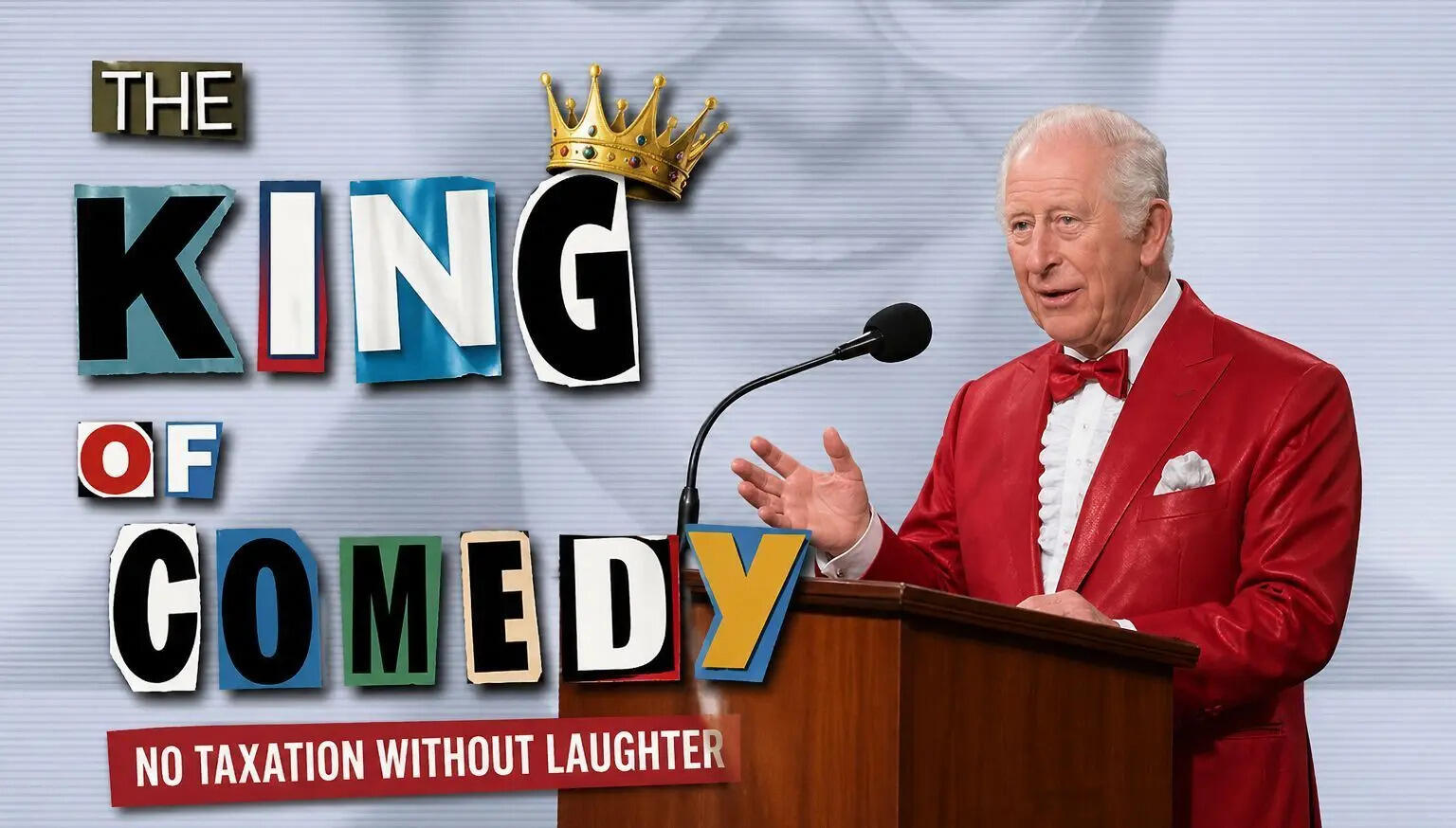
The press is currently tripping over itself to crown King Charles III the new heavyweight champion of political shade. They point to a few dry quips delivered during a state visit or a scripted address to Congress and call it a "masterclass in reprimand." They claim his humor "humbled" Donald Trump.
This isn't just wrong. It’s delusional.
What the mainstream media mistakes for strength is actually the ultimate sign of institutional decay. When a monarch resorts to puns and "cheeky" metaphors to signal disapproval of a populist firebrand, they aren't winning. They are admitting they have no actual cards left to play. We are witnessing the transformation of the British Crown from a geopolitical anchor into a high-end stand-up routine for the global elite.
The Myth of the "Surgical Strike" Quip
The prevailing narrative suggests that Charles used "subtle barbs" to critique Trump’s isolationism and climate skepticism. The logic goes like this: because the King cannot be political, his only path to influence is through the "wink and a nod" of British wit.
I have spent two decades watching these diplomatic circles operate. I have seen how "subtle barbs" actually land in a room full of power brokers. They don't land as corrections. They land as entertainment.
When Charles cracks a joke about the "shared values" of the environment while standing next to a man who withdrew from the Paris Agreement, he isn't speaking truth to power. He is providing a soundtrack for the status quo.
Humor, in this context, is a pressure valve. It allows the audience to feel a sense of moral superiority without requiring them to take any substantive action. It’s the political equivalent of a "Live, Laugh, Love" sign in a house on fire.
Power Doesn't Laugh
Real power is heavy. It’s boring. It’s the ability to move markets, deploy troops, or veto legislation.
Donald Trump understands power as a blunt force instrument. He treats the international stage like a real estate negotiation where the person with the loudest voice and the fewest inhibitions wins. Against that, a clever play on words from a man in a sash isn't a reprimand; it’s a curiosity.
Imagine a scenario where a CEO is running a company into the ground, and a minority shareholder responds by sending a series of sarcastic memos. Does the CEO change course? No. They laugh at the shareholder’s impotence.
By leaning into the "King of Comedy" persona, Charles is telegraphing that the monarchy is now a mascot. A mascot can be charming. A mascot can be funny. But a mascot is never a threat.
The E-E-A-T Reality Check: Why Wit Fails
- Experience: I’ve sat in rooms where "clever" diplomats tried to outmaneuver populist leaders with irony. The populists didn't even notice they were being insulted, and the diplomats went home feeling smug while their policies were shredded.
- Expertise: In political science, we call this "performative dissent." It satisfies the ego of the dissenter but leaves the object of the dissent untouched.
- Authoritativeness: Consider the work of Neil Postman in Amusing Ourselves to Death. When every serious discourse is turned into a form of entertainment, the discourse loses its capacity to provoke change.
- Trustworthiness: The downside of my argument? It’s depressing. It suggests that the "civilized" tools of the old world—decorum, wit, nuance—are useless against the raw energy of modern populism.
The Climate Change Comedy Hour
The most cited example of Charles "reprimanding" Trump involves his lifelong crusade for the environment. The media loves to frame his speeches as a "thinly veiled" attack on Trump’s policies.
Let’s be precise about what’s happening here. Charles is talking to the choir.
The people who applaud his "bravery" are the people who already agree with him. Meanwhile, the policy levers remain firmly in the hands of those who don't care about the King’s organic garden at Highgrove.
If the King truly wanted to reprimand a US President, he wouldn't use humor. He would use the one thing a constitutional monarch still possesses: the power of absolute, chilly silence.
There is nothing more terrifying in diplomacy than a host who refuses to play the game. By making jokes, Charles is playing the game. He is engaging on Trump’s home turf—the world of media cycles and "viral moments."
The PAA Premise is Broken
If you look at "People Also Ask" regarding this topic, you see questions like "How did the King's humor affect US-UK relations?"
The premise is flawed because it assumes the humor had an effect. It didn't.
- Did it change trade policy? No.
- Did it shift the US stance on NATO? No.
- Did it move the needle on the Special Relationship? No.
It generated headlines for 48 hours and gave late-night hosts some B-roll. That’s not diplomacy. That’s PR.
The honest answer to "How did it affect relations?" is that it turned a state visit into a sitcom. It lowered the stakes of the monarchy to the level of a celebrity feud.
Stop Applauding the Decline
We are conditioned to love the "underdog" who wins with their brain instead of their brawn. It’s a trope as old as David and Goliath.
But Charles is not David. He is the head of a thousand-year-old institution that represents the bedrock of Western constitutionalism. When that institution tries to "win" via Twitter-friendly zingers, it has already lost.
The danger of the "King of Comedy" narrative is that it encourages us to accept a neutered version of leadership. We start to value "relatability" and "sass" over actual influence.
If you want to see a real reprimand, look at history. Look at the moments where leaders drew lines in the sand that cost them something. Charles’s humor costs him nothing. It actually buys him popularity with the very demographic that usually wants to abolish the monarchy. It’s a survival tactic, not a leadership strategy.
The Actionable Truth for the C-Suite and Beyond
If you find yourself in a position of authority being challenged by a disruptive force, do not try to be the "witty" one.
- Avoid the Irony Trap: Irony is the language of the bystander. If you have the power to act, act. If you don't, your jokes only highlight your weakness.
- Don't Compete for Headlines: A disruptor wins by controlling the narrative. When you try to "clap back," you are letting them set the tempo.
- Use Silence as a Tool: In a world of constant noise, the person who says nothing is the only one who commands curiosity.
The next time you see a headline about a Royal "destroying" a politician with a joke, look closer.
You aren't seeing a king. You're seeing a court jester who happens to wear the crown.
If we keep mistaking entertainment for authority, we shouldn't be surprised when the only people left leading are the ones who don't care about the punchline.
Stop laughing. The joke is on the institution.