Tyson Fury’s return to the ring serves as a diagnostic tool for the current state of heavyweight boxing, revealing a divergent set of incentives between pure competitive legacy and risk-adjusted capital preservation. While the optics suggest a missed opportunity for a domestic unification bout, a structural analysis reveals that the "call-out" is no longer a tool for matchmaking but a brand-positioning exercise designed to maximize leverage in future negotiations. The refusal of Anthony Joshua to engage with these public overtures indicates a shift from traditional sporting meritocracy toward a model of asset protection.
The Asymmetric Risk Profile of Elite Matchmaking
In professional boxing, the decision-making process for elite athletes functions under a framework of "Legacy Dilution." For a fighter like Anthony Joshua, the marginal utility of a win against Fury is high, but the cost of a definitive loss is catastrophic to his long-term earning potential. We can categorize this decision-making via three primary variables:
- Revenue Floor Retention: Joshua’s brand remains a top-tier commercial asset despite recent losses. Engaging in a high-risk bout without a guaranteed path to victory threatens the "brand premium" he commands for mid-tier fights.
- Negotiation Leverage Decay: By "rising to the call-out," a fighter enters negotiations from a position of perceived weakness. Accepting Fury’s timeline grants the opponent control over the promotional cycle, training camp duration, and purse splits.
- The Recovery Period Bottleneck: A loss at this stage of a career requires a 12-to-18-month rehabilitative cycle. For Joshua, the opportunity cost of that downtime outweighs the immediate payout of a 2024 mega-fight.
Structural Mechanics of the Fury Call-Out
Tyson Fury’s public demands are often dismissed as erratic behavior, yet they follow a consistent logical pattern aimed at "Market Saturation." By dominating the media cycle with aggressive timelines, Fury forces competitors into a binary choice: accept unfavorable terms or face public accusations of cowardice.
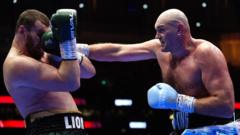
This tactic creates a "Performance Illusion." By soundly defeating a mid-tier opponent like Derek Chisora while simultaneously calling out the division's other marquee name, Fury maintains the appearance of activity and dominance without the immediate necessity of facing a 50/50 threat. The mechanics of this dominance rely on the following pillars:
- Reach and Range Utilization: Fury’s physical dimensions allow him to dictate the "Effective Strike Zone." This forces opponents to overextend, leading to rapid fatigue and increased vulnerability to counter-punching.
- Psychological Displacement: Publicly demanding a fight creates a narrative where the opponent is already reacting to Fury’s tempo before a contract is signed.
- Controlled Output: Fury manages his energy expenditure with high efficiency, utilizing clinch work and leaning on opponents to neutralize their explosive power.
The Value Gap Between Titles and Brand Power
The heavyweight division is currently experiencing a decoupling of "Belt Authority" and "Market Value." Historically, the pursuit of the Undisputed Championship was the primary driver of high-level matchmaking. However, the current landscape proves that a fighter’s individual "Star Quotient" often exceeds the value of the physical titles.
This creates a stalemate. If Joshua does not need a belt to sell out a stadium, and Fury does not need Joshua to maintain his status as the lineal champion, the economic incentive for them to fight is actually lower than the public assumes. They are essentially two monopolies operating in the same industry, where a merger (the fight) risks destroying one of the brands entirely.
The "Cost Function of a Mega-Fight" includes:
- The Sanctioning Fee Burden: Paying 3% of the purse to multiple governing bodies for titles that don't significantly increase the gate.
- The Distribution Split: Complex negotiations between rival broadcasters (e.g., DAZN vs. TNT Sports) create a logistical wall that neither side is incentivized to climb unless the guaranteed floor is astronomical.
Tactical Deficiencies and Strategic Refinement
Analyzing the in-ring performance of Fury’s return, several technical observations emerge that explain why Joshua’s camp remains hesitant. Fury has transitioned from a pure "slick" mover to a "heavy-handed volume" fighter. This evolution increases the physical toll on opponents who rely on traditional guard structures.
Joshua’s style, rooted in Olympic-style fundamentals and explosive combinations, requires a stationary target to be most effective. Fury’s lateral movement, even when diminished by age or layoffs, presents a stylistic "bottleneck" for Joshua. The data from recent heavyweight bouts suggests that fighters with high punch-per-round metrics (like Fury) consistently outwork those with higher "Power per Strike" metrics (like Joshua) over a 12-round distance.
The Strategic Play for 2026
The path forward requires a shift from public posturing to a structured "Multi-Bout Agreement." For the heavyweight division to unlock its maximum valuation, the stakeholders must move away from "Winner-Takes-All" narratives and toward a "Series Architecture."
- Fixed-Date Scheduling: Moving away from the "four-week notice" model to a standardized 12-month calendar.
- Cross-Platform Revenue Sharing: Implementing a joint-venture model between rival promoters to mitigate the broadcasting bottleneck.
- Mandatory Risk Buffers: Creating contracts that guarantee a trilogy or a specific "bounce-back" fight regardless of the outcome of the first bout, protecting the commercial viability of the loser.
The current stagnation is not a result of "fear" but of "rational economic preservation." Until the financial rewards of a loss exceed the current rewards of staying active against lower-tier competition, the "Mega-Fight" will remain a theoretical asset rather than a realized one. The strategic mandate for the Joshua camp is to ignore the noise of the return and focus on a timeline that restores his "Negotiation Parity," likely through two dominant wins against top-ten contenders before engaging with the Fury camp on a 50/50 basis.