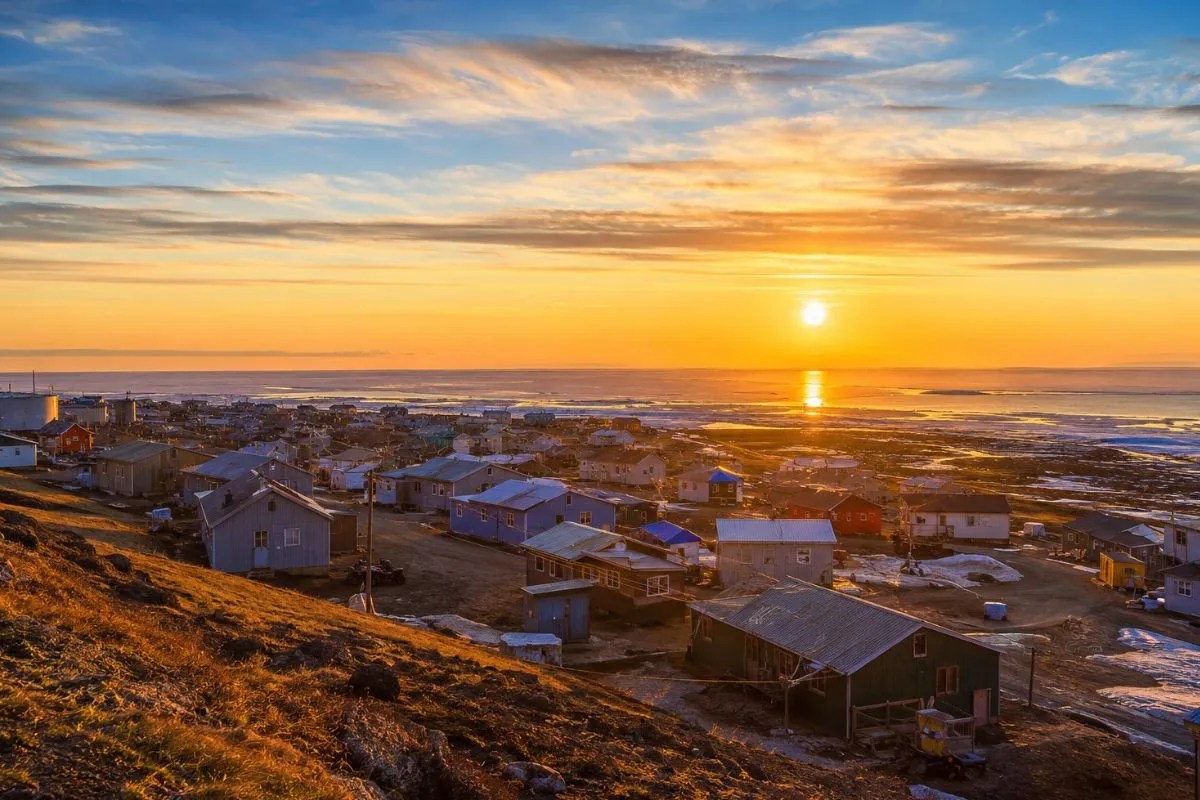
The sun rose over Utqiagvik, Alaska, in mid-May and it will not set again until early August. For 84 consecutive days, the town formerly known as Barrow abandons the concept of night as the star remains fixed above the horizon. This isn't a poetic exaggeration or a seasonal fluke. It is a harsh astronomical reality dictated by the tilt of the Earth. While the rest of the world follows the familiar rhythm of circadian cycles, the 4,500 residents of the northernmost city in the United States are entering a period of perpetual light that tests the limits of human biology and infrastructure.
The Mechanics of the Midnight Sun
To understand why the sun refuses to set, you have to look at the geometry of our planet. Earth rotates on an axis tilted at roughly 23.5 degrees. During the summer solstice, the North Pole is angled toward the sun. For regions located within the Arctic Circle, this tilt creates a window where the sun’s path never dips below the horizon line. Utqiagvik sits at 71.3 degrees north, placing it firmly in the zone where the "Midnight Sun" becomes a months-long marathon rather than a momentary spectacle. Learn more on a similar issue: this related article.
The sun does not stay stationary. It circles the sky in a giant loop, dipping lower toward the north at midnight and climbing higher in the south at noon. Even at its lowest point, the disc remains visible. This creates a psychological vacuum. Without the visual cue of darkness, the brain struggles to produce melatonin. People find themselves washing their cars at 2:00 AM or starting home renovation projects in the middle of what should be the night.
The Biological Toll of Permanent Light
Living without darkness is not a vacation. It is a disruption of the fundamental internal clock that governs human health. Investigative looks into polar health suggest that "Polar T3 Syndrome" and sleep deprivation are common among those who haven’t mastered the art of artificial darkness. The body needs the absence of light to trigger repair mechanisms. Additional analysis by Travel + Leisure delves into comparable perspectives on the subject.
In Utqiagvik, the local architecture reflects this struggle. Windows are not just covered with curtains; they are often sealed with aluminum foil, cardboard, or heavy "blackout" shutters designed for industrial use. If a single sliver of 3:00 AM sunlight pierces a bedroom, the illusion of night is shattered. The local economy and social life shift into a high-gear frenzy. Construction crews work around the clock because the window for outdoor labor is narrow, and the light allows for 24-hour shifts.
The Seasonal Affective Flip
Most people associate Seasonal Affective Disorder (SAD) with the dark, gloomy winters. However, the Arctic summer brings its own version of psychological strain. The pressure to be productive while the sun is out can lead to burnout. There is a communal anxiety that stems from the feeling that you are "wasting" the light if you sleep. This is the opposite of the winter hibernation. It is a manic, high-energy state that can fray nerves and strain domestic life.
Infrastructure in a Liquid Landscape
The 84-day sun does more than just mess with sleep; it fundamentally alters the ground beneath the residents' feet. Utqiagvik is built on permafrost. When the sun beats down for 2,000 hours straight, the "active layer" of the soil thaws. This turns the tundra into a boggy, unstable terrain.
Roads in the Arctic are a constant battle against physics. The heat from the perpetual sun, combined with rising global temperatures, means the permafrost is no longer as "permanent" as it once was. Buildings are often elevated on stilts to prevent the heat from the structure—and the heat absorbed from the sun—from melting the ice underneath. If the ice melts, the foundation sinks. This creates a precarious existence where the very light that brings life to the tundra also threatens the stability of the town’s homes and schools.
The Economic Engine of the North Slope
Utqiagvik serves as a hub for the North Slope Borough, a region roughly the size of the state of Minnesota. The permanent light provides a tactical advantage for the oil and gas industry, as well as scientific researchers who flock to the area to study climate change. Logistics are simplified when you don't need artificial lighting for outdoor operations.
Shipping also relies on this window. The sea ice typically begins to pull away from the shore during the period of constant light, allowing barges to bring in fuel, building materials, and non-perishable food. These "sealifts" are the lifeline of the community. Everything from a gallon of milk to a new truck must arrive during these few months, or be flown in at a staggering cost. The sun is the facilitator of the entire supply chain.
Cultural Resilience of the Iñupiat
The indigenous Iñupiat people have thrived in this environment for thousands of years. They do not view the 84 days of light as a curiosity or a burden, but as a vital part of the traditional whaling cycle. The light is essential for spotting bowhead whales and navigating the dangerous lead systems in the ice.
Their expertise is a reminder that human beings are remarkably adaptable. While a tourist might lose their mind after three days of no sleep, the local culture is built around the harvest. They recognize that the sun is a fleeting resource. The frantic energy of the summer is a preparation for the inevitable 66 days of total darkness that will arrive in November. It is a binary existence: total output or total endurance.
The Reality of Arctic Tourism
Many travelers are drawn to the "Top of the World" to check the Midnight Sun off their bucket list. They arrive expecting a scenic sunset that never ends. What they find is often a gritty, industrial town where the wind still bites and the "sunlight" is often filtered through a thick, gray maritime fog.
The sun is visible, but the heat is a myth. Even with 24-hour light, temperatures in Utqiagvik often hover just above freezing. The "Endless Summer" here doesn't mean palm trees; it means mud, mosquitoes, and the constant hum of diesel engines. The cost of visiting is high, with flights and lodging reflecting the extreme difficulty of maintaining a service industry in the high Arctic.
Environmental Warning Signs
Researchers stationed in Utqiagvik use the 84 days of light to monitor the thinning of Arctic ice. The region is warming at nearly four times the global average. The constant solar radiation accelerates the loss of albedo—the Earth’s ability to reflect sunlight back into space. When the ice disappears, the dark ocean absorbs the heat instead of reflecting it.
This creates a feedback loop. The longer the sun stays up, and the less ice there is to deflect it, the faster the Arctic warms. Utqiagvik is the "Canary in the Coal Mine" for global climate patterns. The 84 days of light are no longer just a local phenomenon; they are a critical window for observing the transformation of the planet’s cooling system.
Surviving the Light
For those living through it, the strategy for survival is discipline. You have to force yourself to go to bed when your eyes tell you it's noon. You have to trust your watch more than your instincts. The community relies on a shared understanding that the rules of the lower 48 states simply do not apply here.
There is a specific kind of silence that happens at 3:00 AM under a bright sun. The birds are awake, the light is golden and long, but the human activity finally slows down. It is a surreal, haunting beauty that few ever witness. But that beauty comes at the cost of biological confusion and the constant maintenance of a civilization that is effectively squatting on a frozen desert.
Invest into a high-quality eye mask and a heavy-duty set of earplugs before stepping off the plane. Without them, the Arctic sun won't just keep you awake; it will break your sense of time entirely.