Coming home from the moon isn't a gentle glide. It's a violent, high-stakes collision with Earth's atmosphere at 25,000 miles per hour. Most of us will never sit inside the Orion capsule, but NASA is changing how we see the mission. They're using augmented reality to let you watch the Artemis II reentry from your living room. It's a gritty, realistic look at the physics that keep four humans alive during a literal trial by fire.
The Brutal Physics of Coming Home
When the Artemis II crew returns from their trip around the moon, they won't just "land." They have to hit a narrow window in the sky. If the angle's too shallow, they skip off the atmosphere like a stone on a pond and drift into deep space. Too steep? The friction creates heat that would melt even the best thermal protection systems. Learn more on a connected subject: this related article.
Orion hits the air so fast that the molecules around the capsule don't just move aside. They're compressed into plasma. We're talking about temperatures reaching $2,760^\circ$C. That's about half as hot as the surface of the sun. The AR visualization shows this perfectly. You see the white-hot envelope of air surrounding the craft. You see the ablative heat shield—made of a material called Avcoat—slowly charring and breaking away to carry that heat into the void.
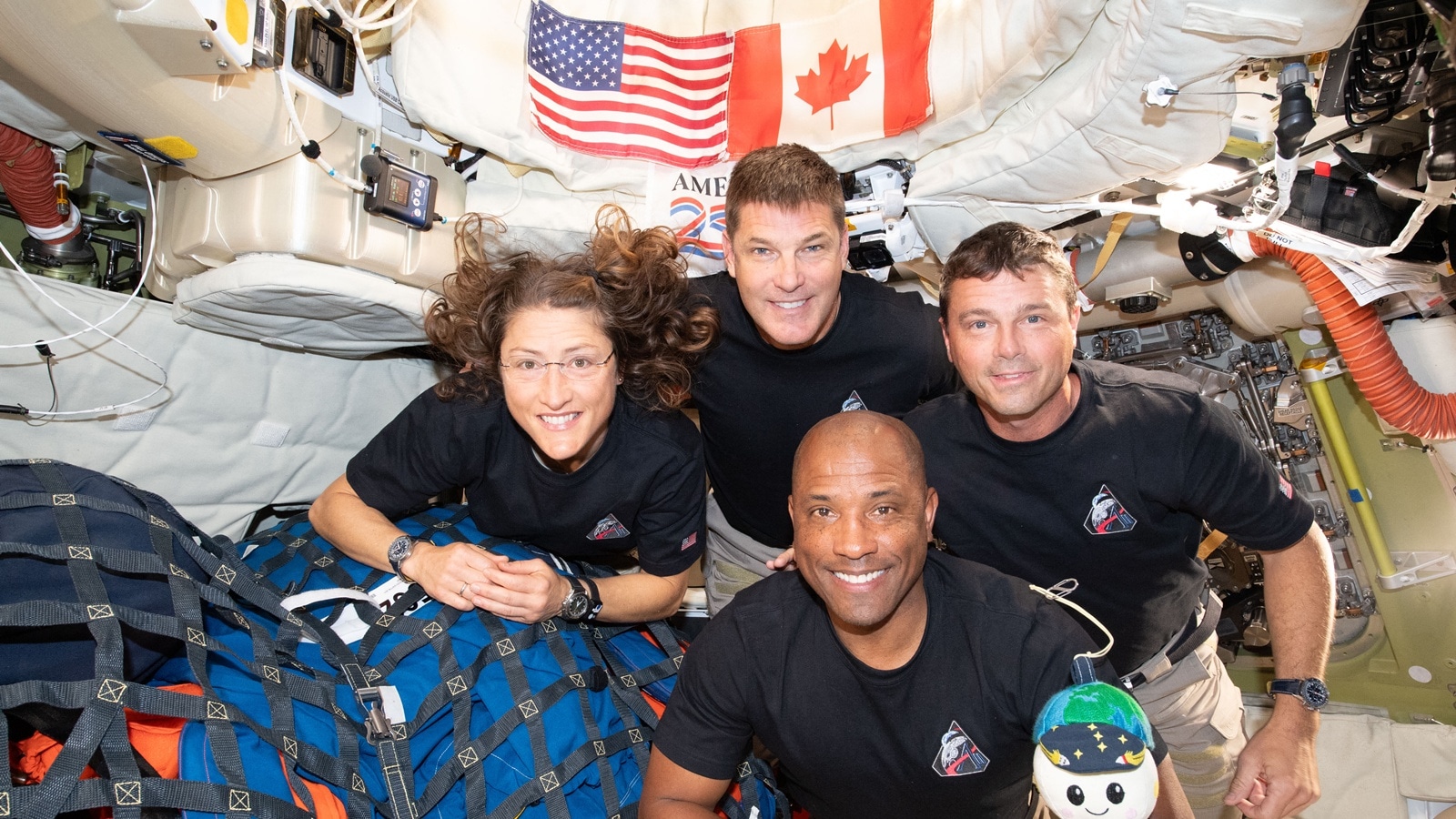
NASA isn't just doing this for "cool" points. They're doing it because space travel feels abstract to most people. When you see a digital Orion capsule sitting on your coffee table, sparking and glowing as it "descends," the danger feels real. It's a reminder that we're putting Reid Wiseman, Victor Glover, Christina Koch, and Jeremy Hansen into a tiny bucket and throwing it at the Earth. More journalism by CNET delves into comparable views on this issue.
Why This AR Experience Beats a Standard Video
Most space documentaries use pre-rendered CGI. It's polished, but it's passive. You just sit there. Augmented reality changes the power dynamic. You're the camera operator. You can walk around the capsule as it sheds its service module. You can lean in to see the thrusters firing for orientation.
Granular Technical Details You Can Actually See
The Skip Maneuver
NASA is using a "skip entry" technique for Artemis. The capsule hits the atmosphere, bounces back up slightly to shed speed and heat, and then dives back in for the final descent. This allows for a more precise landing near the recovery ship. The AR experience tracks this trajectory, showing the altitude fluctuations that would be invisible in a standard wide-shot video.Plasma Blackout Zones
There's a period during reentry where the heat is so intense it creates a sheath of ionized air around the craft. This blocks radio waves. The crew goes silent. In the visualization, you can see the representation of this plasma field. It explains why mission control holds its breath for those few minutes.Parachute Deployment Sequences
It's not just one parachute. It's a dance. First come the drogues to stabilize the tumble. Then the pilots pull out the three massive mains. Seeing this in 3D space gives you a sense of the scale. Those main chutes are huge—each one could cover a small house—and seeing them "unfold" in your room puts that size into perspective.
The Tech Behind the Visualization
Google and NASA collaborated to bring these 3D models into Search. They used high-fidelity telemetry data to ensure the models aren't just "artist's impressions." The textures on the capsule are based on the actual Orion built for Artemis I. You can see the thermal tiles and the metallic sheen of the pressure vessel.
To use it, you just need a smartphone with AR capabilities. Search for "Artemis II" or "NASA Orion" on Google. Look for the "View in 3D" button. Once it’s in your space, you can toggle through different stages of the mission. The reentry phase is easily the most dramatic.
What This Means for Future Missions
We're moving away from the era of "watching" space and into "experiencing" it. This AR tool is a precursor to how we'll follow the Artemis III moon landing. Imagine having the lunar south pole mapped out on your floor while you watch live telemetry of the astronauts stepping out.
It also serves a transparency purpose. Space flight is expensive and risky. When the public can see the complexity of a skip-entry maneuver or the sheer intensity of atmospheric friction, the "why" behind the multi-billion dollar budgets becomes clearer. It's an engineering marvel that happens in a place where no human eye can safely watch. AR bridges that gap.
How to Get the Best AR View
Don't just open the app in a dark room and hope for the best. AR needs light and "anchor points" to look good. Find a clear floor space or a large table. Good lighting helps the phone's sensors track the ground, which prevents the capsule from "sliding" around.
Once you have it locked in, move your phone close. Look at the bottom of the capsule. That's the heat shield that has to survive the $2,760^\circ$C. Think about the fact that on the other side of that shield, there's just a few feet of air and four people trying to get home to their families.
The Artemis II mission is scheduled to send humans around the moon for the first time in over fifty years. While the launch gets all the glory, the reentry is the true test of the hardware. Grab your phone, load the model, and watch how NASA plans to stick the landing. It’s the closest any of us will get to the fireball. After you've explored the reentry, look for the "Lunar Flyby" toggle in the same AR menu to see how the capsule navigates the moon's gravity. It’s a complete orbital mechanics lesson without the textbook.