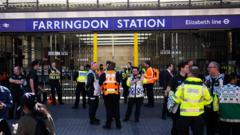
The headlines followed the standard script. "Farringdon station evacuated." "Commuters delayed." "Potential gas leak." The narrative is always the same: a minor environmental anomaly occurs, the authorities hit the big red button, and thousands of productive hours vanish into the ether of "precaution."
We have become a society that worships the false god of zero risk. While the mainstream press treats the reopening of a station as a relief, they ignore the systemic fragility that these incidents expose. The "possible gas leak" at Farringdon isn't a story about public safety. It is a story about the staggering cost of modern paranoia and the aging infrastructure we refuse to truly modernize. For a closer look into this area, we recommend: this related article.
The High Price of "Maybe"
When an alarm triggers in a major transit hub like Farringdon, the response is binary. It is either 0 or 100. There is no middle ground, no nuanced assessment of threat levels, and certainly no consideration of the economic ripple effects.
Think about the math of a London evacuation. You aren't just clearing a platform. You are stalling the Elizabeth Line, the Circle, Hammersmith & City, and Metropolitan lines. You are disrupting the Thameslink corridor. Thousands of people—lawyers, developers, traders, and service workers—are shoved onto the street. If you quantify the lost productivity, the missed meetings, and the logistical chaos, a "precautionary" closure often costs more than the actual risk it seeks to mitigate. To get more context on this issue, detailed reporting can be read at The Guardian.
I have seen operations managers in high-stakes environments freeze because they are more afraid of a PR disaster than they are of a mechanical failure. We have built a system where the "safest" choice is to stop everything, regardless of how thin the evidence of danger actually is.
Sensors Are Smarter Than Your Procedures
The "possible" in "possible gas leak" is the most telling word in the report. In an era of hypersensitive detection technology, we should not be relying on "possibilities."
Most urban gas detection systems are relics. They trigger alerts based on broad thresholds that don't account for environmental variables or harmless fluctuations. We treat every spike on a monitor like the impending end of the world. Why? Because our protocols haven't caught up to our hardware.
If we were serious about infrastructure, we wouldn't just be reacting to leaks; we would be using predictive analytics to identify pipe degradation before a sensor ever goes off. Instead, we wait for a smell or a blip, panic, shut down the heart of the city, and then pat ourselves on the back when nothing happens.
The Farce of the Reopening Narrative
The media loves the "reopening" angle. It suggests a return to normalcy. But normalcy is exactly the problem. Returning to the status quo means returning to an aging, leak-prone network that is managed by reactive bureaucracy.
Every time Farringdon or any other major station closes for a "suspected" issue that turns out to be nothing, it erodes public trust. It's the "Boy Who Cried Wolf" played out on a multi-million-pound stage. Eventually, people stop taking the alerts seriously. They linger on the platforms. They finish their emails. They move slowly. By over-reacting to non-events, the authorities are actually making a real event more dangerous.
Stop Fixing Symptoms and Start Demanding Resilience
The "lazy consensus" is that these disruptions are just an inevitable part of living in a big city. That is a lie sold to you by departments that don't want to admit their maintenance schedules are decades behind.
Real resilience isn't about how fast you can evacuate a building; it’s about building a system that doesn't need to be evacuated every time a sensor gets twitchy. It’s about:
- Redundant Isolation: The ability to cordone off specific zones without killing the entire network.
- Verified Detection: Using multi-factor sensing (thermal, chemical, and pressure) to confirm a leak within seconds, rather than minutes of "investigation."
- Economic Risk Assessment: Acknowledging that sometimes, the disruption is more harmful than the localized risk.
We are told that safety is "paramount" (to use the tired jargon of the risk-averse), but what they really mean is that liability coverage is the priority. If we actually cared about the public, we would stop treating every "possible" leak as a reason to paralyze the city.
The Infrastructure Debt
London sits on a pile of Victorian iron and mid-century concrete. The Farringdon incident is a symptom of a massive, unaddressed infrastructure debt. We keep slapping digital interfaces on top of analog problems.
You can have the most advanced signaling in the world, but if the ground beneath the tracks is saturated with old gas mains and decaying water pipes, the system will remain brittle. The "contrarian" truth is that we shouldn't be celebrating the reopening of a station. We should be furious that the station was vulnerable to a "possible" leak in the first place.
The next time you see a "minor disruption" headline, don't check your watch. Check the budget of the people responsible for the pipes. We are paying for a world-class city and receiving a reactive, nervous wreck of a transit system.
Stop thanking them for reopening the doors. Start asking why the doors keep closing.