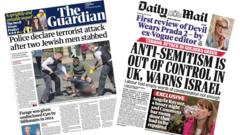
Britain is currently wrestling with a profound breakdown in public order that goes far beyond simple protest. The recent headlines screaming about "terror on our streets" and antisemitism being "out of control" are not just sensationalist tabloids looking for clicks; they are the death rattles of a policing model that has lost its grip on reality. For months, the UK has seen a sharp escalation in communal tensions, fueled by geopolitical conflicts and domestic radicalization, leaving minority communities—particularly the Jewish community—feeling targeted and abandoned by the state.
The core of the issue is a systemic failure to balance the right to protest with the right of citizens to live without intimidation. We are seeing a shift from traditional demonstrations to a form of aggressive street politics where the loudest, most radical voices set the agenda. This is not merely a matter of "hurt feelings" or "offensive speech." It is about the physical safety of citizens and the perceived neutrality of the Metropolitan Police and other regional forces. When law enforcement appears to pick and choose which laws to enforce based on the political sensitivity of the crowd, the rule of law itself begins to dissolve.
The Myth of Even Handed Policing
The British public has long been sold the idea of policing by consent. It is a noble concept, rooted in the idea that the police are the public and the public are the police. But consent is currently being withdrawn by large swathes of the population who see a glaring double standard in how different groups are handled. During recent waves of unrest and mass demonstrations, the police have frequently opted for "de-escalation" over enforcement. While this avoids immediate riots, it creates a vacuum where radical elements feel emboldened.
Take the rise in antisemitic incidents reported by groups like the Community Security Trust (CST). These are not isolated events. They are the result of an environment where extremist rhetoric has been allowed to fester under the guise of free speech. When a protestor shouts for "Jihad" or carries a placard that clearly crosses the line into racial hatred, and the police response is a "wait and see" approach, the message sent to the victimized community is clear: you are on your own.
The police often argue that they lack the manpower or the legislative clarity to intervene in massive crowds. This is a half-truth. The legislative tools, such as the Public Order Act, are already on the books. The missing ingredient is the political will to use them. Command-level officers are increasingly paralyzed by the fear of being labeled "disproportionate" or "biased," leading to a policy of containment rather than control.
The Infrastructure of Intimidation
We must look at the "how" of this crisis. Antisemitism does not just happen; it is organized. The streets have become a stage for a highly coordinated effort to dominate the public square. This involves more than just people marching from point A to point B. It involves the use of social media to doxx individuals, the harassment of Jewish students on campuses, and the targeting of businesses.
The radicalization process has been accelerated by an online ecosystem that operates almost entirely outside the reach of UK law. Foreign actors and domestic extremists use these platforms to spread misinformation that fuels on-the-ground confrontations. When the digital vitriol translates into physical intimidation—protestors surrounding synagogues or chanting outside the homes of MPs—it marks a transition from political expression to targeted harassment.
- The Psychological Toll: For the UK's Jewish community, the current climate is the most hostile in living memory. The feeling of being "othered" in their own country is not a fringe concern; it is a mainstream reality discussed at every Shabbat table.
- The Operational Failure: Intelligence gathering on domestic extremism has lagged. The focus on traditional terror threats has blinded authorities to the more subtle, pervasive radicalization occurring in broad daylight.
- The Legal Grey Zone: Lawyers and civil liberties groups often argue that "offensive" speech is protected. However, when speech is used to incite fear or target a specific ethnic group, it becomes a public order offense. The police’s failure to draw this line has led to the "out of control" status we see today.
Beyond the Tabloid Fear Mongering
While the headlines are grim, we have to distinguish between legitimate protest and the opportunistic violence of the few. Most people attending marches are there for humanitarian reasons. However, every large movement provides cover for a radical vanguard. This vanguard is small but highly effective at shifting the tone of a protest from a plea for peace to an endorsement of terror.
The "terror on our streets" narrative is often dismissed by academics as an exaggeration. But for a woman walking through London who is harassed for the "wrong" lanyard or for a family that feels they must hide their religious identity, the terror is visceral. High-end journalism requires us to acknowledge that perception is a reality in public safety. If a significant portion of the population feels unsafe, the state has failed its primary duty.
The failure is also one of integration. For decades, the UK has championed a hands-off approach to multiculturalism, assuming that shared values would naturally emerge. Instead, we have seen the growth of parallel societies where the laws of the land are secondary to the dictates of the group. This tribalism is now spilling out into the streets, with different factions vying for dominance in the public sphere.
The Economic Impact of Lawlessness
There is a business case for law and order that is rarely discussed. The continued disruption of major city centers has a quantifiable impact on retail, tourism, and investment. When central London becomes a "no-go zone" for certain demographics on weekends, businesses suffer. Investors look for stability. They look for a country where the government can guarantee that the streets won't be overtaken by masked mobs every Saturday.
The cost of policing these events is also astronomical. Tens of millions of pounds are being diverted from neighborhood policing—the very thing that prevents "real" crime like burglaries and assaults—to manage political theater. This is a massive transfer of public wealth into the management of communal friction. We are essentially paying a "chaos tax" because our political leaders refuse to set firm boundaries on acceptable public behavior.
Why Current Solutions are Failing
The government’s response has been largely performative. Proposing new definitions of extremism or issuing stern statements from the dispatch box does nothing on the ground. A new definition of extremism doesn't help a lone police officer facing a mob of five hundred people.
What is needed is a return to proactive, deterrent-based policing. This means:
- Immediate Arrests for Hate Speech: Moving away from the "collect evidence and investigate later" model, which allows the perpetrator to walk free and continue the behavior.
- Strict Enforcement of Protest Routes: Prohibiting demonstrations from entering sensitive areas, such as residential Jewish neighborhoods or outside places of worship.
- Accountability for Organizers: Holding the groups that organize these marches legally and financially responsible for the behavior of their participants.
The argument that this would "inflame tensions" is a coward’s gambit. Tensions are already inflamed. Allowing lawlessness to continue only validates the extremists’ belief that the state is weak. A state that cannot protect its own citizens from intimidation is a state in decline.
The Reality of Communal Friction
We are witnessing the Balkanization of British politics. When communal interests supersede national identity, the result is the kind of street-level conflict we see today. The rise in antisemitism is a canary in the coal mine. It is the first sign that the social fabric is tearing. Today it is the Jewish community; tomorrow it will be another group that falls out of favor with the radical mob.
The "out of control" nature of the current crisis is a direct result of decades of moral relativism. We have become so afraid of offending anyone that we have lost the ability to defend the basic values of a liberal democracy. This isn't just about policing tactics; it's about a national identity crisis. If we cannot agree that calling for the destruction of a people or celebrating acts of terror is wrong, then no amount of police presence will save us.
The current trajectory points toward more frequent and more violent confrontations. As the state retreats, private security firms are being hired by communities to do the job the police won't. This is the hallmark of a failing state—where safety becomes a luxury good rather than a basic right.
The solution requires a total overhaul of the British approach to public order. It requires a judiciary that backs the police when they make tough calls, and a political class that stops using communal tensions for electoral gain. Without a decisive pivot back to the uncompromising enforcement of the law, the headlines we see today will soon look mild compared to the reality of tomorrow.
The streets don't belong to the loudest shouters; they belong to the quiet majority who expect to walk them in peace. Restoring that peace isn't an act of oppression; it is the most fundamental duty of a civilized society.