War is not a Pixar movie.
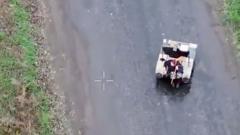
The viral footage of a remote-controlled ground vehicle (UGV) leading an elderly woman away from the ruins of a frontline village is being hailed as a triumph of humanitarian engineering. It is heartwarming. It is cinematic. It is also a dangerous distraction from the cold, hard math of 21st-century attrition.
When you see a robot "rescue" a civilian, you aren't seeing the dawn of automated mercy. You are seeing a desperate patch for a systemic failure in logistics and manpower. The feel-good narrative masks a terrifying shift in how we value human life on the battlefield. We are prioritizing the PR of a single successful extraction over the grim reality that these machines are primarily built to ensure no human ever has to risk their skin to save another—even when a human touch is exactly what is required.
The Humanitarian Theater of the UGV
The "lazy consensus" among tech journalists is that more robots equals fewer casualties. It sounds logical. If a robot leads a civilian through a minefield, a soldier doesn't have to. But this ignores the latency of empathy.
A robot has no peripheral vision for human suffering. It follows a waypoint. It doesn't notice if an eighty-year-old woman with a heart condition is hyperventilating or if she’s about to collapse from a stroke triggered by the very drone overhead protecting her. In the viral Ukrainian footage, the woman follows the machine like a lost soul. It is effective, but it is mechanical.
I have spent years analyzing the integration of autonomous systems in high-threat environments. What the press calls a "rescue," operators call a "low-probability extraction." We are celebrating a 5% success rate because it looks good on Telegram, while ignoring the 95% of civilians who are left behind because they don't have the physical or mental stamina to follow a hunk of vibrating metal through a kill zone.
The Bandwidth Trap
Every robot deployed for a "heroic" rescue mission consumes a finite and precious resource: frequency.
In a high-intensity electronic warfare environment, the electromagnetic spectrum is more crowded than a Tokyo subway. To keep that rescue UGV moving, an operator has to burn through secure channels that could be used for counter-battery fire or medical evacuation of wounded troops.
- Signal Interference: Electronic warfare (EW) units can jam these robots with ease.
- Battery Death: Most small-scale UGVs have a runtime of less than four hours in rugged terrain.
- The "Final Meter" Problem: A robot cannot lift a person into a truck. It cannot provide a tourniquet. It cannot offer a hand to steady a trembling senior.
When we rely on robots for rescue, we aren't "evolving" warfare. We are admitting that we have ceded the ground so completely that we can no longer afford the "cost" of sending a human being to help another human being.
The Efficiency Fallacy
Critics argue that any life saved is a win. That’s a sentiment, not a strategy.
In the real world of military procurement and theater management, every dollar spent on a boutique rescue robot is a dollar not spent on armored evacuation vehicles or heavy lift drones that could move ten people at once. We are falling in love with the "boutique save"—the one-off, high-visibility event—while the structural problem of civilian displacement remains unaddressed.
Imagine a scenario where a commander has two choices: deploy a squad of three UGVs to attempt a guided rescue of a single person, or use those same resources to drop 500 pounds of medical supplies and food to a basement housing fifty. The "heartwarming" choice is the UGV rescue. The "right" choice is the supplies.
The media rewards the UGV. The theater commander loses the war of logistics.
The Ethics of the "Remote" Savior
Let's talk about the psychological toll that the "competitor" articles won't touch.
When we replace a soldier with a robot in a rescue scenario, we are severing the last thread of accountability. If a soldier makes a mistake and leads a civilian into an ambush, there is a trial. There is a weight on a human soul. If a robot’s navigation algorithm glitches and leads a woman into a thermal-sighted machine gun nest, it’s a "technical failure."
We are sanitizing the horror of the frontline by viewing it through the grainy 1080p feed of a drone. This isn't just technology; it's a moral buffer. It allows the public to consume war as a series of successful "missions" rather than a messy, bloody, human catastrophe.
Why the "Rescue Robot" is a Logistics Failure in Disguise
- The Maintenance Burden: For every one robot on the frontline, there are three technicians in the rear. It is a massive "tail" for a very small "tooth."
- Terrain Limits: Most of these machines are defeated by a standard muddy ditch or a pile of brick rubble. The footage you see is always on relatively flat, navigable paths.
- Targeting: A robot leading a civilian is a beacon. It tells the enemy exactly where a high-value, slow-moving target is located. You aren't "sneaking" them out; you are parading them behind a signature-heavy radio transmitter.
Dismantling the "People Also Ask" Delusions
Can robots replace human rescuers?
No. They can provide a moving shield or a waypoint, but they cannot perform the complex triage required in a combat zone. A robot doesn't know the difference between a civilian "hiding" and a civilian "trapped."
Are rescue robots the future of humanitarian aid?
Only if you want aid to be cold, intermittent, and easily jammed. The future of aid is heavy-lift logistics and armored mobility, not RC cars with GoPros.
Is it safer for the civilian?
In many cases, no. A human rescuer can adapt. A human can carry. A human can fight back. A robot is a target that cannot defend the person it is supposedly "saving."
The Cold Hard Truth About Autonomous "Mercy"
The tech industry loves a savior complex. We want to believe that we can code our way out of the brutality of trench warfare. We want to think that a $20,000 UGV is a substitute for the grit of a combat medic.
It isn't.
These robots are being used because the frontline is so lethal that even the most battle-hardened units are terrified to move in the open. The robot isn't a sign of progress; it's a symptom of total stalemate. We are using them because we have no other choice, not because they are better.
By romanticizing these machines, we provide cover for the continued dehumanization of the conflict. We start to value the "innovation" over the outcome. We cheer for the robot's battery life while ignoring the fact that the woman it "saved" lost everything because we couldn't—or wouldn't—secure her home in the first place.
Stop looking at the robot. Look at the void where the human used to be. That is the real story of the frontline.
The machine is just a witness to our absence.