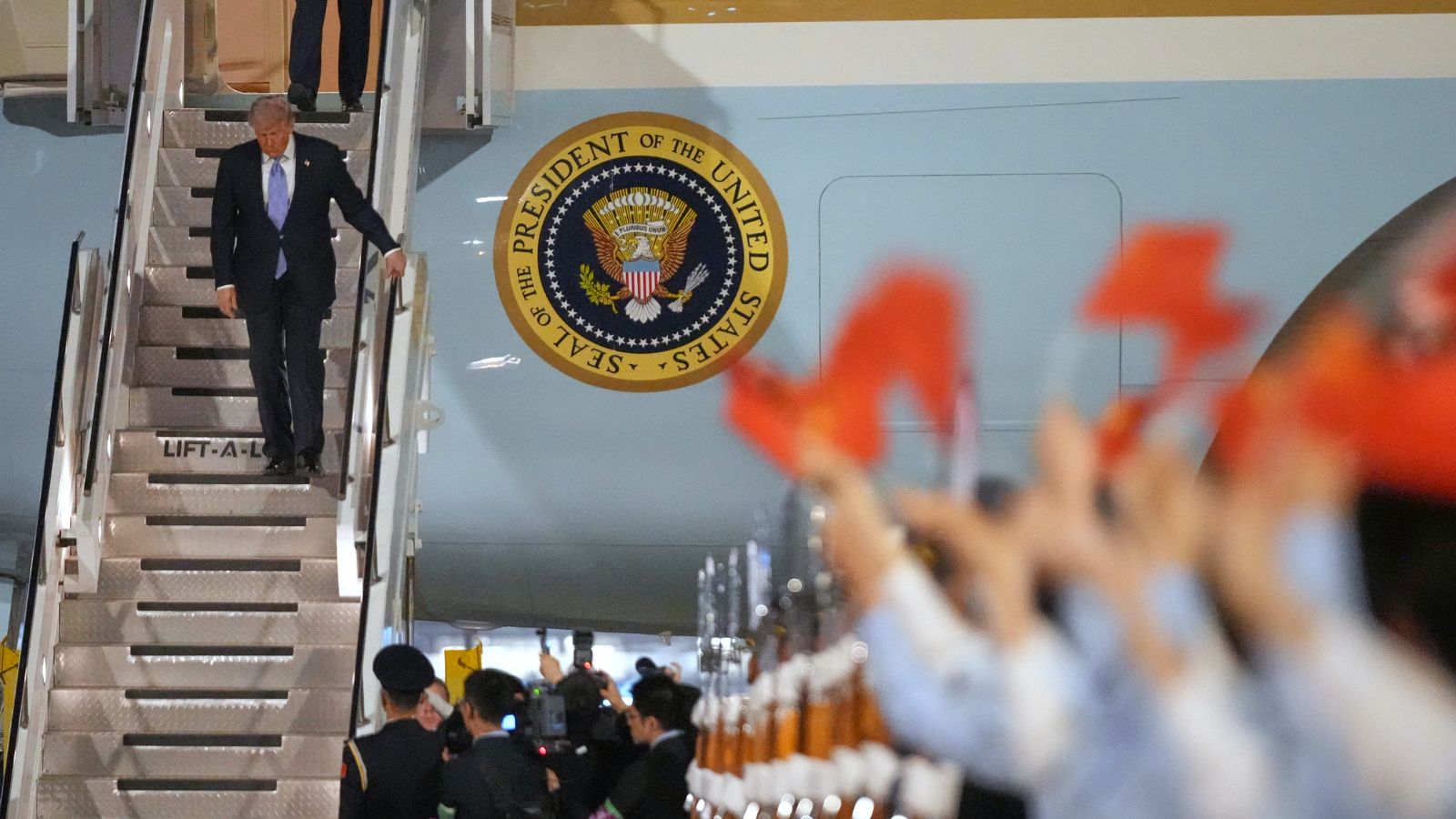
The convergence of trade protectionism and Middle Eastern security architecture represents a dual-front stress test for the global order. When the American executive branch engages the Chinese leadership, the dialogue is not a singular negotiation but a complex multidimensional optimization problem. The core objective is to align domestic economic preservation with international security stabilization, specifically addressing the systemic imbalances in bilateral trade and the escalating risk of kinetic conflict involving Iran. Understanding this summit requires a decomposition of two distinct but interlinked friction points: the structural deficit in the goods exchange and the containment of regional proxy escalations.
The Structural Mechanics of Trade Rebalancing
The primary tension in the U.S.-China trade relationship is not merely the size of the deficit, but the composition of that deficit and the underlying industrial policies that sustain it. To evaluate the success of high-level trade talks, one must analyze the three structural pillars that dictate the flow of capital and goods between the two largest economies.
1. Market Access and Reciprocity Asymmetry
The fundamental friction originates from a lack of symmetry in investment environments. While the U.S. has historically maintained an open-market posture, China utilizes a "Negative List" system to restrict foreign equity in strategic sectors such as telecommunications, finance, and cloud computing. The negotiation strategy focuses on transforming these restrictive administrative barriers into statutory guarantees. Without a shift from discretionary approvals to rule-based access, any "buying spree" of American agricultural or energy products acts as a temporary sedative rather than a structural cure.
2. Intellectual Property and Forced Technology Transfer
The cost function of American innovation is burdened by the systematic extraction of proprietary data. This occurs through joint venture requirements where foreign firms must share R&D secrets with local partners to gain market entry. A rigorous analytical framework views this not just as "theft," but as a forced subsidy to Chinese state-led industrialization. Resolving this requires a verification mechanism that operates independently of local political influence—a hurdle that remains the most significant bottleneck in bilateral agreements.
3. Subsidization and Overcapacity
The Chinese economic model relies on state-directed credit to favored industries, leading to global overcapacity in sectors like steel, aluminum, and increasingly, green technology. When supply exceeds domestic demand, the surplus is exported at prices below the cost of production in market economies. This "dumping" mechanism triggers defensive tariff responses. For the summit to yield a durable outcome, the discussion must move beyond tariff percentages and address the internal credit allocation systems of the Chinese banking sector.
The Iran Variable: Security as a Trade Lever
The inclusion of the Iran conflict in these bilateral talks introduces a geopolitical premium to the trade discussion. China is the largest buyer of Iranian crude oil, providing the Islamic Republic with a critical economic lifeline that mitigates the impact of U.S.-led sanctions. This creates a specific strategic trade-off: Washington seeks Beijing’s cooperation in isolating Tehran, while Beijing views its influence over Iran as a hedge against American pressure in the Pacific.
The Energy Dependency Matrix
China’s energy security is intrinsically tied to the stability of the Strait of Hormuz. However, its strategy is characterized by "hedged neutrality." By maintaining a comprehensive strategic partnership with Iran while simultaneously investing in Saudi Arabian infrastructure, China positions itself as an indispensable mediator. The American objective is to convince the Chinese leadership that an uncontained Iran, potentially possessing nuclear capabilities or closing shipping lanes, poses a greater risk to Chinese energy prices than the cost of aligning with U.S. sanctions.
Kinetic Risk and Global Supply Chains
A war with Iran would not be a localized event; it would be a systemic shock to the "Just-in-Time" manufacturing model. The primary mechanism of contagion is the maritime insurance market. If the Persian Gulf becomes a high-risk zone, war-risk premiums for tankers would spike, effectively taxing every barrel of oil moving to Asian refineries. This economic reality gives the U.S. leverage: the threat of regional instability is a threat to the very industrial stability the Chinese Communist Party relies on for domestic legitimacy.
Deconstructing the "Phase One" Logic
Negotiations of this magnitude rarely result in a "Grand Bargain." Instead, they follow a logic of incremental de-escalation. The strategy employed is often a managed standoff, where both sides agree to a "standstill" on new tariffs in exchange for specific, quantifiable concessions.
The limitation of this approach is "enforcement fatigue." When agreements are based on purchase targets (e.g., China promising to buy $200 billion in American goods), they ignore the market reality of demand. If Chinese consumers do not want the goods, the state must force the purchase, further strengthening the state-controlled economic model that the U.S. is ostensibly trying to dismantle. This paradox remains the central flaw in current diplomatic efforts.
The Technology Cold War: The Real Frontier
Beyond the immediate headlines of soy and oil lies the "Great Decoupling" in the technology sector. The U.S. has increasingly utilized the Entity List to restrict Chinese firms' access to high-end semiconductors and lithography equipment. This is not a trade tactic; it is a long-term containment strategy designed to maintain a qualitative military edge.
The Silicon Bottleneck
The logic is simple: modern military power is a function of compute. By restricting the hardware necessary for Artificial Intelligence and hypersonic modeling, the U.S. aims to bake a permanent lag into Chinese military modernization. China’s response is a massive "Self-Reliance" drive (Chuangxin), attempting to replicate the entire semiconductor supply chain domestically. This race is the true zero-sum game underlying the polite rhetoric of state visits.
Quantifying the Outcomes
Success in these meetings is measured by the delta between rhetoric and implementation. Analysts should monitor three specific indicators to gauge the actual movement in the relationship:
- The RMB Exchange Rate: A managed devaluation of the Yuan can offset the impact of American tariffs. If the People's Bank of China allows the currency to appreciate, it signals a genuine intent to reduce the trade surplus.
- Energy Purchase Diversification: If China shifts oil contracts from Iran to the U.S. or GCC allies, it indicates a concession on the security front.
- The "Unreliable Entity List": If Beijing refrains from retaliating against American tech firms despite U.S. export controls, it suggests a desire to avoid a full-scale economic rupture.
The strategic play for global stakeholders is to prepare for a "Low-Trust Equilibrium." The era of deep integration is over, replaced by a fragmented system where supply chains are "friend-shored" and technology stacks are bifurcated. Organizations must audit their exposure to the Sino-American corridor, identifying "single points of failure" in their manufacturing or raw material sourcing. The optimal strategy is no longer cost-minimization, but resilience-maximization. Diversifying operations into the "Altasia" corridor—stretching from India through Southeast Asia to Japan—is the only logical hedge against the inherent volatility of a bipolar world.
The immediate forecast suggests a temporary stabilization as both leaders face domestic headwinds—inflation in the U.S. and a cooling property market in China. This creates a "Window of Pragmatism" where both sides are incentivized to avoid a total breakdown, but the underlying structural contradictions ensure that this is a pause in a long-term rivalry, not a resolution.