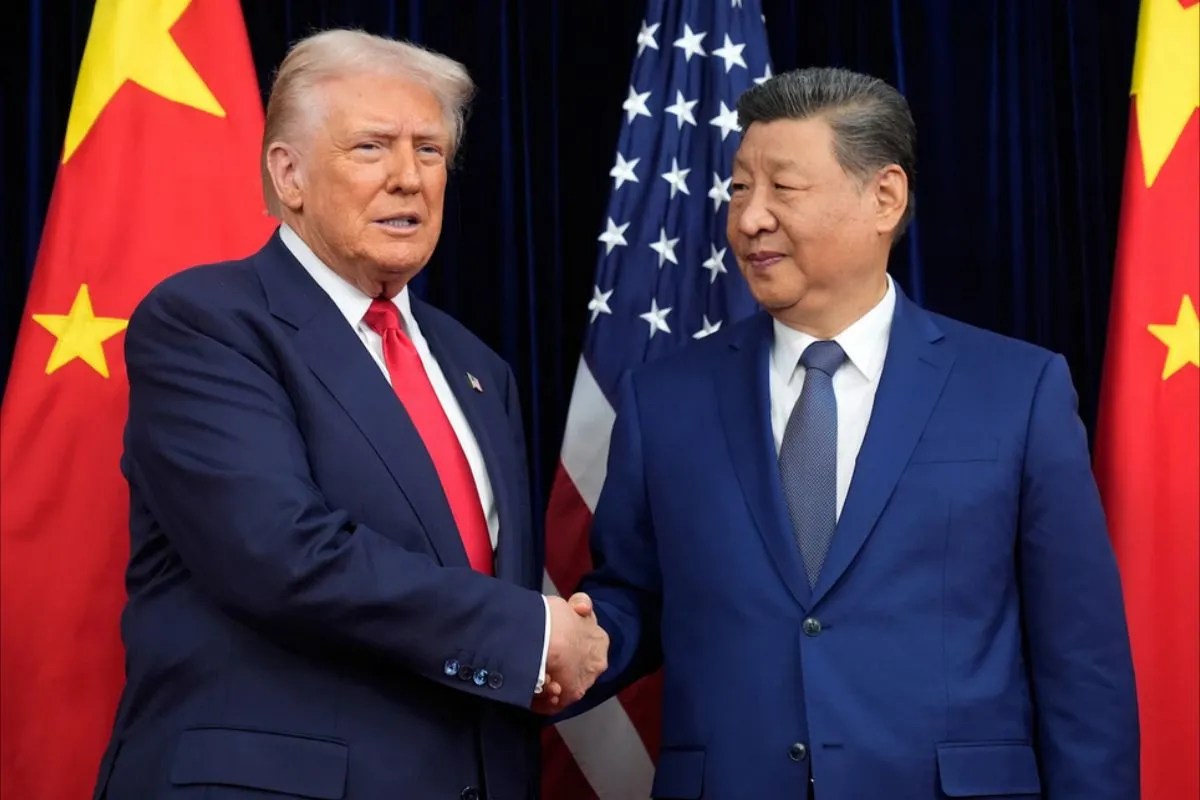
The recent assertion by the Trump administration regarding a Chinese commitment to halt arms transfers to Iran marks a shift in the global security architecture, moving from a paradigm of "unlimited partnership" to one of "conditional pragmatism." This development is not merely a diplomatic victory but a recalibration of the strategic cost-benefit analysis within the Beijing-Tehran-Washington triangle. Understanding this shift requires a deconstruction of the three structural drivers—economic leverage, technological containment, and regional stability—that dictate Chinese arms export policy.
The Tri-Lens Framework of Chinese Strategic Restraint
Beijing’s decision-making process regarding military exports to Iran does not operate in a vacuum of bilateral relations. Instead, it is governed by a three-tiered logic that balances immediate trade gains against long-term systemic risks.
1. The Asymmetry of Economic Interdependence
China’s trade volume with the United States and its allies (the G7) dwarfs its economic engagement with Iran by a factor exceeding 20-to-1. In a high-tariff environment or a regime of secondary sanctions, the cost of maintaining military-technical cooperation with Tehran becomes a liability. The primary constraint is the Secondary Sanction Sensitivity Ratio. For every dollar earned via defense contracts with the Iranian Revolutionary Guard Corps (IRGC), China risks losing thousands in Western market access or being frozen out of the SWIFT international payment system.
2. The Technological Containment Feedback Loop
The modern arms trade is increasingly defined by "dual-use" technologies—semiconductors, AI-driven guidance systems, and carbon fiber composites. China’s domestic semiconductor industry remains reliant on global supply chains that are heavily influenced by U.S. export controls. A continued flow of advanced weaponry to Iran invites a "Maximum Pressure" response on Chinese tech firms like Hikvision or DJI. By signaling a pause in arms transfers, Beijing buys "strategic breathing room" for its own technological indigenization programs.
3. The Energy Security and Regional Balance Equation
China is the world’s largest importer of crude oil, much of which flows through the Strait of Hormuz. While Iran is a key provider, the Gulf Cooperation Council (GCC) nations—specifically Saudi Arabia and the UAE—are equally vital. An Iran that is overly empowered by Chinese ballistic missile technology or advanced drone platforms risks destabilizing the Arabian Peninsula, potentially leading to a regional conflict that would spike oil prices and disrupt Chinese manufacturing.
Dissecting the Iranian Military-Industrial Reliance
To quantify the impact of a Chinese withdrawal, one must map the specific technical dependencies inherent in Iran’s defense posture. Iran does not simply buy "off-the-shelf" tanks; it integrates Chinese subsystems into indigenous platforms.
Guidance and Navigation Systems
The Iranian drone and missile programs are heavily dependent on satellite navigation and micro-electronics. While Iran has developed its own inertial navigation systems, the high-precision capabilities required for long-range strikes often utilize the BeiDou Navigation Satellite System or Chinese-made civilian GPS chips. A restriction on the sale of military-grade chipsets creates an immediate technical ceiling for Iranian precision-guided munitions (PGMs).
Surface-to-Air Missile (SAM) Architecture
The Iranian air defense network is a patchwork of domestic, Russian, and Chinese systems. The HQ-9 derivatives (such as the Bavar-373) rely on radar components and signal processing units where China holds a manufacturing edge. If the supply of replacement components or software upgrades is halted, the readiness rate of Iranian air defenses will degrade at a projected 15% annual rate due to electronic obsolescence.
The Mechanics of the "No-Arms" Commitment
The claim that China will not provide arms to Iran must be scrutinized through the lens of "The Gray Zone Transfer Problem." In international relations, the definition of an "arm" is often fluid.
- Type 1 Transfers (Lethal Aid): Fully assembled missiles, fighter jets (such as the long-rumored J-10C deal), and naval vessels. These are the most likely to be frozen under the Trump-Xi understanding because they are easily tracked by Western intelligence and constitute a clear violation of a stated diplomatic promise.
- Type 2 Transfers (Sub-systems): Engines for loitering munitions, guidance sensors, and specialized alloys. These are often categorized as civilian or dual-use items. This is where the commitment faces its greatest challenge.
- Type 3 Transfers (Knowledge and Licensing): The most difficult to monitor is the transfer of technical blueprints and the establishment of "turnkey" factories on Iranian soil. Once a factory is operational, the "sale" of arms ceases, replaced by the "maintenance of production lines."
Strategic Bottlenecks in the Trump-Xi Agreement
The sustainability of this agreement depends on the resolution of two specific bottlenecks that have historically plagued U.S.-China-Iran relations.
The Verification Gap
Unlike nuclear agreements, arms transfer commitments lack a formal international verification body like the IAEA. The U.S. relies on SIGINT (Signals Intelligence) and IMINT (Imagery Intelligence) to monitor Chinese ports and Iranian airfields. This creates a friction point where China may claim a private company acted without state approval—a "plausible deniability" tactic used frequently in the past.
The Russian Variable
If China retreats from the Iranian arms market, it creates a vacuum. Russia, currently under extreme sanctions and seeking its own military support from Tehran, has every incentive to fill this void. This creates a Competitive Substitution Risk. If Russia provides the Su-35 fighter jets that China refuses to sell, the net security threat to U.S. interests in the Middle East remains unchanged, while China loses its leverage over Tehran.
Quantifying the Geopolitical Arbitrage
Beijing is currently engaging in "Geopolitical Arbitrage"—trading a secondary strategic interest (the Iranian arms market) for a primary strategic gain (stability in the trade relationship with the U.S.).
The value of this arbitrage is calculated as follows:
$$V_{arb} = (G_{trade} - C_{tariff}) - (P_{mil} + L_{leverage})$$
Where:
- $V_{arb}$ is the total value of the diplomatic maneuver.
- $G_{trade}$ is the potential gain from normalized or stabilized trade with the U.S.
- $C_{tariff}$ is the cost of potential punitive tariffs if the deal is violated.
- $P_{mil}$ is the profit lost from military sales to Iran.
- $L_{leverage}$ is the loss of political influence over the Iranian regime.
For China, as long as $(G_{trade} - C_{tariff})$ remains a significantly positive number, the incentive to honor the "no-arms" pledge remains high. However, if the U.S. continues to escalate trade restrictions regardless of Chinese cooperation on Iran, the $C_{tariff}$ becomes a sunk cost, and Beijing will likely resume transfers to regain $L_{leverage}$.
The Operational Reality of Iranian Procurement
Iranian procurement officials are not passive observers of this shift. Historically, Tehran has responded to such restrictions by diversifying its front-company networks. These networks operate in jurisdictions with weak export controls, often moving components through third-party hubs in Southeast Asia or East Africa.
The efficacy of the Trump-Xi agreement will be measured by the closure of these "backdoor" channels. If the agreement only covers direct state-to-state transfers (Type 1), its impact on the ground in the Middle East will be negligible. To be transformative, the agreement must include a protocol for sharing intelligence on dual-use illicit procurement networks.
Strategic Forecast
The immediate result of this commitment will be the indefinite suspension of high-profile Iranian acquisitions, specifically modern fighter aircraft and advanced destroyer-class vessels. Iran will be forced to double down on its "Asymmetric Saturation" strategy—the mass production of low-cost drones and ballistic missiles using increasingly obsolete or smuggled components.
The long-term play for the U.S. is to ensure that the cost of violating this agreement is higher than the benefit of the Iranian alliance. This requires a "Carrot and Stick" synchronization: providing China with predictable trade parameters in exchange for a documented cessation of military-technical support to Tehran.
For Iran, this marks a period of "Strategic Loneliness." Without a guarantee of Chinese high-tech hardware, the Iranian defense establishment must pivot toward a purely indigenous, albeit technologically inferior, production model. This creates a window of tactical superiority for Western-aligned forces in the region, provided they can adapt to the "quantity over quality" threat posed by a cornered Iranian military industry.
The focus now shifts to the enforcement of dual-use export categories. The administration’s next move must be the establishment of a "Technical Monitoring Group" that tracks the flow of specific sub-components—specifically carbon fiber and high-end FPGAs—to ensure the "no-arms" claim translates into a measurable reduction in Iranian strike capabilities. Failure to monitor the sub-component level will render the high-level diplomatic commitment a cosmetic exercise.