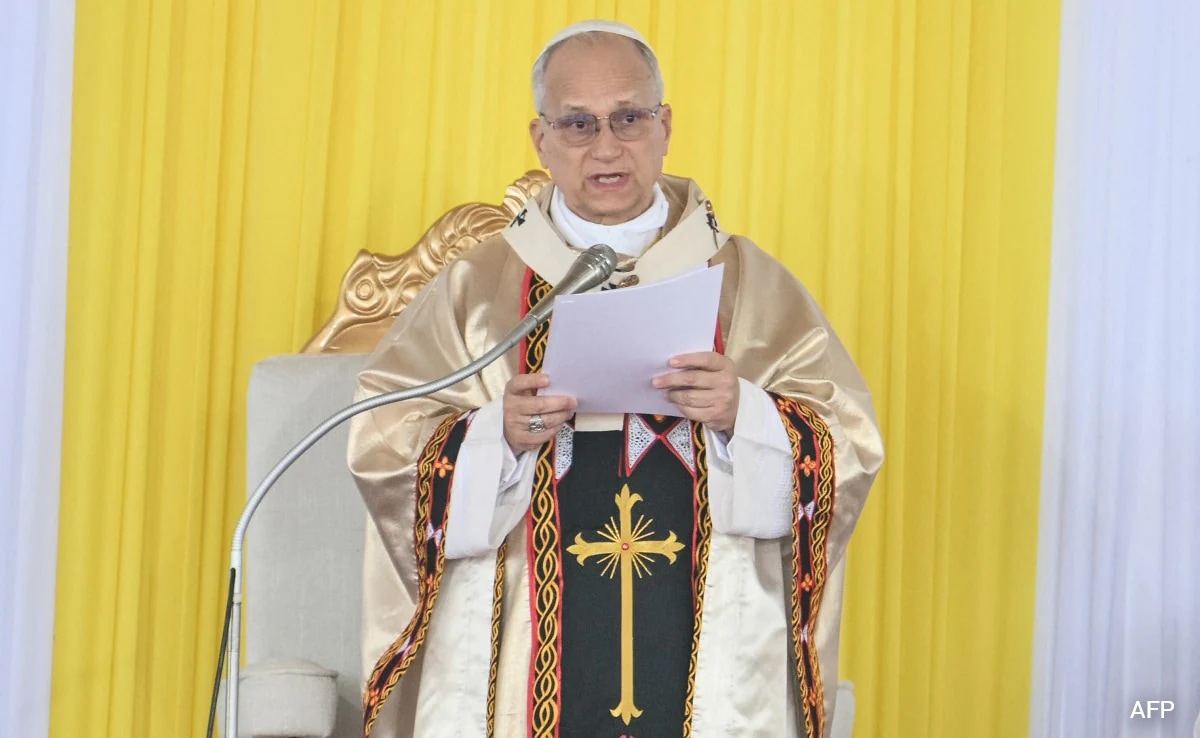
The convergence of the Holy See’s diplomatic mission in Sub-Saharan Africa and the persistent friction with the United States administration represents more than a collision of personalities; it is a structural conflict between two competing models of global influence: supranational moralism and nationalist realism. When the Pope addresses "tyranny" from a platform in Cameroon, he is not merely delivering a sermon. He is deploying soft power to fill a perceived vacuum left by Western isolationism. This friction points to a fundamental shift in how global leadership is brokered in the Global South, where the currency of influence is shifting from military-economic alignment to ethical-humanitarian legitimacy.
The Dual-Axe Framework of Papal Diplomacy
To understand the friction between the Vatican and the Trump-era "America First" doctrine, one must analyze the two primary axes upon which the Holy See operates: the Socio-Economic Axis and the Institutional-Moral Axis.
The Socio-Economic Axis: Distributism vs. Protectionism
The Vatican operates on a platform of Integral Human Development. This framework posits that economic growth is invalid if it ignores the periphery. Conversely, the nationalist realism of the Trump administration prioritizes the National Interest Function, where the primary metric of success is the protection of domestic capital and labor markets.
The conflict arises because these two functions are mathematically incompatible at the margins. The Pope’s critique of "tyrants" often extends to "economic tyrannies"—systems where global capital flows ignore local human costs. In Cameroon, a nation grappling with the "Anglophone Crisis" and long-term presidential incumbency, this rhetoric serves as a direct challenge to the "stability-first" approach often favored by realists who prefer dealing with strongmen to ensure regional security.
The Institutional-Moral Axis: Multilateralism vs. Sovereignty
The Holy See is the world’s oldest continuous diplomatic entity. Its survival depends on multilateralism. The Vatican views international treaties—on climate, migration, and nuclear non-proliferation—as the "infrastructure of peace." The Trump administration’s systematic withdrawal from such frameworks (e.g., the Paris Agreement, the JCPOA) dismantled the very tools the Vatican uses to exert influence. This is not a spat over tweets; it is a systemic rejection of the Vatican’s preferred operating environment.
The Cameroon Variable: A Case Study in Power Vacuums
Cameroon serves as a high-stakes laboratory for this ideological tug-of-war. The country’s internal strife—partitioned by colonial linguistic legacies and threatened by Boko Haram—creates a demand for a "Third-Way" mediator.
The Security-Legitimacy Trade-off
Traditional Western powers face a "Security-Legitimacy Trade-off." If they support President Paul Biya’s administration, they secure a partner against regional terrorism but lose moral standing due to the administration's human rights record. If they withdraw support, they risk a failed state.
The Vatican bypasses this trade-off by operating through the Ecclesiastical Infrastructure. With a network of schools, hospitals, and parishes that penetrate deeper into rural Cameroon than the state itself, the Church maintains a "Ground-Truth Advantage." When the Pope speaks of tyranny in this context, he is leveraging this local data to challenge the high-level diplomatic silence maintained by Washington and Paris.
The Cost of Neutrality in the Anglophone Crisis
The crisis in Cameroon’s Northwest and Southwest regions creates a specific bottleneck for international diplomacy. The "America First" doctrine generally views such conflicts through the lens of Resource Allocation Efficiency: unless there is a direct threat to U.S. interests, intervention is a net loss.
The Vatican’s logic is based on Human Capital Preservation. It views the displacement of thousands and the shuttering of schools as a long-term degradation of the region's "moral and social capital." By vocalizing these concerns during a period of U.S. retreat, the Pope effectively rebrands the Holy See as the primary advocate for the marginalized, thereby increasing its diplomatic leverage with the African Union and the UN.
Quantifying the Spat: Mechanics of the Vatican-Trump Friction
The tension is often dismissed as a clash of styles, but the friction is generated by three specific mechanical disconnects:
- The Migration Flow Function: The Vatican views migration as a demographic necessity and a moral imperative. The Trump administration views it as a security threat and a fiscal drain. These two perspectives cannot be reconciled through negotiation because their foundational axioms are different.
- The Environmental Externality Problem: The Pope’s encyclical, Laudato si’, treats environmental degradation as a "sin" (a non-negotiable moral failure). The Trump administration treats environmental regulations as "deadweight loss" to the GDP.
- The Definition of "Tyranny": For the Trump administration, a tyrant is a leader who opposes U.S. interests (e.g., Maduro in Venezuela). For the Vatican, a tyrant is any leader who suppresses the "common good," regardless of their geopolitical alignment. This leads to the Vatican criticizing leaders that the U.S. might otherwise tolerate for strategic reasons.
The Strategic Shift to the Global South
The Pope’s presence in Africa signifies a pivot in the Church’s "Market Share Strategy." As Catholicism wanes in Europe and faces secularization in North America, the Demographic Center of Gravity is shifting toward Africa and Latin America.
The Competitive Advantage of the Papacy
In the "Market for Influence," the Vatican possesses a unique competitive advantage: Longevity. While U.S. administrations change every four to eight years, the Holy See operates on a centurial timeline. This allows the Pope to take "unpopular" positions that may cause short-term friction with a specific president, knowing that the moral branding of the Church will outlast the political tenure of any individual leader.
The "Moral Arbitrage" Strategy
The Vatican is currently engaging in "Moral Arbitrage." It identifies areas where Western superpowers have abandoned their traditional roles as "defenders of values" and steps into that role. By criticizing tyrants in Africa while simultaneously clashing with the leader of the free world, the Pope establishes a "Non-Aligned" moral identity. This appeals to nations that are wary of both American hegemony and Chinese economic expansionism.
Structural Risks to the Vatican’s Position
This strategy is not without significant risk. The Holy See faces internal and external pressures that could undermine its attempt to outmaneuver secular superpowers.
- Internal Fragmentation: The ideological divide within the Church—specifically between the conservative American prelates and the more progressive Roman curia—mirrors the Vatican-Trump spat. If the Pope loses his "Internal Mandate," his international pronouncements lose their weight.
- Economic Dependency: The Vatican’s charitable and operational arms rely heavily on donations from the very Western nations the Pope is criticizing. A sustained "Financial De-risking" by wealthy conservative donors in the U.S. could create a liquidity crisis for the Holy See’s global missions.
- The Rise of Pentecostalism: In Africa, the Catholic Church is facing intense competition from Pentecostal movements which often align more closely with "Prosperity Gospel" or nationalist ideologies. If the Catholic Church becomes too associated with "Globalist" rhetoric, it risks losing market share to localized, more nationalistic religious movements.
The Evolution of the Conflict
The friction between the Pope and the Trump administration should be viewed as a precursor to a post-secular world. As the 20th-century liberal order fractures, the primary struggle is no longer between Democracy and Communism, but between Fragmented Sovereignty and Universalist Ethics.
The "Tyrant" rhetoric in Cameroon is a signal. It indicates that the Vatican is no longer content to be a silent partner in the Western alliance. Instead, it is positioning itself as an independent pole in a multipolar world. This requires a sophisticated reading of "Tyranny" that includes both the African autocrat and the Western populist.
The Tactical Response for Global Observers
Observers must stop analyzing these interactions through the lens of "personality politics." To accurately forecast the direction of this conflict, one must monitor three key indicators:
- Vatican Appointments in the U.S.: The degree to which the Pope replaces conservative American bishops with "Bergoglian" loyalists will determine his ability to sustain the fight with nationalist movements.
- China-Vatican Relations: Any rapprochement between Rome and Beijing is a direct signal of the Vatican's willingness to diversify its diplomatic portfolio away from the U.S. orbit.
- The African Synod Outcomes: The specific policy recommendations coming out of African Catholic leadership will indicate how the "Tyranny" rhetoric is being translated into local political action.
The strategic play here is not to wait for a "truce" between the Pope and the White House. The friction is the point. For the Vatican, the conflict validates its role as an independent moral arbiter. For the Trumpian nationalist, the conflict validates their stance against "globalist" interference. Both sides gain "Brand Clarity" from the spat, even as the global order becomes more volatile. The real losers in this exchange are the traditional diplomatic institutions that rely on consensus, which is currently the world's most scarce commodity.