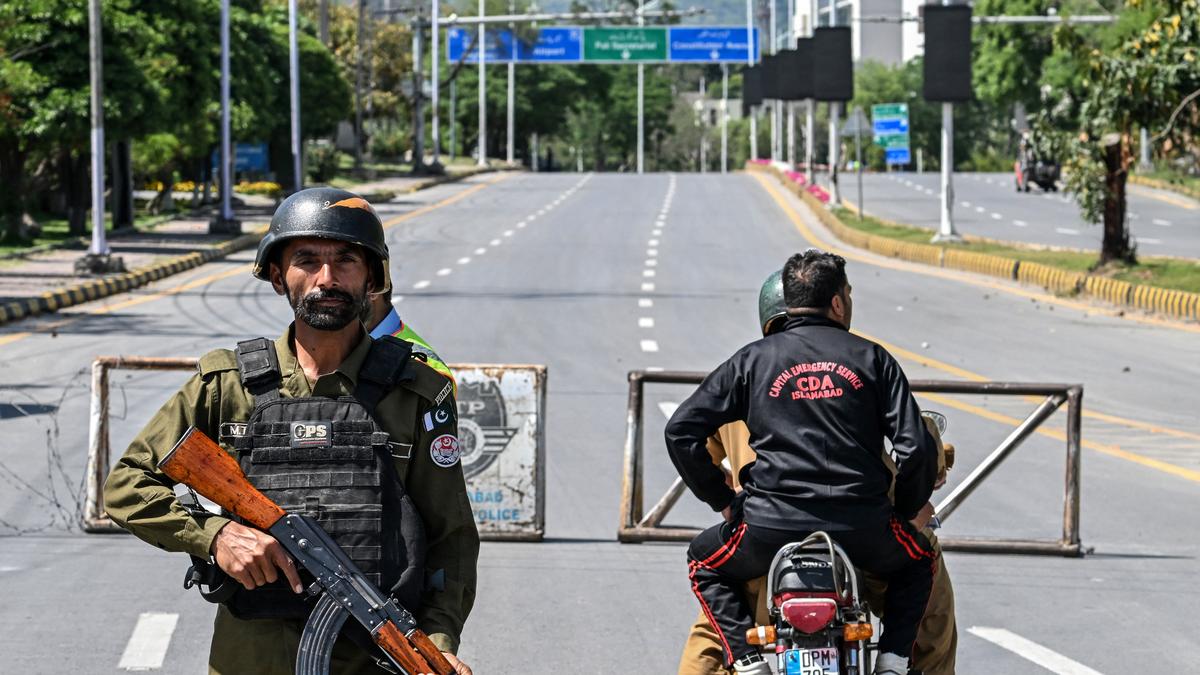
The decision by Pakistani authorities to implement a high-readiness security posture in Islamabad ahead of U.S.-Iranian diplomatic engagement is not a reactive measure of crowd control, but a calculated mitigation of the Geopolitical Friction Coefficient. When two adversarial powers engage in a third-party territory or within its immediate proximity, the host nation faces a spike in "sovereignty risk"—the probability that external tensions will manifest as domestic instability. Pakistan’s strategy functions as a structural insulation layer designed to protect the state’s internal equilibrium while maintaining its utility as a regional intermediary.
The Tri-Sector Security Framework
The intensification of security in the capital follows a modular logic. Rather than a blanket deployment, the state utilizes three distinct layers of operational control to manage the physical and political environment.
- The Diplomatic Exclusion Zone: This layer targets the "Red Zone" and sensitive international missions. The objective is the total elimination of kinetic threats (bombings, assassinations) that would result in an irreparable loss of diplomatic credibility.
- The Information Vacuum: By restricting movements and potentially monitoring communication nodes, the state limits the ability of non-state actors to coordinate counter-narratives or protests that could derail the sensitive optics of U.S.-Iran discussions.
- The Civil-Military Interface: The deployment of both police and paramilitary forces (Rangers) creates a tiered response capability. Police handle the soft interface of traffic and civilian management, while paramilitary units provide the hard-deterrence necessary to prevent organized extremist cells from exploiting the diplomatic window.
The logic here is a Risk-Reward Asymmetry. The cost of over-securing is marginal—temporary economic disruption and public inconvenience—while the cost of a security breach during high-profile talks is existential for Pakistan’s foreign policy ambitions.
Quantifying the Strategic Dilemma
Pakistan’s position in the U.S.-Iran dynamic is defined by a permanent state of Bilateral Dependency. To the West, it shares a porous 900-kilometer border with Iran, involving complex energy interests and cross-border militancy concerns (specifically in the Balochistan region). To the far West and across the oceans, it remains tethered to the United States via financial dependencies, including IMF structural adjustment programs and military-to-military cooperation.
The "Security Tightening" serves as a physical manifestation of neutrality. By suppressing any domestic pro-Iran or anti-U.S. sentiment (and vice-versa) through force, the Pakistani state prevents the "importation" of the conflict. This is essential because the Pakistani demographic is not a monolith; it contains significant sectarian and ideological factions that view the U.S.-Iran relationship through a zero-sum lens.
The Border-Capital Feedback Loop
A security failure in Islamabad during these talks would likely trigger a reciprocal escalation on the Afghan or Iranian borders. Non-state actors often utilize "spectacle violence" in the capital to force a shift in border policy. Thus, the barricades in Islamabad are effectively the front line of border management. If the center holds, the periphery remains manageable. If the center is breached, the border becomes a porous liability.
Operational Mechanics of the Lockdown
The specific tactics employed—Section 144 impositions (banning gatherings), the erection of shipping container barriers, and facial recognition surveillance—are components of Urban Compartmentalization.
This strategy breaks the city into discrete, manageable cells. In the event of a localized breach, the cell can be isolated without the contagion spreading to the rest of the administrative apparatus. This is a shift from traditional "line defense" (protecting a perimeter) to "network defense" (protecting the nodes and links of the city’s infrastructure).
- Logistical Chokepoints: The entry points from Rawalpindi and the motorway are the primary focus. Controlling these prevents the "Mass Inflow Variable"—the arrival of thousands of protesters from surrounding provinces who could overwhelm the capital’s resident police force.
- Technological Force Multipliers: The use of the Safe City Project’s camera network allows for a reduction in "Man-to-Citizen" ratios. By leveraging high-definition surveillance, the state can keep its heavy infantry in reserve, deploying them only when a specific threshold of threat is detected.
The Economic Shadow Price
The tightening of security is not cost-neutral. The Economic Friction of Securitization in Islamabad can be measured through three primary metrics:
- Trade Velocity: The physical blockage of roads slows the movement of goods between the industrial hubs of the Punjab and the administrative center, leading to a temporary contraction in local GDP.
- Human Capital Downtime: Forced holidays or telecommuting mandates for government employees and private contractors result in a "deadweight loss" of productivity.
- Foreign Investment Perception: While the security measures protect the immediate talks, the visual of a capital under siege reinforces a "High-Risk Jurisdiction" narrative, which increases the risk premium demanded by international investors.
Despite these costs, the Pakistani state views them as a necessary insurance premium. In the hierarchy of national priorities, the preservation of the "State-as-a-Platform" for international mediation outweighs the transient economic losses of a week-long lockdown.
Structural Vulnerabilities in the Current Model
The primary weakness in Pakistan’s approach is its Linear Scalability. The current security model relies heavily on physical presence and crude blockades. This creates a "diminishing return" effect: the more the state secures the capital, the more it alienates the local populace, potentially creating the very unrest it seeks to prevent.
Furthermore, this model does not account for Hybrid Interference. While the streets are locked down, the digital space remains a theater for disinformation. Foreign intelligence agencies or domestic dissidents can use social media to bypass physical barricades, inciting "flash protests" that the rigid, container-based security system is ill-equipped to handle.
Strategic Recommendation for Regional Stability
The Pakistani administration must pivot from a Reactive Containment posture to a Predictive Governance model. The following structural shifts are required to manage future diplomatic summits of this magnitude:
- Dedicated Diplomatic Enclaves: Transitioning from a city-wide lockdown to a self-contained, high-security diplomatic hub outside the urban core of Islamabad. This would decouple international high-stakes meetings from the daily life of the capital, reducing the economic friction of security.
- Cyber-Physical Integration: Integrating real-time social media sentiment analysis with physical troop deployments. This allows for "Precision Policing" rather than the blunt instrument of city-wide Section 144 orders.
- The Buffer State Doctrine: Pakistan should formalize its role as a "Neutral Regulatory Zone." By establishing clear, pre-negotiated protocols for security during foreign talks, the state can signal to both the U.S. and Iran that the environment is controlled and predictable, reducing the need for emergency, ad-hoc lockdowns.
The immediate security tightening in Islamabad is a successful short-term tactic but a failing long-term strategy. To sustain its role as a regional hinge-point, Pakistan must evolve its security apparatus to be invisible yet omnipresent, ensuring that the friction of diplomacy does not lead to the combustion of the state.