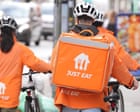
The myth of the "independent contractor" in the food delivery sector is facing its most significant threat to date. Thousands of couriers are currently mounting a legal challenge against Just Eat, claiming they are effectively employees and deserve the basic protections that come with that status. This isn't just a dispute over small change or holiday pay. It is a fundamental assault on a business model that relies on offloading every ounce of operational risk onto the individual worker. If the courts side with the couriers, the entire financial structure of the delivery industry could collapse under the weight of backdated wages and pension contributions.
For years, Just Eat and its rivals have operated under a convenient fiction. They claim to be nothing more than a software bridge connecting hungry customers with local restaurants. In this narrative, the person on the bike is an autonomous entrepreneur, free to work whenever they want. The reality on the street is far more restrictive. Algorithms dictate where you go, how fast you get there, and which jobs you are allowed to take. When a platform controls the price, the timing, and the performance standards, the word "independent" starts to sound like a legal loophole rather than a professional reality.
The Algorithmic Boss
Traditional management involves a human being making decisions based on nuance and performance. In the gig economy, the boss is a line of code. This shift has allowed companies like Just Eat to scale at a rate that would have been impossible thirty years ago, but it has also stripped away the traditional safety nets of the labor market. Couriers aren't just fighting for a minimum wage; they are fighting against the opacity of the software that governs their lives.
When a courier logs into the app, they enter a digital marketplace where the rules can change without warning. The legal claim argues that because Just Eat exercises significant control over how work is performed, the relationship is one of employment. It is a distinction that matters. An employee gets sick pay, protection against unfair dismissal, and a guaranteed hourly rate. A contractor gets the bill for their own insurance, the cost of bike maintenance, and the risk of earning nothing during a slow shift.
The financial pressure on these workers has reached a breaking point. Inflation has driven up the cost of living while the "per drop" rates offered by delivery platforms have remained stagnant or, in some cases, decreased in real terms. By misclassifying these individuals, the industry has effectively externalized its labor costs. Every minute a courier spends waiting for an order at a street corner is a minute the company doesn't have to pay for, despite the worker being "at work" in every practical sense.
Why the Self-Employment Label is Crumbling
The courts have already started to look past the dense contracts written by corporate lawyers. In similar cases involving Uber, judges have noted that the "freedom" promised to gig workers is often illusory. If you have to maintain a certain acceptance rate to stay on the platform, you aren't really free to turn down work. If you cannot set your own prices, you aren't running your own business.
The Dependency Trap
Most couriers aren't "side-hustling" for extra beer money. For the thousands joining this legal action, delivery is their primary or sole source of income. This creates a power imbalance that the current legal framework wasn't designed to handle. When a worker is dependent on a single app for their livelihood, the platform has all the leverage. They can "de-activate" a worker—a sanitized term for firing them—with the press of a button and no right to appeal.
This lack of job security is the hidden engine of the delivery industry. It keeps workers compliant and prevents them from organizing. However, the sheer volume of couriers now joining the lawsuit suggests that the fear of being blocked is finally being outweighed by the desperation for a fair deal. Leigh Day, the law firm representing the claimants, is betting that the precedent set by the Uber ruling will apply here. If Just Eat loses, the bill could run into the hundreds of millions.
The Hidden Costs of Cheap Delivery
We have become addicted to the convenience of five-pound delivery. We want our food hot, fast, and cheap. But that price point is only possible because the companies aren't paying for the overhead of a workforce. They don't pay employer National Insurance. They don't contribute to pensions. They don't provide a vehicle.
If the courts force Just Eat to reclassify its couriers, those costs will have to go somewhere. The most likely destination is the consumer's wallet. We are looking at a future where a burger delivery costs double what it does now. Alternatively, the companies will have to accept lower profit margins—a tough sell for shareholders who have been promised infinite growth through "disruption."
The business model was built on the assumption that labor laws would never catch up to the technology. For a decade, that assumption held. The tech moved fast, and the regulators moved slow. But the gap is closing. Across Europe and the UK, the tide is turning toward worker protection. The "California model" of gig work is being rejected by judges who see it as a regression to nineteenth-century piecework.
The Counter-Argument from the Boardroom
Just Eat will argue that their workers value the flexibility above all else. They will produce surveys showing that couriers enjoy being their own boss. They will claim that a forced move to employment status will result in fewer jobs and less choice for the workers themselves. There is some truth to this. If you are an employee, you have a rota. You can't just decide to go home because it started raining.
However, this argument ignores the middle ground. The legal claim is seeking "worker" status, a specific UK legal category that provides some rights while maintaining some flexibility. It isn't a binary choice between being a traditional nine-to-five employee and being a totally unprotected contractor. The companies present it as a zero-sum game because it serves their narrative that regulation kills innovation.
The reality is that "innovation" should not be synonymous with "evading labor laws." If a company cannot survive while paying its workers a living wage and providing basic security, then that company does not have a viable business model. It has a subsidy model, where the workers and the state—which picks up the bill when these workers fall into poverty or ill health—are subsidizing the company's growth.
The Impact of the Multi-App Reality
Many couriers work for Just Eat, Deliveroo, and Uber Eats simultaneously. They have three phones mounted to their handlebars, chasing whichever algorithm offers the best "boost" at that specific moment. This complicates the legal argument for employment with a single firm, but it also highlights the volatility of the industry. These workers are constantly playing a high-stakes game of digital arbitrage just to make ends meet.
If Just Eat is forced to change, the ripple effects will hit every other platform. We are witnessing the beginning of the end for the unregulated gig economy. The legal action isn't just about back-pay; it is a referendum on what we consider a "job" in the twenty-first century.
The Math of Misery
Consider the expenses of a typical moped courier. Fuel, high-performance insurance, maintenance, and the depreciation of the vehicle can eat up 30% or more of their gross earnings. When you subtract these costs from a "gig" that pays slightly above minimum wage on paper, the effective hourly rate often falls well below the legal floor.
Key Financial Pressures:
- Commercial Insurance: Specialist "pay-as-you-go" insurance is expensive and mandatory.
- Waiting Time: Couriers are often unpaid while waiting for restaurants to prepare food.
- Vehicle Risk: Accidents result in an immediate loss of income with no sick pay.
The legal challenge seeks to account for these "hidden" costs. By demanding worker status, the couriers are asking for their work time to be measured from the moment they log in to the moment they log out, not just the minutes they are carrying a bag of food. This is the existential threat to Just Eat. Paying for the "down time" would fundamentally change the economics of the platform.
Beyond the Courtroom
The outcome of this case will define the next decade of the UK labor market. If the couriers win, it will signal to the entire tech sector that the era of the "free lunch" is over. You cannot build a billion-dollar empire on the backs of people you refuse to acknowledge as your staff. The technology might be new, but the exploitation is old.
For the couriers, this is a fight for dignity. It is about being seen as a human being rather than a data point in a routing algorithm. They are the ones navigating traffic in the rain, climbing stairs, and dealing with aggressive customers, while the executives in the city offices talk about "optimization" and "efficiency."
The legal system is finally being forced to answer a simple question. If it looks like a job, acts like a job, and pays like a job, why isn't it a job? The answer Just Eat provides in court will determine whether the gig economy survives in its current form or is forced to finally grow up and pay its way.
The era of ignoring the human cost of the "Order" button is coming to an abrupt and expensive end.