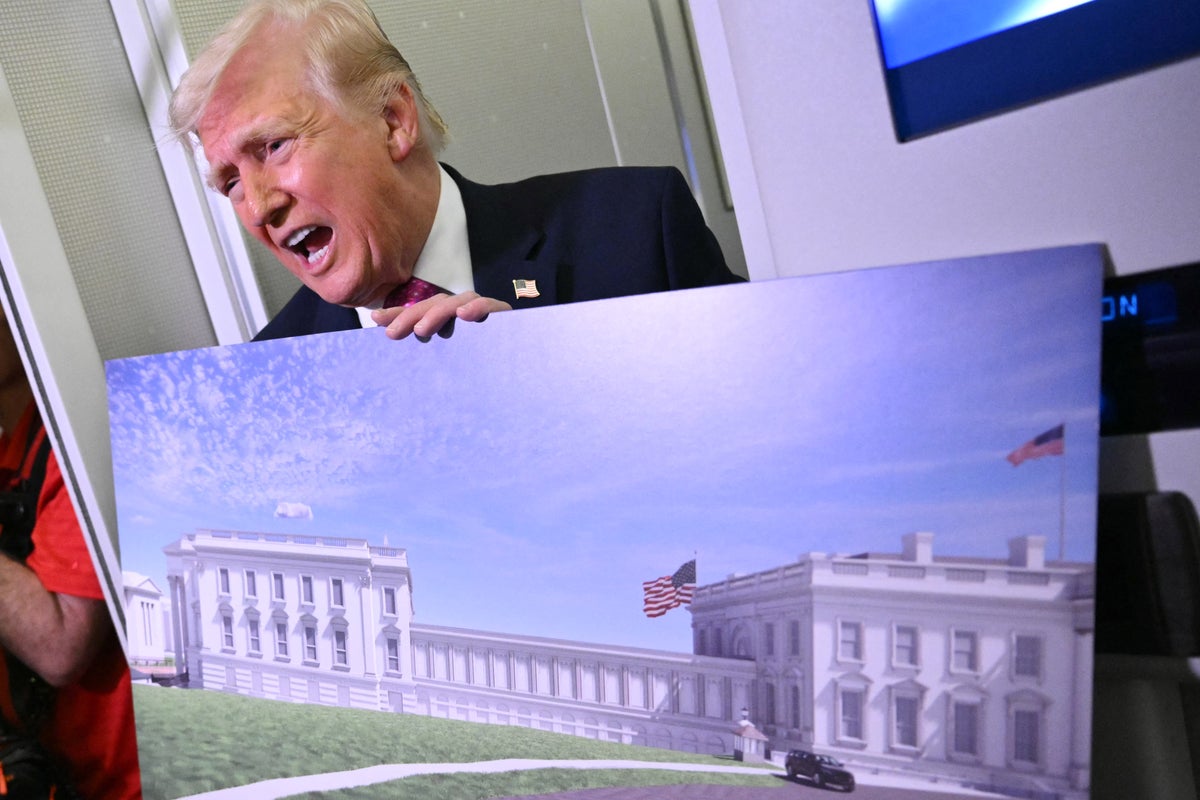
The blueprints for a dream usually arrive with a specific price tag. When Donald Trump stood before the cameras to discuss the renovation of his prized property, he didn't speak in the cautious, muffled tones of a career bureaucrat. He spoke with the cadence of a man who knows the exact weight of a marble slab and the refractive index of a crystal chandelier. He put a number on the table: $400 million. It was a staggering sum, intended to evoke images of unparalleled luxury, a ballroom that would dwarf its peers in both opulence and ego.
But while the public was busy squinting at the glitter of that $400 million price tag, something strange was happening in the windowless rooms of Capitol Hill.
Numbers in Washington D.C. often behave like shadows; they stretch and morph depending on where the light is coming from. While the former president was anchoring the public’s imagination to his multimillion-dollar ballroom, Republican lawmakers were quietly sliding an extra $1 billion into a spending bill for a project that, on the surface, seemed to mirror the very thing Trump was boasting about. It is a story of two different worlds using the same vocabulary but playing for entirely different stakes.
Consider the perspective of a small-business owner in a town like Janesville or Erie. To them, $400 million is an abstraction, a figure so large it ceases to be money and becomes a myth. A billion dollars is even more removed from reality. It is the kind of money that could fix every pothole, fund every school lunch, and revitalize every main street in a dozen counties. When these people hear their representatives arguing over "spending floors" and "discretionary allocations," they aren't hearing policy. They are hearing the sound of their own tax dollars being vacuumed into a sky-high vault they will never see.
The tension here isn't just about the math. It is about the optics of excess versus the reality of governance.
Trump’s $400 million ballroom is a private endeavor, or at least phrased as one in the context of his brand’s prestige. It represents the pinnacle of private sector indulgence. Yet, when the Republican party—the traditional bastion of "fiscal responsibility" and "small government"—decides to tack on an additional billion dollars to a legislative package, the narrative of the penny-pinching conservative begins to fracture. The question isn't just why it costs so much. The question is why the party is suddenly comfortable with a surplus of spending that contradicts decades of their own rhetoric.
The Anatomy of a Price Gap
To understand the billion-dollar discrepancy, you have to look at the machinery of the federal budget. It is a beast made of paper and ink, fueled by compromise and lubricated by backroom deals. When a bill is drafted, it starts as a lean skeleton. By the time it reaches the floor, it has usually put on a massive amount of weight.
In this instance, the "extra" billion dollars isn't just a rounding error. It represents a pivot. Critics argue that the funds are being diverted to projects that serve as political trophies rather than public necessities. If the leader of the party claims a world-class, gold-leafed ballroom can be built for $400 million, how does a government entity justify spending more than double that on a project of similar scope?
Efficiency is the ghost that haunts these halls.
In the private sector, if a developer overshoots a budget by $600 million, they are ruined. They lose the building, the brand, and the trust of the banks. In the public sector, that same $600 million gap is often treated as a necessary adjustment. It is "unforeseen costs." It is "inflationary pressure." It is a series of polite excuses that mask a fundamental lack of accountability.
The Human Cost of the Invisible Billion
Let’s step away from the marble floors and the committee rooms for a moment. Think about a family sitting at a kitchen table, trying to decide if they can afford the higher premium on their health insurance this month. To them, the difference between $400 million and $1.4 billion is not a political debate. It is a betrayal.
They see a billionaire bragging about luxury while the people they elected to protect their interests are signing off on massive spending increases without blinking. It creates a sense of profound vertigo. If the "business guy" says it costs $X, and the "government guys" say it costs $X plus a billion, the average citizen is left wondering who is lying and who is simply incompetent. Often, the answer is both.
The invisible stakes are found in the programs that don't get that billion dollars.
Money is finite, even if the Treasury's printing presses suggest otherwise. Every dollar that is swallowed by a bloated construction project or a legislative "add-on" is a dollar that isn't going toward rural broadband, veteran services, or border security. The billion dollars added by the GOP isn't just "extra" money; it is a redirection of the nation’s lifeblood.
The Language of the Deal
The disconnect also highlights a fascinating shift in the Republican identity. For years, the party’s primary weapon was the veto and the budget cut. They were the ones who stood at the gates and demanded that the government live within its means. But the influence of Trump’s brand of politics has introduced a new element: the grand gesture.
Trump treats every project as the "biggest," the "best," and the "most expensive." He has turned spending into a marker of status. This has put his colleagues in a difficult position. They want to align themselves with his image of strength and success, but they also have to manage the mundane, messy reality of a federal budget that is already trillions of dollars in the red.
When the GOP adds a billion dollars to a bill, they are attempting to buy their way out of a problem. They are trying to fund enough local projects to keep their caucus together, effectively using the public's money to grease the wheels of their own political survival. It is a far cry from the tea-party era of "not one cent more."
The Illusion of Transparency
Transparency in Washington is often like a stage magician’s trick. The performer points to one hand—the $400 million ballroom—to make sure you don't look at what the other hand is doing. The ballroom is a perfect distraction. It is shiny, it is controversial, and it is easy to talk about on cable news. It fits into a neat "rich man does rich things" narrative.
The billion dollars in the spending bill is different. It is buried in hundreds of pages of legalese. It is hidden under line items with names like "General Administrative Oversight" or "Specialized Infrastructure Grants." It is designed to be boring so that no one looks at it too closely.
But the math remains.
If we accept the premise that a high-end, secure, and massive facility can be constructed for $400 million, then the government’s demand for $1.4 billion for an equivalent project is an admission of failure. It is an admission that the bureaucracy is so thick and the waste so ingrained that it costs a billion-dollar premium just to get the doors open.
The Final Account
As the sun sets over the Potomac, the lights flick on in the offices of the lobbyists and the lawmakers. They are still there, moving numbers around like chess pieces. They aren't thinking about the ballroom, and they certainly aren't thinking about the kitchen table in Erie. They are thinking about the next cycle, the next vote, and how to keep the machine running.
The billion-dollar shadow continues to grow, stretching across the country, fueled by a collective shrug of the shoulders from those in power. We are told that this is just how things work. We are told that we shouldn't worry about the math because we wouldn't understand it anyway.
But the people understand more than they are given credit for. They understand that when a man tells you a ballroom costs $400 million, and his friends ask for a billion more, the only thing being built is a monument to the public's vanishing trust.
The gold on the ceiling of that ballroom might be real, but the debt used to pay for the shadow behind it is even more permanent. It is a weight that doesn't just sit on the shoulders of the present; it is a mortgage on the future of every person who still believes that a billion dollars should mean something more than a political footnote.
The crystals in the chandelier may sparkle, but they cannot illuminate the dark corners of a budget that has lost its way.
The bill is coming due. And as always, the people who weren't invited to the party are the ones who will have to pay for the cleanup.