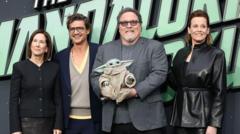
Pedro Pascal is a company man. When he stands on a press junket stage and claims a three-foot puppet is the "real star" of the upcoming The Mandalorian & Grogu film, he isn't offering a creative insight. He is performing a corporate ritual. He is signaling to the Disney shareholders that the golden goose—the one that fits perfectly into a plush toy mold—is still laying eggs.
But let’s get one thing straight: Grogu is not a character. He is an aesthetic. He is a high-yield savings account dressed in burlap. To call him the "star" of a feature-length film isn't just a slight to the actors; it’s a confession that the franchise has officially run out of things to say.
The Puppet Trap
The lazy consensus in film journalism suggests that the "Child" saved Star Wars. They point to the 2019 cultural explosion as proof that the brand is healthy. This is a fundamental misunderstanding of the difference between a mascot and a protagonist.
A star carries a narrative. A star undergoes an arc that challenges the audience's worldview. Grogu does none of that. He exists to be rescued, to coo at the right frequency for social media clips, and to provide "forced" emotional stakes for Din Djarin. I have watched studios sink hundreds of millions into "cute-centric" properties, thinking they can coast on charm. It works for a season. It fails for a decade.
In The Mandalorian, the puppet worked because it was a mystery. In a feature film, that mystery has evaporated. We are left with a static object that cannot speak, cannot evolve, and cannot drive a plot without a human doing the heavy lifting. Pascal’s praise is a polite way of saying his job has been reduced to being the world’s most expensive babysitter.
The Merchandise Margin Fallacy
Industry insiders love to talk about "ancillary revenue." They see Grogu and see $1 billion in licensing. This is what we call the Merchandise Margin Fallacy. It’s the belief that because a character sells toys, the character is inherently valuable to the cinematic canon.
Actually, the opposite is often true. The more a character is optimized for the toy shelf, the more restricted the storytelling becomes.
- Safety first: You can't put Grogu in real moral peril because it hurts the brand's "comfort" appeal.
- Stagnant growth: You can't let him age or change significantly because the current "look" is what's trademarked.
- Screen time bloat: Scenes are written around his reactions rather than the plot's necessity.
When Pascal says Grogu is the star, he is admitting the film is a product first and a story second. This isn't cinema; it's a 110-minute commercial for a theme park expansion.
Why the Audience Is Asking the Wrong Question
People keep asking, "What will Grogu do next?" or "Will he become a Jedi?"
These are the wrong questions. The real question is: "Can Star Wars survive without a pacifier?"
By leaning on the "Baby Yoda" crutch, Lucasfilm is delaying the inevitable. They are terrified of an audience that might demand complex political intrigue or gritty, adult-oriented stakes—the kind of stakes that made Andor a critical masterpiece and a commercial "risk." Grogu is the "safe" choice. He is the path of least resistance.
If you want to understand the decline of the modern blockbuster, look no further than the "reaction shot." Watch any episode from the last season. Count how many times the camera cuts to the puppet for a "cute" noise during a moment of supposed tension. It’s a tension-breaker. It’s a narrative reset button. It tells the audience, "Don't worry, nothing bad will actually happen."
The Pascal Paradox
Pedro Pascal is currently one of the most sought-after actors on the planet. He has The Last of Us. He has Gladiator II. He has the Fantastic Four. He is a performer of immense range and "prestige" gravity.
So why is he being sidelined by a silicone doll?
It’s the Pascal Paradox: The more famous the actor, the less the studio wants to show their face. By keeping the helmet on and the puppet in the foreground, Disney decouples the brand from the human. They want a "Mandalorian" they can replace if contract negotiations go south. They want a "star" that doesn't age, doesn't demand a raise, and doesn't have an agent.
I’ve seen this play out in dozens of franchises. The "face" of the brand becomes an IP asset rather than a human being. When the actor starts praising the asset as the "true star," it’s usually because they’ve realized they are just a ghost in the machine.
The High Cost of Cute
There is a technical debt to building a film around a silent, puppet protagonist.
- Dialogue Imbalance: The supporting cast has to engage in constant exposition to explain what the puppet is "thinking."
- Choreography Limits: Action sequences are throttled because you have to protect the "asset" in the frame.
- Emotional Ceiling: There is only so much pathos you can squeeze out of a creature that has three facial expressions.
We are reaching the point of diminishing returns. The "Grogu Effect" is wearing thin. The data shows that while toy sales remain high, viewer engagement with the "Cute-sy" era of Star Wars is drifting. The novelty has been replaced by a formula.
Stop Pretending It’s Art
We need to stop treating these press statements as artistic manifestos. Pascal isn't talking about the craft of acting. He’s talking about the hierarchy of the Disney ecosystem.
If Grogu is the star, the movie is a sandbox. It’s a plaything. It lacks the teeth required to make Star Wars relevant to a new generation that is already tired of the same nostalgic tropes. You can only jingling the keys in front of the audience for so long before they realize there’s no door behind them.
The film won't fail because the puppet is bad. It will fail because the puppet is a shield. It’s a shield against risk, a shield against change, and a shield against actual creativity.
Pascal is right about one thing: Grogu is the star. And that is exactly why the movie is already in trouble.
Build a story around a soul, not a SKU. Until then, we’re just watching a very expensive retail activation.