For over three decades, the province of Guangdong has functioned as the engine room of the Chinese economic miracle. Since 1989, it has stood unchallenged at the top of the GDP rankings, a symbol of the reform and opening-up era. It was the place where the world’s assembly lines migrated, where Shenzhen morphed from a fishing village into a global technology hub, and where the sheer volume of export-led growth seemed inexhaustible. That dominance is now eroding.
The gap between Guangdong and its primary rival, Jiangsu, has narrowed to a margin that is statistically fragile. This is not merely a transient fluctuation in quarterly data. It is the result of deep structural changes in the Chinese economy that Guangdong was uniquely positioned to benefit from in the past, but is now ill-equipped to survive in the present. If the province that defined China's rise loses its crown, it signals that the country has entered a fundamentally different stage of development.
The real estate anchor
The primary factor dragging on Guangdong’s economic performance is its heavy exposure to the property sector. During the boom years, local governments and private developers in the Pearl River Delta embraced a model of rapid urbanization and land-value capture. Major developers, many headquartered in Guangdong, built fortunes on high-leverage expansion. When the central government moved to deleverage the property market, the impact was not felt equally across all provinces.
Guangdong’s economy was disproportionately reliant on the construction and real estate services cycle. While other regions were transitioning their capital toward advanced manufacturing or services, Guangdong remained tethered to the property development engine. The default of major developers, most of which were anchored in the province, created a localized credit crunch that stalled investment in other sectors. Capital that might have funded small-scale innovation or retail growth instead became trapped in unfinished projects and balance sheet restructuring.
While Jiangsu also faced the pressures of the property slowdown, its economic foundation was structurally more diverse. The province invested heavily in its industrial base throughout the 2010s, focusing on chemicals, sophisticated machinery, and pharmaceutical production. Because Jiangsu’s growth model was less reliant on high-turnover real estate, it remained more insulated from the sector’s collapse. The resulting drag on Guangdong is a persistent, grinding weight that prevents the province from regaining its previous momentum.
The Yangtze advantage
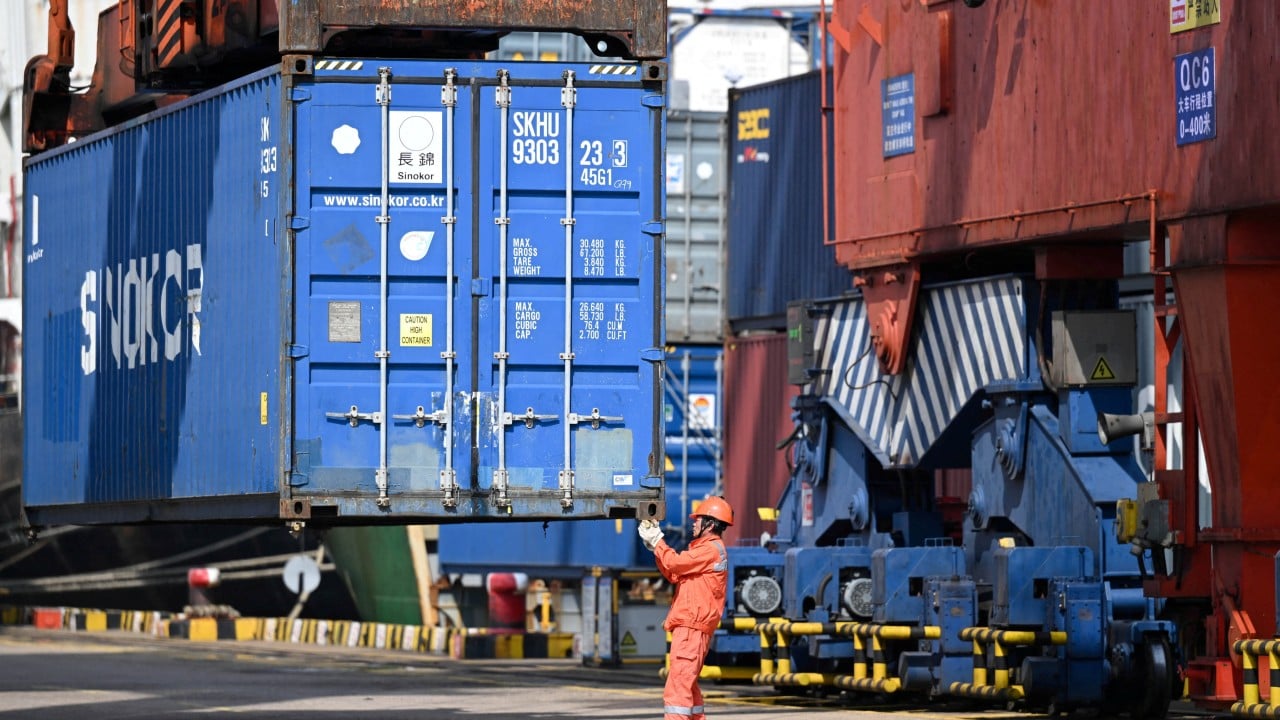
Geography has always been an economic destiny in China. Guangdong sits at the mouth of the Pearl River, an area physically and culturally oriented toward exports. It thrived when the global economy demanded consumer electronics, textiles, and light manufacturing. It was the ideal location for the "Made in China" phase of global trade.
However, the nature of global demand has shifted. The current era favors integrated supply chains, high-end industrial automation, and internal market integration. Jiangsu, situated in the Yangtze River Delta, benefits from proximity to Shanghai and a highly connected cluster of manufacturing hubs that stretch deep into the hinterland. This region functions as a unified industrial organism.
江苏 (Jiangsu) has effectively integrated its local supply chains into a network that is less vulnerable to disruptions in global shipping routes than the export-heavy hubs of the Pearl River Delta. When global demand for low-margin consumer goods softened, Guangdong’s manufacturers faced a sharp decline in volume. In contrast, Jiangsu’s focus on industrial intermediate goods meant that even as final consumer demand waned, the demand for its machinery and specialized materials remained sticky.
The province has also been more effective at attracting foreign direct investment that aligns with Beijing’s current strategic priorities. While Guangdong was busy exporting finished devices, Jiangsu was building the capacity to manufacture the components, chemicals, and industrial equipment those devices require. The shift from exporting finished goods to producing the building blocks of industrial output is exactly where the value has migrated.
The geopolitical squeeze
Shenzhen, Guangdong’s crown jewel, is on the front lines of the friction between Beijing and Washington. As the epicenter of China's telecommunications and high-end hardware industries, the city has been the primary target for export controls and trade sanctions. The restriction on semiconductors and advanced computing power has hit Guangdong’s technological sector harder than any other part of the country.
This is a specific burden that Jiangsu does not carry to the same degree. While all Chinese provinces face the challenges of a tightening geopolitical environment, Guangdong’s economy is structurally "short" on high-end hardware access. Companies in the Pearl River Delta have had to aggressively pivot to domestic substitutes or find ways to survive with restricted access to global markets.
This environment has forced a painful transition. Innovation in Guangdong is now defined by the necessity of survival rather than the freedom to expand. This redirection of resources—diverting capital and talent away from growth and toward defensive engineering—is costly. It acts as a tax on the province's productivity, effectively lowering the ceiling on what the local economy can produce.
The demographic reality
The labor model that powered Guangdong for decades is fracturing. The province was the main destination for millions of migrant workers who fueled the low-cost assembly lines. That workforce is aging, and the supply of young, mobile labor from the inland provinces is dwindling.
In the past, Guangdong could mitigate rising labor costs by simply increasing the volume of output. That math no longer works. The shift toward automation is mandatory, yet the capital intensity required to automate the older, labor-heavy factories in the Pearl River Delta is staggering.
Jiangsu, meanwhile, has leaned into a more capital-intensive industrial model for longer. By investing in robotics and automated production lines a decade ago, it was better prepared for the inevitable labor squeeze. Guangdong is currently playing catch-up, forced to spend massive amounts of capital to modernize its older industrial facilities while facing a stagnant labor market. This transition period is inherently deflationary, as it creates a mismatch between capacity and actual output.
Rethinking the hierarchy
The obsession with who holds the "GDP crown" misses a more uncomfortable truth. The reliance on provincial GDP as a metric for economic health has become a distraction. Both Guangdong and Jiangsu are fighting for position within a national system that is struggling with the same core issues: a lack of domestic consumer confidence, a debt overhang, and the necessity of shifting toward high-value-add industries.
The struggle between these two provinces is a symptom of a larger transition. The old model of growth—based on high-volume, export-oriented manufacturing and land development—is exhausted. Whichever province wins the race to the top of the GDP rankings is arguably just the one that has managed its decline most effectively.
If Guangdong loses its top spot, it will not be because it failed in the way we traditionally measure success. It will be because the definition of success has changed. The economy that prioritized the highest volume of output is losing favor to the economy that prioritizes the most efficient, integrated, and technologically secure industrial base.
History rarely offers an easy transition for regional powers that have defined an era. Guangdong’s institutions, from its corporate giants to its local bureaucracies, were built for a different world. They are now tasked with operating in a reality that rewards caution over speed and integration over sheer capacity.
The decline of a leader is often a slow, agonizing process of reorientation. Guangdong is not dying; it is simply being forced to abandon the habits of its youth. Whether it can find a new identity that allows it to lead in an economy defined by internal demand and technological sovereignty is the question that matters. The GDP ranking is just a tally of the past. The future belongs to whichever province can successfully navigate the transition from being a workshop for the world to an incubator for its own industrial future.