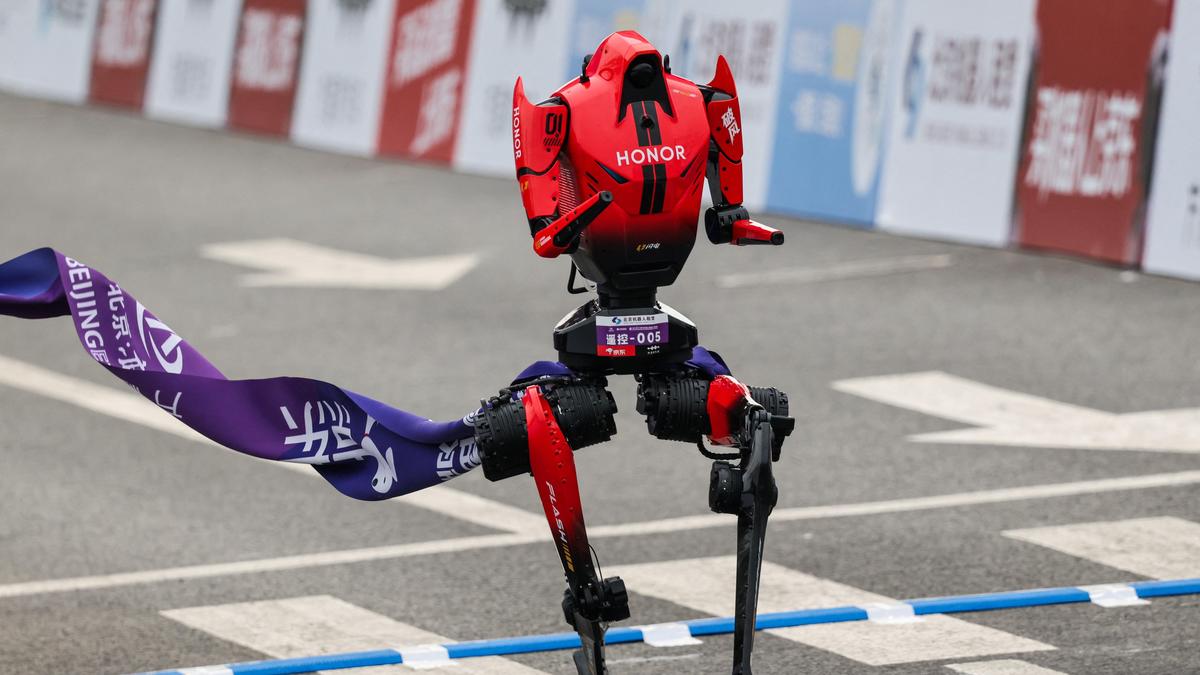
Humanoid robots aren't just clunky laboratory experiments anymore. If you thought we were years away from seeing machines move with the fluid grace of an athlete, the recent Beijing Half-Marathon just proved you wrong. This wasn't a tech demo behind closed doors. It happened on the pavement, in the heat, alongside thousands of human runners. Watching Tiangong, the Chinese-developed humanoid, cross that finish line wasn't just a gimmick. It was a clear signal that the mechanical gap between us and them is closing faster than most experts predicted.
The bot didn't just walk. It ran. It maintained a steady pace that would leave many casual joggers gasping for air. We've seen Boston Dynamics' Atlas do backflips, but sustained endurance in a public race is a different beast entirely. It requires real-time processing of uneven terrain, battery management, and thermal regulation that mimics human perspiration—all while maintaining a center of gravity that doesn't result in a faceplant on live television. Recently making waves in this space: Why Helion Energy is Betting Everything on a 2028 Fusion Deadline.
The Engineering Behind the Beijing Sprint
Tiangong stands about 163 centimeters tall and weighs around 43 kilograms. It’s light. That’s the secret. Most people assume robots need to be heavy and armored, but for running, weight is the enemy. The engineers at the Beijing Humanoid Robot Innovation Center focused on "pure electric" drive. They ditched the heavy hydraulics that make older robots look like they’re moving through molasses.
The robot uses a sophisticated array of sensors that refresh at speeds humans can't comprehend. Think about how your brain tells your ankle to adjust when you hit a small crack in the sidewalk. You do it instinctively. A robot has to calculate that. Tiangong’s "brain" processes visual and tactile data to adjust its torque dozens of times per second. It didn't just follow a pre-programmed path. It navigated a crowded race course with unpredictable human movements happening all around it. Additional information on this are explored by MIT Technology Review.
It's about power density. We’re finally seeing batteries and actuators that can handle the violent, repetitive impact of a running gait without shaking the internal circuitry to pieces. Most robots fail because they can't handle the vibration. Tiangong handled 21 kilometers of it.
Why Speed Matters Less Than Stability
Everyone wants to talk about how fast these things go. Currently, Tiangong tops out at around 6 kilometers per hour for long distances, though it can sprint faster in bursts. That’s not going to win an Olympic gold medal yet. But speed is the easy part. The hard part is not falling over when a runner accidentally bumps into you or when the wind picks up.
The Beijing race was a test of "dynamic balance." When you run, you're essentially in a state of controlled falling. You're constantly throwing your weight forward and catching it. Teaching a machine to find that rhythm is incredibly difficult. If the robot is too rigid, it breaks. If it’s too soft, it collapses. This race showed that Chinese robotics firms have found a middle ground that works in the real world, not just on a smooth lab floor.
The Growing Divide in Global Robotics
China is pouring billions into this. They aren't just building one or two cool prototypes for YouTube. They’re treating humanoid robots like the new smartphone—a commodity they want to dominate. The Ministry of Industry and Information Technology (MIIT) even put out a blueprint aiming for mass production of humanoids by 2025 and 2026. They want these things in factories, in homes, and apparently, on our race tracks.
Compare this to the West. We have Tesla’s Optimus and Figure AI. These companies are doing incredible work, but their focus is often on dexterity—picking up eggs or folding shirts. China seems obsessed with mobility and scale. They want robots that can navigate the messy, unoptimized world that humans live in. A marathon is the ultimate "messy" environment.
There’s a clear demographic reason for this push. China's workforce is shrinking. They don't just want these robots to be cool; they need them to be functional. If a robot can run a half-marathon, it can walk through a warehouse, climb stairs in a multi-story delivery route, or patrol a park.
What This Means for Human Athletes
Don't worry, robots aren't going to "ban" humans from marathons. Not yet. But we are entering an era of "mixed-species" sports. We’ve already seen this in chess and e-sports. Now it’s physical. The presence of Tiangong in Beijing raised some eyebrows about safety and fairness. Should a machine that doesn't feel pain or fatigue be allowed to set the pace for human runners?
Some runners found it inspiring. Others found it eerie. There's a psychological impact when you're at mile 10, your lungs are burning, and a silent metal entity drifts past you without a hint of effort. It changes the vibe of the race. We’re going to need new rules. World Athletics and other governing bodies aren't ready for this. They’re still arguing about "super shoes" with carbon plates. Wait until they have to deal with a participant that has a lithium-ion heart and lidar eyes.
Common Misconceptions About Humanoid Mobility
People see these videos and think the robot is "thinking" like a human. It's not. It's executing a very complex set of physics equations. It doesn't know it's in a race. It doesn't care about the medal. It’s simply solving the problem of "stay upright while moving forward at X speed."
Another mistake is assuming these robots are fragile. While a fall can be expensive, the materials used now—carbon fiber and high-strength aluminum—are tougher than human bone. If a human and a Tiangong-class robot collide at full speed, the human is probably going to the hospital. That’s a real safety concern that race organizers have to figure out before the next big event.
The Practical Side of Mobile Humanoids
So why do we need a running robot? It's not just for the spectacle.
- Search and Rescue: If a building collapses, you need something that can move over rubble at a human-like speed to find survivors.
- Last-Mile Delivery: Drones are great, but they can't ring doorbells or navigate apartment hallways. A humanoid can.
- Elderly Care: A robot that can't move quickly can't catch someone who is falling. Speed is safety.
The Beijing Half-Marathon was a high-profile stress test for these use cases. It proved the hardware is ready for the elements. Rain, dust, and temperature fluctuations are the enemies of electronics, yet the bot stayed functional for the entire duration of the race.
Reality Check on the Battery Problem
I’ll be honest. The biggest hurdle isn't the walking; it's the power. Running 21 kilometers takes a massive amount of energy. Most humanoid robots currently have a battery life of about two to four hours under normal conditions. Pushing that to include high-intensity running is a massive feat of engineering.
We aren't at the point where these bots can go all day. But the fact that Tiangong finished a half-marathon suggests we're getting close to a full workday of battery life for less intensive tasks. That’s the threshold for when these machines become economically viable for businesses.
Get Ready for the Robot Next Door
You’re going to see more of this. It starts with a race in Beijing, then a mall security guard in Singapore, then a delivery bot in San Francisco. The technology is moving at an exponential rate because the software—the AI that controls the legs—is finally catching up to the hardware.
If you're a business owner or an investor, ignore the "robot apocalypse" hype and look at the logistics. We’re looking at a new workforce that doesn't need sleep and can now navigate the world as well as you can.
Keep an eye on the following developments over the next twelve months:
- Open Source Locomotion: More companies are sharing the code that helps robots balance, which will lead to a flood of cheap, capable humanoids.
- Sensory Integration: Watch for robots using "vision-only" navigation, ditching expensive lidar to lower costs.
- Regulatory Battles: Cities will start debating where these things are allowed to walk.
Start thinking about how your local environment—your office, your street, your favorite park—will change when these machines become a common sight. The race in Beijing wasn't a one-off. It was the starting gun.