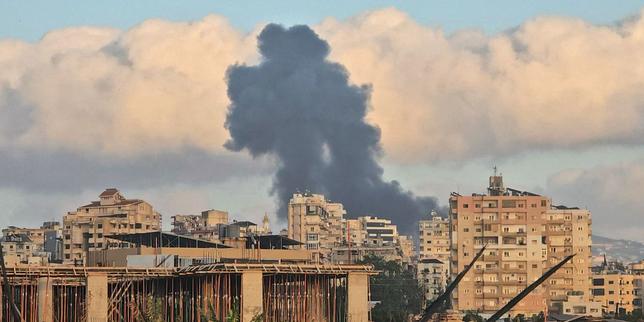
The Mediterranean breeze carries the scent of roasted coffee and exhaust fumes through the streets of Tyre. For three days, that breeze was supposed to mean peace. A piece of paper signed hundreds of miles away had decreed a truce, a temporary pause in the violence fracturing southern Lebanon. Shopkeepers rolled up their corrugated metal shutters. Children, kept indoors for weeks by the low, predatory hum of drones, stepped onto balconies to taste the autumn air.
Then the sky tore open again.
A flash, a delayed thud that vibrates in the chest before it hits the ears, and the dust rose. Another Lebanese hillside swallowed by smoke. The ink on the extension of the truce was barely dry, but the artillery didn't care about the ink.
We tend to view geopolitical conflicts through the clean, clinical lens of maps and news tickers. We read headlines about tactical strikes, strategic buffer zones, and diplomatic framework extensions. But war is not a series of press releases. It is a sensory assault. It is the smell of pulverized concrete, the sudden, terrifying absence of sound right after an explosion, and the frantic calculation a mother makes in a split second: do we run to the basement, or is the basement a trap?
Understanding what is happening in Lebanon right now requires moving past the standard diplomatic vocabulary. The reality is simple, brutal, and entirely human. A truce on paper is not a truce in the dirt.
The Geography of Fear
To understand why a prolonged truce can exist simultaneously with falling bombs, you have to look at the landscape of southern Lebanon. Consider a hypothetical farmer named Nabih. He lives near the Litani River, a crucial ribbon of water that has historically served as a geopolitical line in the sand.
For Nabih, the conflict is not an abstract debate about sovereignty. It is about his olive groves. When a truce is announced, diplomatic correspondents report on the macro-agreements between governments and armed factions. They speak of compliance and violations. But on the ground, compliance is an invisible metric. A violation is a tangible crater in your backyard.
During a technical truce, the surveillance never actually stops. Drones still crisscross the sky, their high-pitched whine a constant psychological weight. Imagine trying to sleep, to cook, or to comfort a child while a mechanical eye hovers miles above you, deciding whether your movements look suspicious enough to warrant a missile.
The Israeli military states that its continued strikes during these periods are pre-emptive, targeting infrastructure or positions that pose an immediate threat. They view these actions as defensive maintenance, a necessary enforcement of security parameters even while political negotiations drag on.
But from the receiving end, the distinction between a pre-emptive strike and an outright assault is completely meaningless. The shrapnel feels exactly the same.
The Anatomy of a Broken Promise
Why do these pauses fail to hold? The answer lies in the deep chasm of mistrust that defines the region.
A truce is not peace; it is merely a collective holding of breath. When one side observes what it perceives as a mobilization, a movement of personnel, or the setup of a launch site, the temptation to strike first overrides the diplomatic agreement. The logic of survival in a war zone is unforgiving: it is always better to apologize for breaking a truce than to bury your own soldiers because you honored one.
This creates a vicious, self-fulfilling cycle.
- A pause is agreed upon to allow civilians a respite and diplomacy a chance.
- Minor movements or defensive posturing on the ground are interpreted as imminent threats.
- A "localized" strike is launched to neutralize that perceived threat.
- The other side retaliates, claiming the truce was violated first.
- The boundaries of the agreement erode until the truce exists only in name.
This erosion happens in minutes, but the consequences echo for generations. When these strikes occur despite diplomatic announcements, it shatters the one commodity more precious than ammunition: trust.
When international bodies announce that a truce has been extended by another twenty-four or forty-eight hours, civilians face an agonizing dilemma. Do they trust the television broadcast and return home to salvage what is left of their lives? Or do they stay in overcrowded shelters in Beirut, knowing that the sky over their villages could ignite at any moment?
The Invisible Toll
The damage of a broken truce cannot be measured solely by the body count or the number of destroyed buildings. The deepest scars are psychological.
When a war is continuous, the human mind adapts to a baseline of survival. Adrenaline becomes a permanent resident in the bloodstream. You expect the worst, so you are rarely surprised. But a truce introduces something incredibly dangerous: hope.
It tells the nervous system that it might be safe to lower its guard. It allows people to dream, if only for an hour, about a return to normalcy. When a strike occurs during that window, the psychological whiplash is devastating. It proves that nowhere is safe, that no promise is sacred, and that the international community’s words carry no weight where the bombs fall.
The conflict in Lebanon is often framed as a binary struggle, a chess match between regional powers and heavily armed non-state actors. Lost in this narrative are the millions of people who belong to neither category, those who simply want to wake up in the morning and find their homes still standing.
Consider what happens next when the smoke clears from these latest strikes. The diplomats will return to negotiation rooms. They will issue statements condemning the violations or justifying them as necessary security measures. They will debate the exact wording of the next resolution, arguing over commas and clauses while sitting in air-conditioned rooms.
Meanwhile, in the villages of southern Lebanon, the residents will sweep up the glass from their storefronts once again. They will look up at the sky, listening to the unchanging hum of the drones, fully aware that their lives are governed not by the treaties signed in European capitals, but by the cold, unpredictable logic of the next payload.
A grandmother sits on a plastic chair outside a damaged home in Tyre, her hands methodically sorting through a bowl of lentils for dinner. She does not look up when a distant explosion echoes from the hills. She has learned the hard way that peace is a luxury of distance, and that out here, the quiet is always the loudest part of the storm.

_Biopsy.png?branch=uat_release_3)
