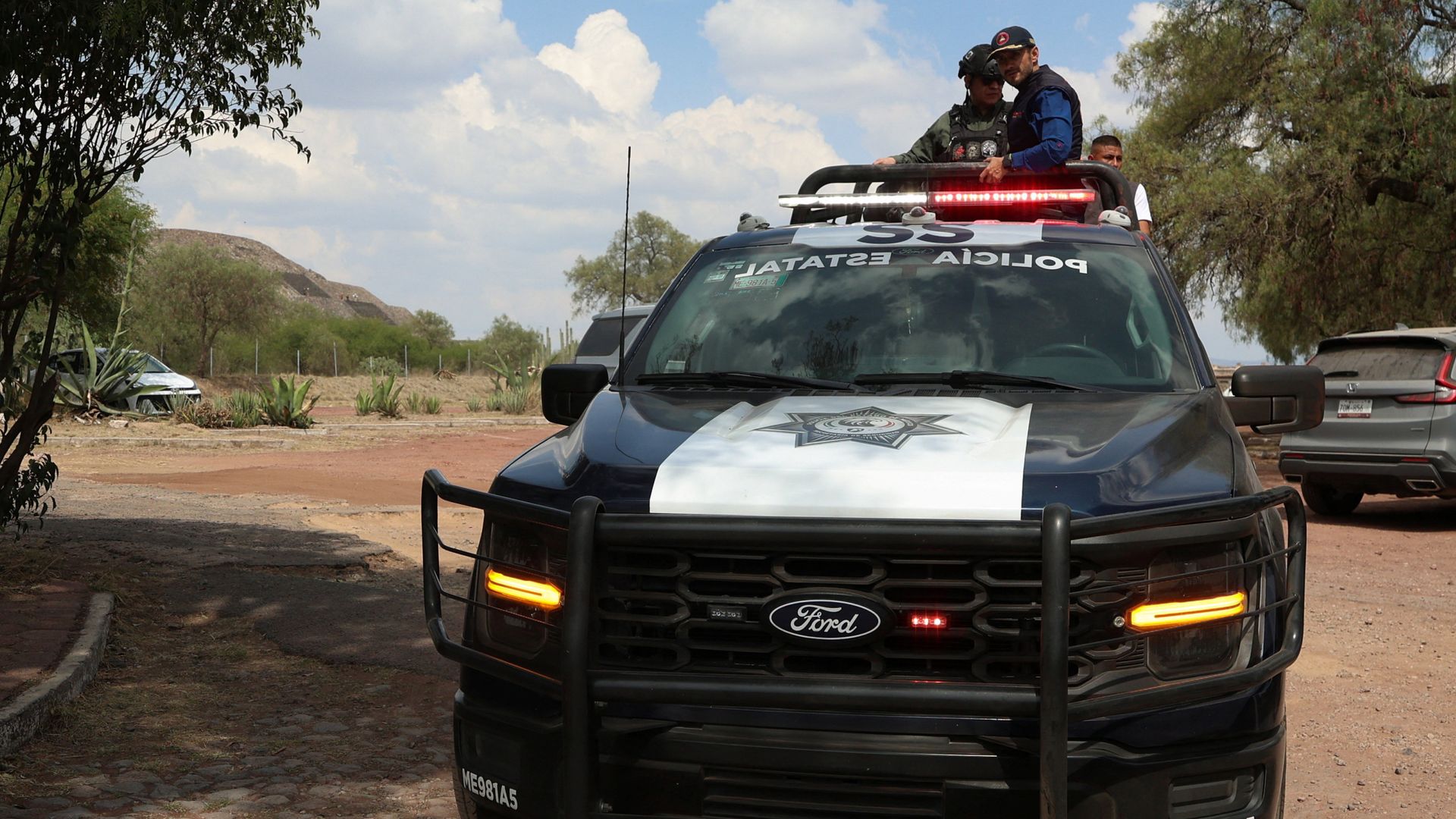
Ten people are dead after an early-morning mass shooting in the town of Tehuitzingo, located in Mexico's east-central state of Puebla. Gunmen stormed a private residence at roughly 1:55 a.m. on Sunday, executing six men, three women, and a minor before fleeing into the night. While municipal authorities arrived to find bodies scattered across the property, a lone woman succumbed to her injuries during an emergency transport. The massacre comes at the worst possible time for the federal government. With less than a month left before Mexico co-hosts the FIFA World Cup, this bloodshed punctures the narrative of a stabilizing nation and highlights the terrifying volatility that remains just beneath the surface.
To understand how ten lives could be extinguished so casually in a quiet town of 11,000 residents, one must look past the standard police press releases. Local officials blamed the carnage on unidentified armed individuals, a frustratingly vague boilerplate phrase that has come to characterize the state’s opaque handling of organized crime. The regional Attorney General’s office quickly announced a multi-pronged investigation involving the National Guard, local police, and state intelligence units. Yet, no suspects are in custody. No clear motive has been established. For those who watch the region closely, this absence of immediate clarity is a hallmark of an evolving undercurrent in the domestic security theater.
The shooting in Puebla is not an isolated burst of violence but part of a highly complex, destabilized criminal landscape that has shifted dramatically over the last few months. In February, Mexican military forces killed Nemesio "El Mencho" Oseguera, the elusive leader of the hyper-violent Jalisco New Generation Cartel. His death sent shockwaves through the criminal underworld. Instead of neutralizing the threat, the elimination of top leadership has sparked an intense, fractured turf war as regional factions fracture, mutate, and push into territories previously considered stable. Puebla, long used as a logistics corridor rather than an active battleground, is now experiencing the spillover of this internal re-packing of criminal power.
The Illusion of Declining Numbers
On paper, the administration of President Claudia Sheinbaum had reasons to be optimistic. Data compiled by independent monitoring groups showed that homicides dropped by 19.8 percent over the previous calendar year. It was a statistical victory that the government frequently highlighted to reassure nervous international trading partners and sports federations.
The numbers, however, hide a dark reality. Criminal organizations have altered their tactics. Rather than leaving bodies on public display, which draws immediate military heat and media scrutiny, gangs have increasingly turned to forced disappearances. A body that is never found is a crime that is never registered on a government ledger.
This statistical maneuvering fails when armed commandos choose to hit a domestic residence with absolute, public brutality. The Tehuitzingo massacre proves that despite a macro-level dip in national statistics, the operational capacity of these criminal groups remains entirely uninhibited. They still possess military-grade weaponry, actionable local intelligence, and the complete certainty that they can execute ten people and escape before a single police cruiser arrives on the scene.
The World Cup Pressure Cooker
The timing of the Tehuitzingo massacre could not be more catastrophic for Mexico's international standing. In a matter of weeks, hundreds of thousands of foreign tourists, journalists, and sports fans will descend upon the country for the World Cup. The government has already pledged to deploy a massive security blanket consisting of 100,000 personnel, blending National Guard forces, local police, and private security contractors.
But a blanket only covers so much ground. While stadiums, high-end hotels, and tourist zones in major hubs will be heavily fortified, rural towns and logistical corridors remain completely exposed. The contrast is stark.
- The Urban Strategy: Hyper-concentration of security forces in visible, high-traffic zones to maintain international confidence.
- The Rural Reality: Minor municipalities left with depleted, underfunded local police forces that are easily outgunned or corrupted by regional cartels.
This vulnerability was already exposed in April when a lone gunman opened fire from the top of the Pyramid of the Moon at the historic Teotihuacan archaeological site, killing a Canadian tourist and wounding 13 others. That attack was a localized, ideological act of mass violence, but it demonstrated a broader truth. The state cannot guarantee absolute safety even at its most prized cultural treasures. When organized crime pairs that institutional weakness with targeted, tactical executions like the one seen in Puebla, the cracks in the national security apparatus become impossible to hide.
Sovereignty and the Threat of Foreign Intervention
The inability of domestic forces to contain these sudden spikes of violence is feeding an increasingly dangerous diplomatic feud with the United States. Washington's patience has worn thin.
President Donald Trump has repeatedly threatened to take unilateral military action on Mexican soil to neutralize cartel networks, declaring that the criminal syndicates pose a direct threat to American national security. The White House views the ongoing bloodshed as proof that Mexico City lacks either the capability or the political will to dismantle these organizations entirely.
President Sheinbaum has stood firm, denouncing any potential American military incursion as an unacceptable violation of national sovereignty. She recently denied reports of unauthorized CIA operations running within Mexican borders, attempting to project an aura of total domestic control. Yet, every time an event like the Tehuitzingo shooting occurs, it provides immediate political ammunition to hawks in Washington who argue that Mexico is a failing partner in regional security.
The true crisis is not just the tragic loss of ten lives in Puebla. It is the systemic reality that Mexico is running out of time to prove it can govern its own territory before external geopolitical pressures force its hand. The deployment of 100,000 troops for a soccer tournament will do nothing to solve the deep-rooted corruption, the lack of investigative resources, or the vacuum of power left by dead cartel bosses. Until the state addresses the structural rot in its municipal policing and confronts the reality behind its falling homicide data, the quiet towns of the interior will continue to pay the ultimate price in blood.