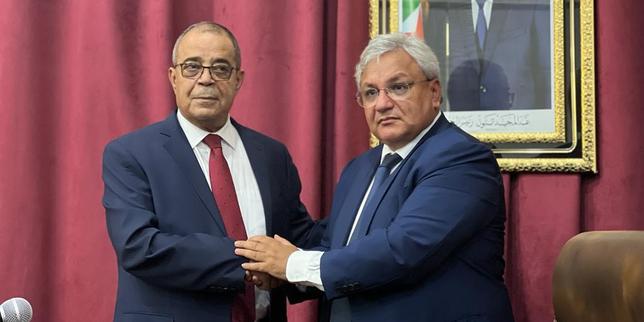
The incarceration of former Algerian Minister of Relations with Parliament, Tahar Khaoua, signals more than a mere judicial proceeding; it represents the continued execution of a high-stakes stress test on the nation’s bureaucratic integrity. By sentencing Khaoua to five years in prison for influence peddling and illicit enrichment, the Algerian judiciary is not just penalizing a single actor but is attempting to re-establish the state’s monopoly on legitimate transaction. This move functions as a corrective mechanism within a broader structural realignment designed to decouple private interest from public administrative functions.
The Tripartite Architecture of Political Corruption
To understand the conviction of Tahar Khaoua, one must dissect the specific operational modes through which state resources were historically diverted. Corruption in this context is not a series of isolated lapses in judgment but a sophisticated system of extraction defined by three primary pillars.
1. Influence Brokerage as a Marketable Asset
In a highly centralized administrative environment, access is the ultimate currency. Influence peddling transforms a public servant’s proximity to decision-makers into a private commodity. When a minister leverages their title to facilitate contracts or secure permits for third parties—as seen in the allegations surrounding Khaoua’s interventions in the Batna province—they are effectively privatizing the state's regulatory authority. This creates a shadow market where the price of entry is determined by political connections rather than economic competitiveness.
2. The Asymmetry of Illicit Enrichment
Illicit enrichment occurs when the growth of an official's personal balance sheet cannot be mathematically reconciled with their declared legal income. This discrepancy serves as a proxy metric for the "corruption tax" levied on the economy. The prosecution of these cases relies on the reversal of the burden of proof regarding the origin of assets, a legal pivot that has become a cornerstone of the post-2019 judicial strategy in Algiers.
3. Laundering Through Legal Facades
The third pillar involves the integration of "dirty" capital into the formal economy. By funneling bribes or kickbacks through legitimate business fronts or real estate acquisitions, actors attempt to mask the trail of state-diverted funds. The five-year sentence reflects the court's attempt to signal that the cost of these activities now outweighs the potential yield, shifting the risk-reward ratio for current and future bureaucrats.
The Mechanical Failure of Oversight
The ability of a minister to operate an influence-peddling scheme for years suggests a systemic failure in the "Check and Balance" protocols of the Algerian administration. This failure is characterized by several specific bottlenecks.
The lack of digital transparency in procurement and administrative approvals allows for human intervention points where bribes can be extracted. When processes are opaque, the "middleman" becomes a necessity. Furthermore, the historical subordination of investigative bodies to the executive branch meant that anti-corruption efforts were often reactive rather than preemptive. The current wave of trials indicates a shift toward using the judiciary as a primary tool for "elite circulation"—purging the remnants of the previous administration to stabilize the new political order.
The Economic Cost Function of Bureaucratic Graft
The impact of high-level corruption extends far beyond the stolen sums. It introduces significant distortions into the national economy that can be quantified through specific cost functions.
- Misallocation of Capital: Resources are directed toward projects favored by corrupt officials rather than those with the highest Social Return on Investment (SROI). This leads to "white elephant" projects that provide no long-term economic utility.
- Erosion of Foreign Direct Investment (FDI): Global investors apply a "corruption premium" when evaluating markets. If the legal framework is perceived as arbitrary or subject to the whims of influential ministers, the cost of capital increases, and high-quality investors exit the market, leaving only predatory actors.
- Talent Brain Drain: When advancement within the state or economy depends on "Maârifa" (nepotism/connections) rather than merit, the most productive segments of the workforce emigrate, resulting in a long-term depletion of the nation’s human capital.
The Judicial Pivot as a Strategy for Legitimacy
The sentencing of Tahar Khaoua is part of a broader sequence that includes the imprisonment of former Prime Ministers and prominent business leaders. This judicial activism serves a dual purpose. Internally, it aims to satisfy the public demand for accountability that fueled the 2019 protest movement. Externally, it seeks to signal to international financial institutions that Algeria is moving toward a more standardized, rules-based governance model.
The second limitation of this strategy, however, is the risk of "administrative paralysis." When the cost of a mistake—or a perceived favor—is five years in prison, mid-level bureaucrats often become averse to making any decisions at all. This creates a bottleneck where files sit stagnant on desks for months because no official wants to risk the scrutiny of an anti-corruption probe. For the state to function, it must find a way to punish graft without suffocating the speed of legitimate administrative action.
Distinguishing Between Reform and Retribution
A critical analytical challenge lies in determining whether these trials represent a fundamental shift in the rule of law or a targeted purge of a specific political faction.
Evidence for a fundamental shift would include:
- Legislative Permanence: The codification of stricter transparency laws that apply regardless of who is in power.
- Institutional Independence: The granting of budgetary and operational autonomy to the Court of Auditors and the High Authority for Transparency, Prevention, and Combating Corruption.
- Digital Transformation: The removal of human intermediaries from the tender and licensing processes.
Conversely, if the judicial process remains focused exclusively on actors associated with the pre-2019 era while ignoring contemporary irregularities, the system risks being viewed as a tool for political consolidation rather than impartial justice.
The Operational Reality of Asset Recovery
Securing a prison sentence is the simplest part of the anti-corruption equation. The more complex challenge is the "Recovery of Illicit Assets."
The Algerian state faces significant hurdles in clawing back funds moved to offshore jurisdictions or hidden behind complex shell company structures. This requires international legal cooperation and a level of forensic accounting that is still being developed within the Algerian Ministry of Justice. The seizure of local assets—villas, luxury vehicles, and bank accounts—provides immediate symbolic victories, but the bulk of the "missing" state wealth often remains beyond the immediate reach of the national treasury.
The sentencing of Tahar Khaoua must be viewed as a single data point in a much larger trendline of institutional recalibration. The state is currently signaling that the old "Rules of the Game" are obsolete. However, for this to result in a more efficient economy, the focus must shift from the punishment of individuals to the hardening of the systems they exploited.
The immediate tactical requirement for the Algerian administration is the implementation of a dual-track policy: maintaining the credible threat of prosecution to deter graft, while simultaneously simplifying the regulatory environment to remove the incentives for corruption in the first place. The success of this strategy will not be measured by the number of ministers in the El Harrach prison, but by the increase in non-hydrocarbon FDI and the restoration of public trust in the administrative apparatus.
The state must move beyond the "Trial of the Day" and toward the "Protocol of the Future," ensuring that the removal of one corrupt node does not simply create a vacuum for another to fill.