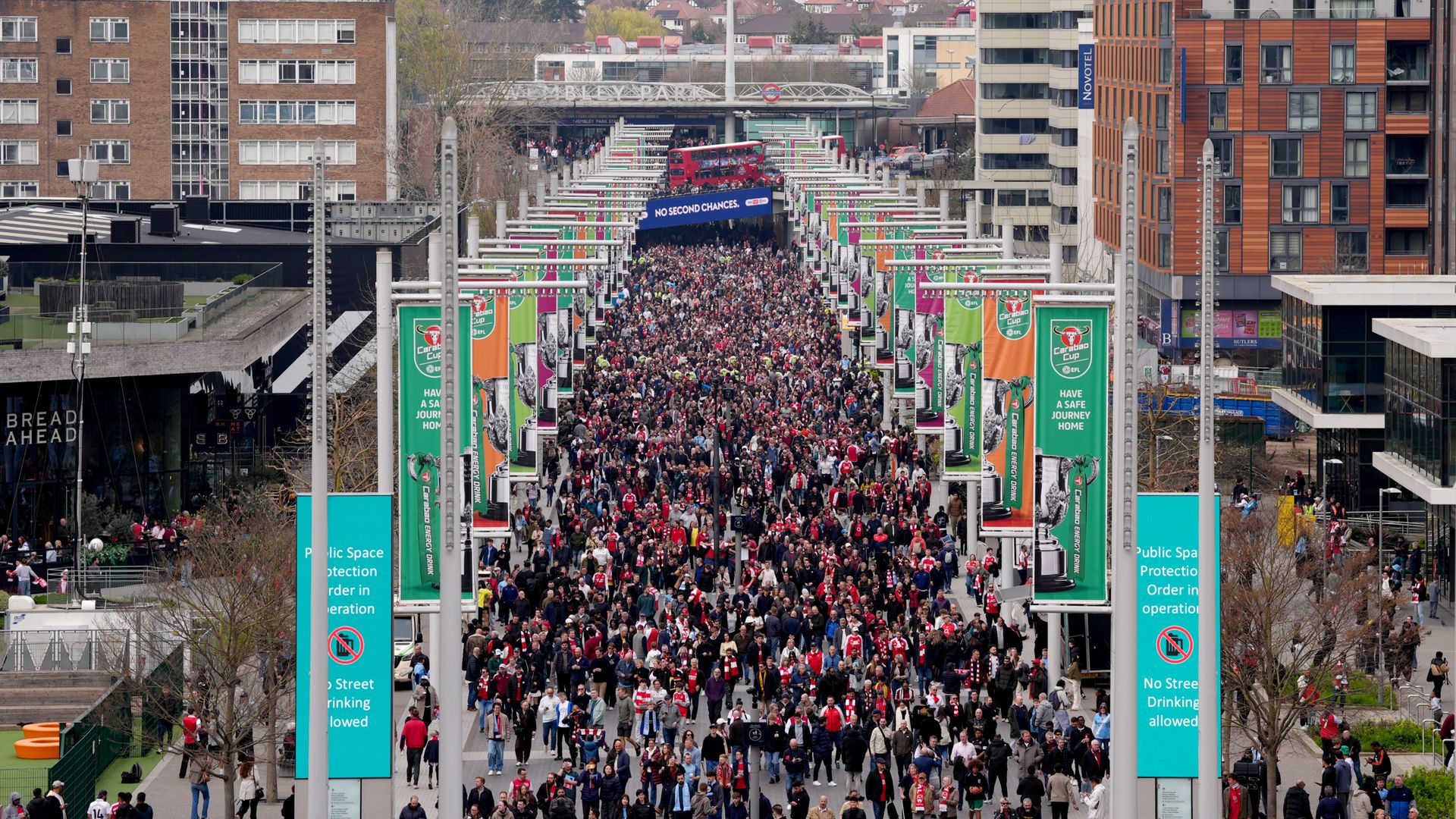
The air outside the turnstiles carries a specific, electric charge. It is a mixture of stale beer, fried onions, and the frantic, rhythmic chanting that defines a Saturday afternoon. For decades, this space—the concourse, the perimeter, the shadow of the floodlights—was a gray zone. It was a place where the desperate and the ticketless played a high-stakes game of shadows, hoping to slip through a side door or ride the wake of a legitimate fan.
We call it tailgating. Not the American tradition of grilling burgers in a parking lot, but the European shadow-act of sticking so close to a stranger’s back that you pass through the automated barriers on a single scan. It used to be seen as a nuisance. A cheekiness. A shrug of the shoulders from overworked stewards.
That era ended this week.
When the first person was charged under a new, surgical piece of legislation designed specifically to kill the "tailgating" culture, the shift wasn't just legal. It was cultural. For the first time, the act of following someone through a gate without a ticket isn't just a breach of stadium rules. It is a criminal offense that carries the weight of a permanent record.
The Anatomy of a Breach
To understand why the law finally bared its teeth, you have to look at the physics of a crowd. Imagine a stadium as a pressurized vessel. Every seat is an exhaust valve. When the number of people inside matches the number of valves, the pressure remains stable. But when hundreds, sometimes thousands, of untricketed fans force their way into the stands, the vessel begins to groan.
The nightmare of the Euro 2020 final at Wembley remains the ghost in the room. That night, the "invisible" fans—those who surged through fire doors and tailgated through disabled access points—turned a sporting event into a site of genuine terror. Men, women, and children with legitimate tickets found their seats occupied by aggressive strangers. The gangways, which must remain clear for medics and emergencies, were choked with bodies.
Safety is a fragile equilibrium.
The new legislation targets the very beginning of that chaos. It recognizes that the moment a fan pushes through a turnstile behind a stranger, they aren't just "sneaking in." They are compromising the digital manifest of the entire building. If an evacuation is triggered, the emergency services rely on accurate counts. A tailgater is a ghost in the machine. They are someone the system doesn't know is there, standing in a place where they shouldn't be, blocking an exit that someone else might need to survive.
The Human Cost of a "Free" Seat
Consider a hypothetical fan named Mark. Mark has supported his club for thirty years. He saves his money, navigates the Byzantine online ticketing queues, and finally secures a seat for a high-stakes derby. He arrives early, scans his phone, and feels the familiar click of the turnstile.
But as he moves through, someone is pressed against his spine. Before Mark can even turn around, the stranger has vanished into the concourse.
Later, when Mark reaches his seat—Row 12, Seat 44—he finds someone already there. The stranger is defiant. "Find another spot, mate," he says. Mark looks around. Every spot is full. The aisles are packed two-deep with people who have no right to be there. The atmosphere, once celebratory, is now thick with a jagged, territorial tension. Mark, who paid eighty pounds for his afternoon, spends the match standing on a concrete stairwell, unable to see the pitch, while stewards struggle to manage a crowd that has outgrown its environment.
This is the reality the law seeks to prevent. It isn't about protecting the profits of billionaire owners. It is about protecting the sanctity of the experience for the person who actually paid to be there.
The Weight of the Law
The first individual to be charged under this new regime likely didn't think they were making history. They were likely doing what thousands have done before: looking for a gap, a moment of distraction, a heavy-set fan who moves slowly enough to follow.
But the legal machinery has changed. Previously, police often had to rely on broader public order offenses or simple trespass, which are notoriously difficult to make stick in the frantic environment of a stadium. The new law is different. It is specific. It defines the act of unauthorized entry as a standalone crime.
This means the police no longer need to prove that a fan was being violent or "disorderly" in the traditional sense. The act of entry is the crime itself.
The consequences are life-altering. We aren't just talking about a fine or a slap on the wrist. A criminal conviction for this offense can lead to a Football Banning Order (FBO). For a true supporter, an FBO is a form of social exile. It means being barred from every stadium in the country. It means surrendering your passport when the national team plays abroad. It means having to report to a police station during the very hours you used to spend singing with your friends.
The "rush" of getting in for free is suddenly balanced against the possibility of never seeing your team play again.
A System Under Pressure
The technology at the gates is also evolving. Modern turnstiles are being fitted with infrared sensors and weight-sensitive floor plates designed to detect when two bodies occupy the space meant for one. High-definition CCTV now uses facial recognition to track individuals from the moment they approach the perimeter to the moment they take a seat.
Yet, technology is only a deterrent. The real change has to be behavioral.
There is a segment of the fanbase that views tailgating as a victimless crime. They see it as a blow against high ticket prices or a "pass" for the "real" fans who couldn't get a ticket. But this romanticized view of the gate-crasher ignores the physical reality of the modern stadium. These buildings are not the crumbling terraces of the 1970s. They are precisely engineered environments. When you exceed the capacity, you don't just make it "cozy." You make it dangerous.
The crushing of fans at Hillsborough and the chaos at the Stade de France are not just historical footnotes. They are warnings. They are the reasons why "one ticket, one person" is not a suggestion, but a fundamental requirement for public safety.
The Ripple Effect
The prosecution of the first tailgater sends a signal that vibrates through the entire football pyramid. It tells the clubs that the government is taking their security concerns seriously. It tells the stewards that they have the backing of the law when they intercept someone at the gates.
But most importantly, it tells the fans that the rules have changed.
The old excuses—"I just wanted to see the game," "The gate was open," "Everyone else was doing it"—no longer hold water. The legal threshold has shifted. The moment you press your chest against the back of a stranger to beat the sensor, you are no longer a fan. You are a defendant.
The game is changing. The blind spots are being illuminated. The shadow-players who thought they could bypass the system are finding that the system has finally caught up to them.
As the floodlights flicker on for the next match, the message is clear. The turnstiles are no longer just a doorway; they are a boundary. And for those who choose to ignore that boundary, the price of admission will be far higher than any ticket price. It will be the cost of their freedom to ever walk through those gates again.
The first charge has been laid. It won't be the last. The invisible fans are being made visible, and the consequences are finally real.