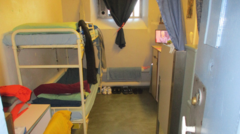
The steel door doesn't just close. It clangs. It is a sound that vibrates in the marrow of your bones, a definitive acoustic punctuation mark that signals the end of your autonomy. But for the men inside HMP Bedford, the loss of freedom isn't the most grinding part of the day. It’s the small, quiet, persistent erosion of basic human dignity that happens when the sun goes down and the laundry doesn't come back.
Consider a man we will call Elias. He isn't a statistic in a watchdog report. He is a person who, for the last three days, has been forced to wear the same pair of underwear. The fabric is stiff. It smells of sweat and the stale air of a cell designed for a different era. He asks the guard for a fresh pair. The guard shrugs. There aren't any. It sounds like a minor inconvenience to someone on the outside, a "first-world problem" transposed into a cage. It isn't. When you strip a person of the right to be clean, you aren't just managing a prisoner; you are unmaking a human being.
The HM Inspectorate of Prisons recently walked through those same halls, and what they found was a facility failing at the most primal level of care. It wasn't just a shortage of briefs. It was a systemic collapse of the basic infrastructure required to maintain a civilized society within stone walls.
The Arithmetic of Neglect
Prisons run on a strict, almost military rhythm. Or they should. At HMP Bedford, that rhythm has slowed to a funereal crawl. The report highlighted a startling reality: many inmates were lucky to get a shower twice a week. In a crowded, poorly ventilated Victorian-era building, the physical sensation of three-day-old grime becomes a psychological weight. It itchy. It burns. It reminds you, every second of every hour, that you are viewed as less than.
The numbers tell a story that the official press releases try to soften. The inspectors found that the "basic requirements of a decent life" were being missed. This isn't about luxury. We aren't talking about thread counts or organic cotton. We are talking about the fundamental ability to change your clothes after you’ve sweated in them under the summer heat or shivered in them through a damp winter night.
Why does this happen? It’s rarely a single villain twirling a mustache. It’s a bureaucracy that has become so frayed that "good enough" has shifted downward until it hit the floor. Budget cuts meet staff shortages, and suddenly, the laundry contract is the first thing to suffer. The supply chain breaks. The washing machines fail and aren't repaired. The result is a population of men who are forced to live in conditions that would be flagged as an emergency in any other public institution.
The Cost of the Scent
Smell is the most visceral sense. It bypasses the logical brain and hits the emotional center. When a wing of a prison smells of unwashed bodies and dirty laundry, it changes the chemistry of the environment. It ratchets up the tension.
Imagine being trapped in a small room with another person. Neither of you has had a clean change of clothes in a week. Neither of you has showered since Tuesday. The air is thick. Every movement releases a reminder of your shared degradation. In this environment, a misplaced glance or a sharp word isn't just an annoyance—it’s a spark in a room full of gasoline. The watchdog report noted that violence and self-harm remain high at Bedford. Is it any wonder? When you treat people like animals, you shouldn't be surprised when the environment becomes feral.
There is a direct line between a lack of clean underwear and a riot. It’s the line of self-respect. Once a man feels he has lost his last shred of dignity, he has nothing left to protect. He has no reason to follow the rules of a system that cannot even provide him with a pair of socks.
A Relic in the Modern Age
HMP Bedford is an old house. Built in the 19th century, it was designed for a world that understood punishment differently. But we are in the 21st century now. We claim to believe in rehabilitation. We talk about "correcting" behavior so that these men can return to our streets, our shops, and our neighborhoods as functioning neighbors.
But how do you rehabilitate someone while denying them a shower?
The disconnect is staggering. We expect these individuals to reflect on their crimes, to undergo therapy, and to learn new trades, all while they are literally rotting in their own clothes. It’s a cognitive dissonance that would be laughable if it weren't so cruel. The inspectors described the conditions as "squalid." That’s a heavy word for a government official to use. It’s a word that evokes Dickensian London, not a modern British city.
The report also pointed to the "overcrowding" that plagues the facility. Bedford was holding hundreds more men than it was ever meant to house. This isn't just about floor space. It’s about the strain on every single pipe, wire, and person in the building. When you double the population, you double the need for every basic resource, yet the resources stayed stagnant or shrank.
The Myth of the Easy Fix
The typical response to these reports is a flurry of promises. A new manager is appointed. A "deep clean" is scheduled. A one-time shipment of surplus clothing arrives at the loading dock. But these are Band-Aids on a severed artery.
The problem at Bedford isn't a lack of underwear; it’s a lack of value. We, as a society, have decided that once someone crosses the threshold of a prison, their basic biological needs become optional. We’ve outsourced our conscience to a system that is designed to be invisible. If we don't see the man in the dirty shirt, he doesn't exist. If we don't smell the wing, it isn't rotting.
But the inspectors saw it. They noted the "dilapidated" state of the cells. They saw the "vermin" that shared the space with the inmates. They saw the damp, the mold, and the crumbling plaster. They saw the men who had given up, sitting in the dark because their lightbulbs hadn't been replaced in weeks.
The Mirror in the Cell
The way we treat our prisoners is a mirror. It doesn't reflect who they are; it reflects who we are. If we allow a man to go without a change of clothes for a week, we are saying that our standards of decency are contingent on a person’s utility or their record.
This is a dangerous path. Decency is not a reward for good behavior. It is the baseline of a civilized society. When we lower that baseline, we all sink. The guards at Bedford have to breathe that same air. They have to manage that same tension. They go home to their families carrying the weight of that squalor on their skin. The trauma of the prison system isn't contained by the walls; it leaks out into the community through the staff and, eventually, through the men who are released.
Ninety percent of prisoners will eventually be released. They will walk among us. They will sit next to us on the bus. If they have spent years being told they aren't worth a clean pair of underwear, how do we expect them to value the lives and property of others? We are training them for resentment, not for reintegration.
The Silence of the Laundry Room
There is a specific kind of silence in a place where the systems have failed. It’s not a peaceful silence. It’s the heavy, expectant silence of a pressure cooker. At HMP Bedford, that silence is punctuated by the sound of water dripping from a leaky pipe that no one has the parts to fix.
The watchdog’s findings aren't just a critique of a single prison. They are a warning. Bedford is a symptom of a wider malaise, a "chronic" failure to prioritize the human element in our justice system. We have focused so much on the "justice" part—the sentencing, the locking away—that we have forgotten the "system" part. A system requires maintenance. It requires investment. It requires the acknowledgment that the people inside it are still people.
Elias sits on the edge of his cot. He looks at the small window, the light fading into a bruised purple over the Bedford skyline. He is thinking about his mother, or his daughter, or the life he had before he made the choices that landed him here. He wants to feel like that man again. He wants to feel human.
He reaches for his towel, hoping today might be the day the showers are working, or the day the laundry truck finally pulls into the yard. He waits. The steel door remains shut. The clang echoes.