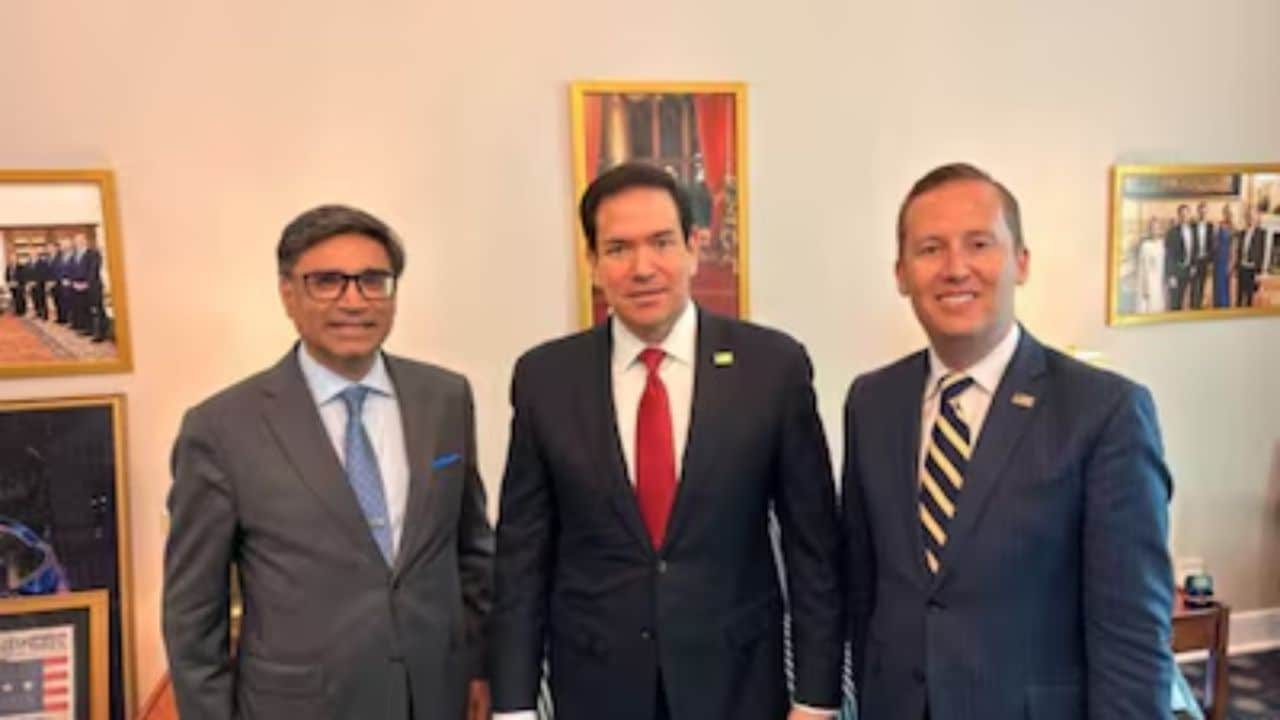
In a quiet corner of a high-ceilinged room in Washington, two men sat across from each other, surrounded by the weight of history and the silent hum of global power. On one side, Vikram Misri, India’s Foreign Secretary, a man who navigates the intricate maze of South Asian diplomacy with the precision of a watchmaker. Across from him, Marco Rubio, the newly minted U.S. Secretary of State, representing an administration that has made no secret of its desire to recalibrate how the West interacts with the world.
They were not merely discussing trade numbers or security protocols. They were sketching the blueprint for the next century.
The headlines will tell you about the "Quad" or "critical technologies." They will mention a diplomat’s visit to New Delhi in May. But if you focus only on the calendar, you miss the heartbeat. This is a story about two giants trying to figure out how to lean on one another without falling over, at a time when the ground beneath them is shifting faster than ever before.
The Weight of the Chip
Consider a small factory worker in Bengaluru. Let’s call him Arjun. Arjun doesn’t follow the daily briefings from the State Department. He cares about the silicon wafers arriving on his assembly line and the stability of the power grid that keeps his machines humming. To Arjun, "strategic partnership" isn't a phrase in a communique; it is the difference between a steady paycheck and a closed gate.
When Misri and Rubio talk about the Initiative on Critical and Emerging Technology (iCET), they are talking about Arjun’s world. For decades, the supply chains that power our smartphones, our medical devices, and our defense systems ran through a single, increasingly volatile corridor. Now, the United States is betting heavily that the future of democratic technology lies in the partnership between American innovation and Indian scale.
It is a marriage of necessity. The U.S. brings the capital and the high-end design; India brings a talent pool that is deep, young, and hungry. But marriages, even political ones, require constant maintenance. Rubio’s upcoming visit in May isn’t just a victory lap. It is a working session to ensure that the friction of bureaucracy doesn’t heat up enough to melt the progress they have made.
Shadows in the Indo-Pacific
The conversation inevitably drifted toward the water. Specifically, the vast, blue expanse of the Indo-Pacific.
The Quad—a partnership between the U.S., India, Japan, and Australia—is often described in the dry language of "maritime domain awareness." That is a polite way of saying they are watching the horizon together. Imagine a neighborhood watch where the stakes aren't just a stolen bicycle, but the freedom of the entire ocean.
India has always been protective of its autonomy. It doesn't join "alliances" in the traditional, Cold War sense of the word. It seeks partnerships. This distinction is vital. Rubio, known for his hawkish stance on global competition, understands that to pull India closer, the U.S. cannot treat it as a junior partner. It must be treated as a pillar.
When they discussed the Quad, they weren't just talking about naval drills. They were talking about undersea cables that carry the world’s data and the shipping lanes that ensure a farmer in Kansas can sell grain to a market in Mumbai. If those lanes narrow, the world gets smaller, poorer, and more dangerous.
The Friction of the Marketplace
Trade is where the poetry of diplomacy meets the prose of the ledger. It is rarely smooth.
There are thorns in this relationship. Agriculture, tariffs, and the movement of skilled professionals are topics that can turn a friendly meeting into a tense standoff. Rubio represents an "America First" ethos that prioritizes domestic manufacturing. Misri represents a "Make in India" initiative that seeks to turn his nation into a global factory.
On the surface, these goals seem to collide. If both nations want to build everything at home, who buys from whom?
The reality is more nuanced. The goal isn’t to stop trading; it is to stop being dependent on people who don't share your values. Misri and Rubio are looking for the "sweet spot"—a way to integrate their economies so tightly that separating them would be unthinkable. They are moving toward a "friend-shoring" model, where the components of a fighter jet or a quantum computer are built across borders, but within a circle of trust.
The Human Signal
Why does a visit in May matter so much?
Diplomacy is a business of presence. You can send emails, you can hold secure video calls, and you can sign digital treaties. But trust is built over shared meals and face-to-face arguments. Rubio’s planned trip to India is a signal to the world—and specifically to Beijing—that the U.S.-India relationship is not a temporary convenience. It is a long-term investment.
The stakes are invisible until they aren't. We don't notice the stability of the global order until a port closes or a border flares up. We don't value the "standardization of tech protocols" until our devices stop talking to each other. These men are the mechanics of that order. They are under the hood, tightening bolts and checking fluid levels so that the rest of us can keep driving.
As Misri left the meeting, the world continued its frantic spin. The challenges remain: a volatile Middle East, a stalemate in Europe, and the relentless march of artificial intelligence. Yet, for a few hours in Washington, the focus was narrowed to a single, powerful idea.
The future is not a foregone conclusion. It is something carved out of granite by people who are willing to sit in a room and find a common language. Rubio will head to New Delhi with a long list of demands and an even longer list of opportunities. He will find a nation that is no longer content to be a bystander in global affairs, but one that is ready to lead.
The iron of security and the silk of trade are being woven into a new fabric. It is a heavy, complex, and sometimes scratchy material. But it is the only thing strong enough to shield two very different democracies from the cold winds of an uncertain age.
The door closed behind them, but the echoes of their conversation are already vibrating through the boardrooms of Silicon Valley and the tech hubs of Hyderabad. The world is watching, waiting to see if the promises made in the spring will survive the heat of the summer.
Success won't be found in a signed piece of paper. It will be found in the silence of a radar screen that stays clear, the click of a chip fitting into its socket, and the quiet confidence of a worker who knows that the world outside his window is, for today, a little more stable.