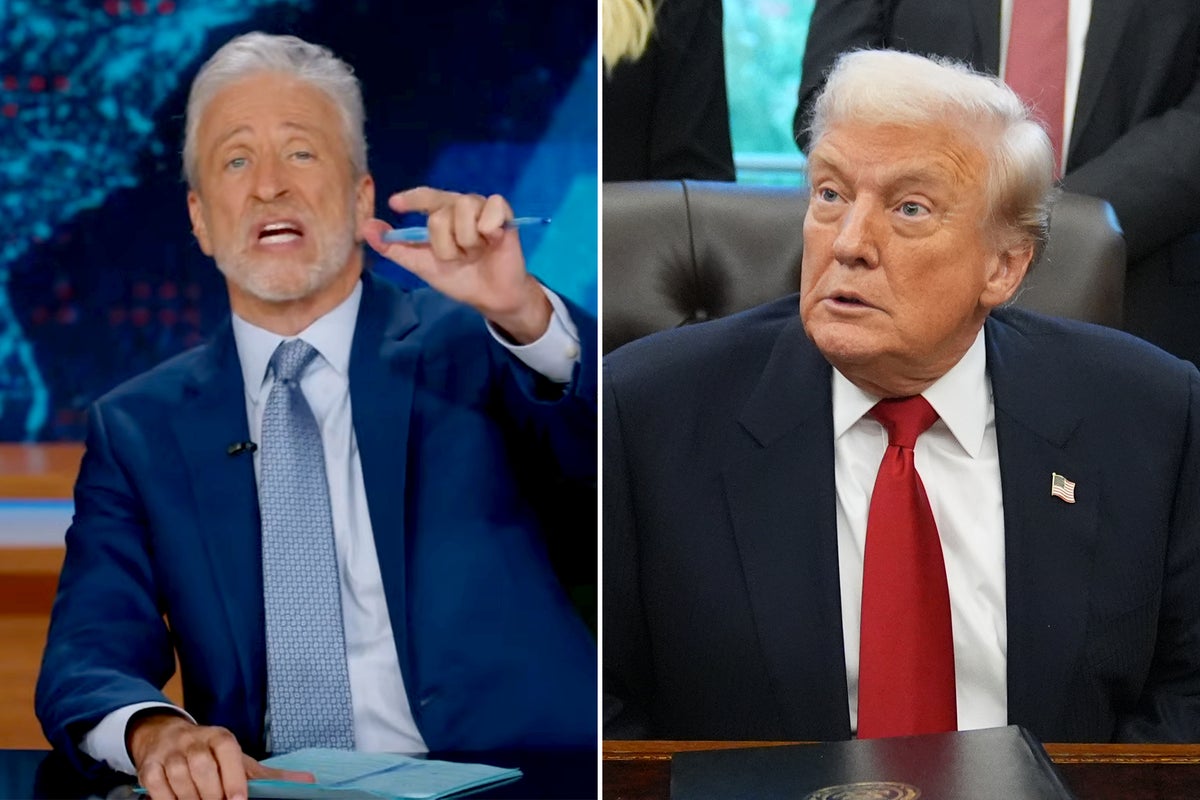
Donald Trump and Jon Stewart have spent the better part of two decades locked in a cycle of mutual loathing that defines the modern American political theater. Stewart, the architect of the satirical news-as-weaponry movement, and Trump, the ultimate creature of the television camera, usually interact through a series of predictable insults. However, a recent shift in the airwaves suggests a different tactic. When Stewart offered a rare, measured acknowledgment of Trump’s political instincts, the former president didn’t just accept the olive branch—he leaned into the absurdity.
The catalyst for this strange alignment was a segment involving ibogaine, a powerful naturally occurring psychedelic. While the surface-level story is about a late-night host making a joke and a politician playing along, the underlying reality reveals a sophisticated manipulation of media narratives. Both men are masters of the "clout economy," and they both know that the fastest way to dominate a news cycle is to break character.
The Psychedelic Pivot
During a recent broadcast, Jon Stewart deviated from his usual script of relentless critique. He paused to note that, regardless of one’s stance on the man, Donald Trump possesses a certain "animal instinct" for the grievance of the American voter. It was a moment of clarity that stood out in a sea of partisan noise. But Stewart being Stewart, he couldn't leave the praise unvarnished. He pivoted to a bizarre, hallucinogenic riff involving ibogaine—a substance often cited in counter-culture circles for its ability to "reset" the brain’s addiction centers.
Stewart’s mockery suggested that Trump’s erratic energy was less about strategy and more about a psychedelic-induced fever dream. In any other era of politics, a candidate would ignore the jab or issue a stern condemnation of drug-themed humor. Trump did neither. Instead, he signaled an awareness of the joke, effectively neutralizing the sting by treating it as part of the shared comedy of the campaign trail.
This isn't just about two famous men trading barbs. It is about the normalization of fringe topics through the lens of political entertainment. Ibogaine is not a household name. It is a Schedule I substance in the United States, derived from the root bark of the Tabernanthe iboga plant. By injecting it into the national conversation, Stewart used it as a metaphor for the country's perceived madness. By playing along, Trump signaled that he is "in on the joke," a move that makes him appear more human and less like the caricature his opponents hope to sustain.
Why Ibogaine Entered the Chat
The mention of ibogaine was no accident. Stewart, an astute observer of the cultural zeitgeist, tapped into a growing trend: the "psychedelic renaissance" currently sweeping through Silicon Valley and veteran advocacy groups. There is a serious movement to legalize ibogaine for the treatment of opioid addiction. By using it as a punchline, Stewart was playing to an audience that is increasingly literate in the world of alternative medicine and "bio-hacking."
- The Clinical Reality: Ibogaine is a potent tryptamine. Unlike psilocybin or LSD, it is known for producing a "dream-like" state while the user is awake, often accompanied by intense physical side effects.
- The Political Utility: For Stewart, it serves as the ultimate "weird" factor. For Trump, it represents another opportunity to show his base that he is unbothered by the coastal elite's attempts to frame him as unstable.
When Trump acknowledged the segment, he wasn't endorsing the substance; he was endorsing the spectacle. This is the core of his media strategy: embrace the chaos, acknowledge the hunter, and then walk away unscathed. It’s a defensive maneuver that looks like an offensive strike.
The Architecture of the Rare Praise
Why did Stewart offer praise in the first place? To understand this, you have to look at the current state of late-night television. Ratings are in a death spiral. The "clapping over laughing" era of political comedy has exhausted the general public. Stewart, who returned to The Daily Show to reclaim his throne as the elder statesman of satire, knows that pure vitriol is no longer a viable product.
By admitting that Trump has a "talent," Stewart regains his credibility as a "fair" arbiter of truth. It allows him to say, "I am not just a partisan hack; I am an analyst." This provides him with a larger platform when he eventually delivers the killing blow. It is a classic journalistic "setup"—build them up just enough so that the subsequent takedown feels earned rather than reflexive.
Trump, for his part, is a connoisseur of his own press. He monitors his mentions with the obsessiveness of a teenager. When a high-profile critic like Stewart gives him even an inch of credit, Trump uses it as a shield. He can point to the praise as proof that even his "enemies" recognize his greatness, while simultaneously laughing off the "ibogaine mockery" as the harmless ramblings of a comedian. It is a win-win for both parties, regardless of the actual political fallout.
The Mechanics of the Interaction
The exchange functioned through a specific three-step process:
- The Admission: Stewart concedes a point of strength to Trump.
- The Absurdist Anchor: Stewart attaches that strength to something ridiculous (ibogaine).
- The Amplification: Trump reacts to the admission, ignoring the mockery to validate the praise.
This creates a feedback loop where the actual policy issues are buried under a layer of meta-commentary. We are no longer talking about the border, the economy, or foreign policy. We are talking about Jon Stewart talking about Donald Trump talking about ibogaine.
The Undercurrent of Addiction and Recovery
There is a darker, more serious layer to this that neither man addressed directly. Ibogaine is primarily known as an "interrupter" for heroin and fentanyl addiction. Using it as a prop in a comedy routine about a presidential candidate ignores the harrowing reality of the opioid crisis that has devastated the very voters Trump claims to represent.
In certain parts of the country, ibogaine is viewed with a sense of desperate hope. There are "underground railroads" taking Americans to clinics in Mexico and Costa Rica where the drug is legal. By turning the substance into a punchline about Trump’s "visions," Stewart risks trivializing a tool that many see as a last-resort lifesaver. This is the danger of high-level political satire: it often uses the most painful realities of the human condition as mere colors on a palette.
The Counter-Argument
One could argue that Stewart’s mention of the drug actually helps. By putting the word "ibogaine" into the mouths of millions of viewers, he triggers a search for knowledge. People go to Google. They read about the promising trials for PTSD and addiction. They learn about the heart risks associated with the treatment. In this view, the mockery is the delivery vehicle for awareness.
Trump's participation, however cynical, also brings the topic into the "populist" sphere. If the leader of the MAGA movement is talking about—or even acknowledging—psychedelic mockery, it removes some of the "hippie" stigma from the class of drugs. This could, ironically, pave the way for more serious policy discussions regarding breakthrough therapies.
A Masterclass in Distraction
Ultimately, the Stewart-Trump-Ibogaine triangle is a masterclass in modern distraction. We are living through a period of intense institutional distrust. The media is fractured, the political parties are at each other's throats, and the average citizen is exhausted. In this environment, "moments" like these serve as a pressure valve.
They provide the illusion of a conversation. We feel as though something has happened because two giants of the 2000s-era media landscape have acknowledged each other’s existence. But when you strip away the clever writing and the characteristic Trumpian bluster, what remains?
Nothing changed. No policy was debated. No mind was truly moved.
Stewart got his clips for social media. Trump got to show he still has a pulse on the comedy world he once dominated as a roast subject and SNL host. The ibogaine joke served its purpose: it was weird enough to be memorable, but harmless enough to prevent any real damage.
The strategy is simple. If you can make the electorate focus on the "vibe" of the exchange, they won't focus on the substance of the critique. Stewart provided the vibe, and Trump rode the wave. It is a symbiotic relationship disguised as a feud. They need each other to remain relevant in a world that is increasingly looking for new voices.
The "ibogaine" incident isn't a sign of a softening relationship or a new direction in political discourse. It is a reminder that the circus still requires performers who know how to play their parts. As long as we are laughing at the hallucinations, we aren't looking at the reality of the room.
Watch the hands, not the mouth. The trick isn't in what they say; it's in what they make you forget while they’re saying it.