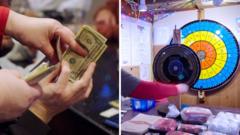
The wheel is a chipped, wooden relic of a louder era. It stands on the bar at an American Legion post in Waconia, groaning as it turns, a rhythmic clack-clack-clack that cuts through the hum of Friday night gossip and the hiss of tap beer. Every head in the room follows the red pointer.
For forty years, this has been the heartbeat of rural Minnesota.
It is called a meat raffle. To an outsider, it sounds like a punchline. To the people in this room, it is the difference between a local youth hockey team having new jerseys or playing in hand-me-downs. It is the fuel for veterans' memorials. It is a social safety net disguised as a gambling game.
The pointer slows. It skips past 22, nudges 23, and stops dead on 5.
Andrea "Mama" Avaloz lets out a holler that vibrates the glassware. She just won a $2 bet. Her prize is a plastic-wrapped bundle of fajita meat and beef sticks. She is ecstatic. She is the lucky one.
But beneath the cheers, there is a quiet, mathematical rot eating away at this tradition. The steaks are getting thinner. The "grill packs" are shrinking. The math of the Midwest is no longer adding up.
The Shrinking Perimeter of the Plate
The problem is not a lack of enthusiasm. People still want to win. The problem is a set of rigid, dusty laws clashing with a global economy that doesn't care about Waconia.
Since the late 1980s, Minnesota state law has kept a tight leash on these raffles. For nearly four decades, the maximum price for a ticket was frozen at $2. The maximum value for a prize was capped at $70. In 1987, $70 could buy you enough T-bones to feed a neighborhood. It bought a sense of abundance.
Today, $70 barely covers a modest Sunday roast and a few packs of bacon.
Consider the trajectory of a pound of ground chuck. Twenty years ago, you could snag it for $2.55. Now, you are looking at over $6. The cattle population in the United States has hit a 75-year low. Feed costs are up. Fuel for transport is up. Trade tariffs have choked the flow of imports.
When the wholesale price of beef doubles, but the legal prize limit stays frozen, the raffle becomes a ghost of itself. Charities are forced to offer "prizes" that feel more like leftovers.
The Invisible Stakes
This isn't about people losing out on free dinner. That is a common misunderstanding.
The meat raffle is a engine for charitable gambling. In Minnesota, these events are run by nonprofits—Lions Clubs, VFWs, and youth athletic associations. Every dollar spent on a ticket, after the butcher is paid and the lights are kept on, flows directly back into the town.
When the raffle fails, the community feels it in ways that aren't immediately obvious.
It’s the scholarship that doesn't get funded. It’s the local food shelf that sees a smaller donation. It's the veteran who doesn't get the assistance he needs because the American Legion's Friday night take was down by 40%.
The "meat" is the lure, but the community is the catch.
A Bipartisan Peace Offering
In a political climate where the Minnesota Legislature can barely agree on the color of the sky, the meat raffle has achieved something rare: total, desperate agreement.
Lawmakers are currently moving a bill to drag the tradition into the 2020s. The proposal is simple. Raise the ticket price limit to $5. Raise the prize cap to $200. It is a frantic attempt to keep pace with an inflationary beast that has been running unchecked.
"This is probably the best feel-good bill we have," says Representative Jim Nash. He isn't talking about the steak. He is talking about survival.
If the bill passes, the $200 limit will allow organizers to offer "super packs"—the kind of prizes that actually draw a crowd. It allows the local butcher, like those at Borchert’s Meat Market, to provide quality cuts again rather than searching for the cheapest possible filler to stay under the $70 ceiling.
The Sound of the Wheel
Back at the 1029 Bar in Minneapolis, the room is packed. The walls are decorated with a squad car door riddled with bullet holes—a reminder of the grit of the neighborhood. Roberta Rodriguez, who runs the raffle for the Northeast Minneapolis Lions Club, watches the regulars.
They tease each other. They buy rounds. They wait for their number to hit.
If you ask them about inflation, they’ll tell you about the price of eggs. If you ask them about the meat raffle, they’ll tell you it’s the only place where a couple of bucks still feels like it has a chance to turn into something real.
The wheel spins again.
It is a low, humming sound, the sound of a community trying to hold onto its rituals while the world around it gets more expensive by the hour. The pointer ticks against the pins.
Clack.
Clack.
Clack.
Everyone is leaning in. They aren't just looking for a prize. They are looking for the assurance that some things don't have to change, even when everything else does.
The wheel stops. Someone wins. For tonight, at least, the fire stays lit.