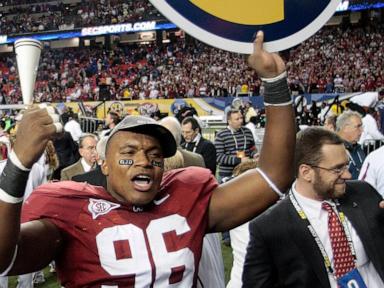
The Ghost on the Defensive Line
Success in the SEC isn't just about strength; it’s about presence. When Justin Vincent Smiley stepped onto the field for the Alabama Crimson Tide, he occupied space that most men couldn't imagine. He was a 300-pound mountain of potential, a former four-star recruit who lived in the pressurized air of Bryant-Denny Stadium. In that world, your name is your currency. Your face is your brand. But as the bright lights of a football career began to dim, Smiley discovered a dark, lucrative truth.
Names can be stolen. Faces can be painted.
The transition from elite athlete to "former" athlete is a quiet trauma that thousands of young men face every year. One day you are the pride of Tuscaloosa, and the next, you are just another large man in a grocery store aisle. For Smiley, the descent didn't lead to a coaching job or a broadcast booth. It led to a makeup chair and a trunk full of wigs.
The scheme he allegedly built wasn't just a simple lie. It was a $20 million theatrical production where the stage was the high-stakes world of private equity and the audience was a group of investors who should have known better. But when a man looks like an NFL star and talks like an NFL star, the brain stops looking for the cracks in the foundation.
The Art of the Disguise
Imagine sitting across from a man who claims to be a household name in professional sports. He has the build. He has the confidence. He even has the specific, weathered look of a veteran who has spent a decade crashing into human brick walls. Federal prosecutors argue that Smiley didn't just tell people he was a pro; he became them.
He used high-end cosmetics and professional-grade wigs to bridge the gap between his own identity and the identities of the athletes he was impersonating. This wasn't a Halloween costume. It was a psychological weapon. By altering his appearance to match the aging faces of specific, retired NFL players, Smiley bypassed the natural skepticism of his marks.
He understood a fundamental flaw in human nature. We see what we expect to see. If you are told you are meeting a linebacker, and a man with the shoulders of a linebacker sits down in front of you wearing the right jewelry and speaking with the right cadence, you don't ask for a passport. You reach for your checkbook.
The stakes were staggering. This wasn't about a few thousand dollars for a "charity" appearance. This was a sophisticated machine designed to siphon $20 million into a vacuum of fraud. Smiley allegedly convinced investors that they were getting in on the ground floor of elite business ventures backed by the heavy hitters of the sporting world.
The Invisible Toll of the Grift
To understand the weight of this crime, you have to look past the dollar signs and into the lives of the men whose names were used as bait. To a professional athlete, their reputation is their only permanent asset. A career in the NFL is a flash of lightning—blindingly bright and over in seconds. What remains is the integrity of the name on the back of the jersey.
When that name is used to lure investors into a $20 million hole, the damage is radioactive. It creates a stain that no amount of legal exoneration can fully scrub away. The victims here aren't just the people who lost their life savings; the victims are also the players who woke up to find their legacies weaponized by a man who once shared their dreams of glory.
Consider the hypothetical investor, let's call him David. David worked thirty years in logistics. He was a fan. He followed Alabama football. When he met a man he believed was a legend, he felt a sense of proximity to greatness. It wasn't just an investment; it was an invitation into an inner circle. That emotional hook is the most dangerous part of any fraud. It blinds the logical mind. David didn't just lose his retirement; he lost his trust in the one thing that gave him joy on Sunday afternoons.
The Cracks in the Porcelain
Every performance has a final curtain. No matter how many layers of latex or how many expensive wigs Smiley allegedly employed, the reality of the paper trail was something he couldn't mask. While he was busy playing a character, federal agents were busy following the money.
The complexity of the impersonations suggests a man who was deeply committed to the craft. He wasn't just a scammer; he was a method actor. But in the cold light of a federal courtroom, the makeup comes off. The wigs are boxed up as evidence. What is left is a former athlete who realized too late that the most valuable thing he ever owned was the identity he tried so hard to hide.
The sheer audacity of the $20 million figure points to a systemic failure in how we vet "influencers" and public figures in the business world. We have become so enamored with celebrity and the proximity to power that we have forgotten the basic tenets of due diligence. A famous face—or a convincing replica of one—has become a master key that opens doors that should remain locked.
The Quiet After the Storm
There is a specific kind of silence that follows a massive fraud. It’s the sound of realized loss. In the locker rooms of the SEC, coaches talk about "character" and "integrity" as if they are permanent traits, baked into a young man’s soul by the heat of the game. But the story of Justin Vincent Smiley suggests that these traits are more fragile than we want to admit.
When the cheering stops and the body starts to ache, the temptation to find a shortcut back to the spotlight can be overwhelming. Some men go into real estate. Some go into coaching. Smiley allegedly went into the mirror, looking for a way to be anyone but himself.
The tragedy isn't just the money lost. It’s the realization that a man who once had the world at his feet felt he needed to wear another man’s face just to survive. The greasepaint is gone now, and the wigs are in evidence bags, leaving behind a story of a mountain of a man who tried to disappear into the shadows of people he used to call peers.
The courtroom will eventually decide his fate, but the narrative is already written in the ledgers of those who lost everything. The $20 million is gone, scattered into the winds of a lifestyle that required constant maintenance to keep the illusion alive. In the end, the most expensive thing in the world isn't a luxury car or a mansion.
It is the cost of maintaining a lie that you can no longer afford to live.