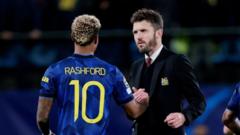
Michael Carrick is not a man prone to hyperbole or emotional outbursts. During his time patrolling the midfield at Old Trafford, he was the personification of calm, a player who saw the entire pitch three moves ahead of everyone else. Now, as he navigates the volatile waters of football management, that same calculated composure is being applied to one of the most polarizing figures in the modern English game. By refusing to shut the door on a Marcus Rashford return to form or perhaps even a future role under his guidance, Carrick is playing a sophisticated game of psychological chess that extends far beyond the touchline.
The current narrative surrounding Rashford is one of stagnation and spent potential. At Manchester United, he has become a lightning rod for criticism, often appearing like a man carrying the weight of the entire city on his shoulders. The spark that once terrified defenders has flickered, replaced by heavy touches and a body language that suggests a deep-seated exhaustion with the scrutiny of the Premier League. When Carrick speaks about Rashford, he isn't just offering a former teammate a lifeline. He is identifying a market inefficiency in the player’s current mental state. He knows that beneath the lack of confidence lies a world-class athlete whose fundamental mechanics haven't changed, even if his output has. For a different perspective, check out: this related article.
The Psychology of the Door Left Ajar
In the high-stakes environment of elite football, public statements are rarely accidental. When a manager of Carrick’s standing suggests that the "door is open," it serves two distinct purposes. First, it acts as a direct signal to the player that there is a sanctuary available where his past successes are valued more than his recent failures. Second, it shifts the pressure back onto the current coaching staff at Manchester United. It asks a silent, uncomfortable question: If Michael Carrick believes he can fix Marcus Rashford, why can’t you?
Rashford’s struggles are not technical. You do not forget how to strike a ball with that level of whip or how to time a blind-side run overnight. The breakdown is systematic and internal. He is a high-variance player who thrives on instinct and explosive bursts. Under the rigid tactical structures that have defined United’s recent history, that instinct has been coached out of him in favor of safe passes and defensive positioning that drains his energy before he even reaches the final third. Carrick, having spent years feeding Rashford those very through-balls, understands that the player needs a specific type of freedom to function. Further reporting regarding this has been provided by Bleacher Report.
Tactical Freedom Versus Structural Rigidity
The modern game has become obsessed with "control." Managers want to script every movement, turning players into chess pieces that move only on specific diagonals. For a player like Rashford, this is a death sentence. He is at his best when the game is chaotic, when he can use his pace to exploit a disorganized high line.
If we look at the tactical setups Carrick has favored at Middlesbrough, we see a heavy emphasis on fluid transitions and giving attacking players the license to fail. This is the crucial missing ingredient for Rashford right now. At Old Trafford, a single lost ball leads to a ten-minute highlight reel of his "poor work rate" on social media. In a Carrick system, that lost ball is seen as the necessary cost of an ambitious play. The psychological safety of knowing you won't be hauled off for taking a risk is what built the Rashford of 2020.
The Burden of the Local Hero
There is a unique pressure that comes with being the homegrown face of a global brand. Rashford is more than a footballer; he is a symbol of the club’s academy and a prominent social activist. While his off-field work is commendable, it has created an impossible standard. He is expected to be a saint off the pitch and a superstar on it, with no room for the human fluctuations in form that every athlete experiences.
Carrick understands this burden because he watched it break players of lesser resolve. By maintaining a public connection to Rashford, Carrick is offering a version of the game that is stripped back to the basics. No politics, no brand management, just football. It is a compelling proposition for a player who looks like he has stopped enjoying the sport.
The Financial Reality of a Career Pivot
From a business perspective, the idea of Rashford moving away from the bright lights of the "Big Six" seems nonsensical. His wages are astronomical, and his commercial value is tied to the global reach of Manchester United. However, we are approaching a tipping point where the depreciation of his on-field value will eventually outweigh his marketing pull.
A "step down" to work under a manager like Carrick could be the most lucrative move Rashford ever makes in the long run. If he stays and continues to decline, he becomes a backup player on a massive contract, a situation that rarely ends well for the athlete's legacy or future earnings. If he moves to a system designed to highlight his strengths, he rehabilitates his image and proves he can still lead a line.
Why Carrick is the Right Architect
Management is about more than just drills and video analysis. It is about empathy. Carrick isn't a shouter. He is a whisperer. He is the type of coach who pulls a player aside and explains the "why" behind a movement rather than screaming the "what." For a sensitive, confidence-driven player like Rashford, this approach is far more effective than the "tough love" often advocated by old-school pundits.
The league is full of talented players who were "discarded" by major clubs only to find their best form under a manager who actually understood them. Think of the way certain strikers found their footing again after leaving the pressure cooker of London or Manchester. Carrick is betting on the fact that Rashford’s "ceiling" hasn't lowered; the floor beneath him has just become unstable.
The Risk of Staying Put
The most dangerous thing Marcus Rashford can do right now is nothing. Sticking with the status quo at Manchester United, hoping for a sudden change in fortune, is a strategy rooted in denial. The club is in a state of perpetual transition, and in those environments, individual development often takes a backseat to short-term survival.
Every game where he looks disinterested or ineffective chips away at his standing with the fans. The "door" Carrick mentioned isn't just an exit; it's an opportunity to change the narrative from "failing star" to "comeback story." The media loves a redemption arc, and the foundations for that story are currently being laid in the North East.
Redefining the Modern Career Path
We are seeing a shift in how elite players view their careers. The idea that you must stay at a top-tier club at all costs is fading. Players are realizing that playing time and tactical fit are more important for their long-term health and happiness than sitting on a prestigious bench.
Carrick’s comments are a beacon for this new mindset. He is inviting Rashford to stop being a symbol and start being a striker again. Whether this specific move happens is almost secondary to the message it sends. It tells the football world that Marcus Rashford is still a wanted man, and that his best years might not be behind him, but simply waiting for a different set of keys to unlock them.
The transition from a global icon to a functional, high-performing footballer requires a level of humility that many struggle with. It requires admitting that the current path is a dead end. Carrick has offered the map. Rashford just has to decide if he’s willing to drive.
The window for this kind of intervention is small. Football moves fast, and today’s "open door" can quickly become tomorrow’s "missed opportunity" as teams move on to younger, less complicated targets. The silence from Rashford's camp in response to these overtures is telling. It suggests a player who is weighing the safety of his current struggles against the terrifying uncertainty of a fresh start. But in the cold light of day, the only thing more frightening than leaving is staying exactly where you are while the world watches you fade.
The ball is in Rashford’s court, but Carrick has already shown him exactly where the goal is.