The seizure of a sanctioned vessel within the Strait of Hormuz is not merely a tactical maneuver; it is a high-stakes calculation of sovereign risk, kinetic capability, and international maritime law. When U.S. forces execute a six-hour interdiction of an Iranian-affiliated tanker, they are managing a compressed timeline where the failure of any single operational pillar—intelligence, boarding speed, or escalation dominance—results in a strategic setback. The efficacy of these operations depends on the ability to maintain a localized monopoly on violence while navigating the densest maritime chokepoint on the planet.
The Triple Constraint of Hormuz Interdictions
Operational success in the Strait of Hormuz is dictated by three interlocking variables that form a zero-sum environment for commanders.
- Geography as a Force Multiplier for the Adversary: The strait’s narrowest point is approximately 21 miles wide, with shipping lanes even more restricted. This proximity places U.S. assets within the "envelope" of land-based anti-ship cruise missiles (ASCMs) and fast-attack craft (FAC) swarms.
- The Six-Hour Window of Sovereignty: From the moment a boarding team hits the deck to the point the vessel reaches international or protected waters, there is a fixed window where the legal status of the ship is in flux. If the interdiction exceeds this timeframe without establishing physical control of the engine room and bridge, the risk of a counter-boarding or swarm intervention scales exponentially.
- Signal vs. Noise in the Commons: Identifying a specific tanker among thousands of daily transits requires persistent ISR (Intelligence, Surveillance, and Reconnaissance) that integrates SIGINT (Signals Intelligence) with visual confirmation. A mistake in identification carries the cost of a multi-million dollar diplomatic incident.
Anatomy of the Boarding Sequence
The mechanics of a specialized maritime raid are defined by the "Fast Rope and Secure" protocol. In the specific context of the tanker interdiction, the U.S. Navy and Coast Guard utilize Advanced Interdiction Teams (AIT) to overcome the structural defenses of a VLCC (Very Large Crude Carrier).
The primary obstacle is the sheer verticality of the vessel. Tankers of this class often possess a "freeboard"—the distance from the waterline to the deck—that makes boarding from RHIBs (Rigid Hull Inflatable Boats) dangerous if the vessel is making way. To mitigate this, the operation utilizes a Vertical Insertion (VI).
Phase I: Aerial Suppressance and Insertion
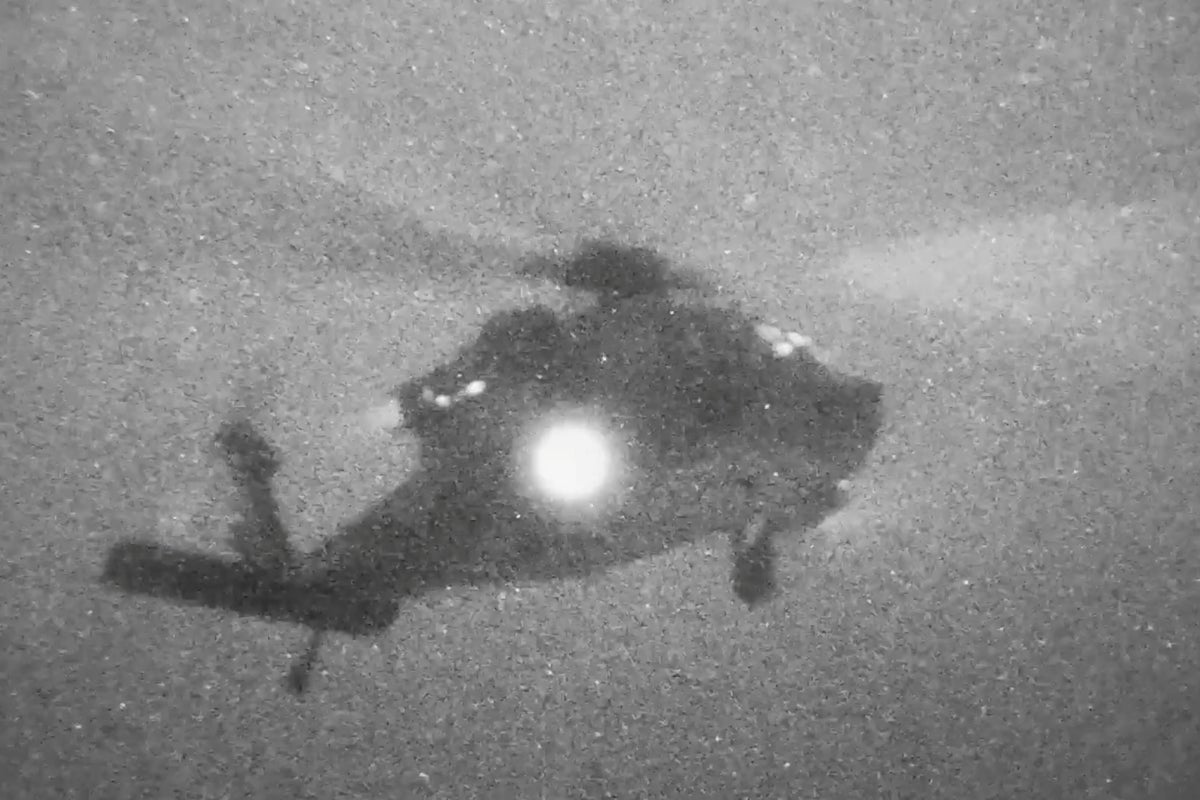
Two MH-60S Seahawk helicopters provide the primary insertion platform. While one helicopter hovers to deploy the fast-rope team, the second maintains an offset position to provide overwatch. This "high-low" coverage is designed to discourage Iranian Revolutionary Guard Corps (IRGC) fast boats from closing the distance. The psychological pressure of a hovering rotor-wing asset acts as a kinetic deterrent before a single shot is fired.
Phase II: Bridge and Engine Room Neutralization
Control of a tanker is binary. The boarding team must split into two elements immediately upon hitting the deck. The first element secures the bridge to prevent the crew from scuttling the vessel or altering course into Iranian territorial waters. The second element moves to the "Aft Peak" and engine spaces. Without mechanical control, the vessel becomes a drifting 300,000-ton liability.
Phase III: The Stand-off Radius
As the boarding team secures the interior, the surrounding surface assets—typically a destroyer like the USS Mason or an Arleigh Burke-class equivalent—establish a 5,000-yard "bubble." Any vessel entering this radius without authorization is met with a graduated response:
- Bridge-to-bridge radio warnings.
- Long-Range Acoustic Device (LRAD) broadcasts.
- Optical warning shots (flares).
- Kinetic disabling fire.
The Iranian Response Matrix: Swarm Tactics and Asymmetric Escalation
The IRGC Navy (IRGCN) does not fight for total sea control; it fights for "sea denial." During the six-hour stand-off, the primary threat is the use of Boghammar-class fast boats. These vessels operate on a principle of saturation.
The logic of the swarm is simple: overwhelm the Target Acquisition System of the U.S. destroyer. If thirty boats approach from 360 degrees, the destroyer’s Phalanx CIWS and 5-inch guns cannot track every target simultaneously. This creates a "leaking" effect where one or two boats might reach the tanker to attempt a counter-boarding.
The presence of the U.S. Air Force or Navy air cover (F/A-18s or A-10s) is the only factor that breaks this logic. By providing "top-down" targeting, aircraft can neutralize swarms before they enter the destroyer's defensive inner layer. This creates a multi-layered defensive shield that forces the IRGCN to calculate whether the loss of thirty hulls is worth the political gain of reclaiming one tanker.
Logistical Friction in Contested Waters
A hidden complexity of these raids is the "Prize Crew" requirement. Once the AIT has neutralized the ship, they are not equipped to sail it. A separate crew of specialized merchant mariners or Navy engineers must be transferred to the vessel to operate the complex ballast and propulsion systems.
The fuel transfer logic also dictates the timeline. If the tanker is being seized to prevent the delivery of illicit oil, the U.S. must decide whether to divert the ship to a friendly port (such as Fujairah) or perform a ship-to-ship (STS) transfer in open water. An STS transfer is an engineering nightmare that requires calm seas and hours of precise maneuvering—luxury items not available during an IRGC stand-off. Therefore, the strategic play is always "Transit First, Transfer Later."
The Legal and Economic Calculus of Interdiction
The United States operates under the "Right of Visit" as outlined in Article 110 of the UN Convention on the Law of the Sea (UNCLOS), though it often relies on domestic sanctions law (e.g., IEEPA) as the underlying justification. This creates a friction point: the U.S. must prove the vessel is carrying "stolen" or sanctioned cargo to maintain international legitimacy.
From an economic perspective, these stand-offs create a "Risk Premium" in the oil markets. Each hour the stand-off persists, the insurance "War Risk" rates for the entire Strait of Hormuz increase.
$$Cost_{Total} = (Vessel_{Value} + Cargo_{Value}) \times Risk_{Factor} + Operational_{Outlay}$$
Where the $Risk_{Factor}$ is a function of the proximity to IRGC bases and the duration of the kinetic engagement.
Strategic Forecast: The Shift to Unmanned Interdiction
The current model of high-risk human boarding is reaching a point of diminishing returns. The introduction of Task Force 59—the U.S. 5th Fleet’s unmanned systems unit—suggests a transition in how these six-hour windows are managed.
In the near term, we will see the deployment of "USV Pickets." Unmanned Surface Vessels (USVs) equipped with sensors and non-lethal deterrents will be used to form the initial cordon around a seized tanker. This reduces the risk to sailors and allows the destroyer to stay further back, out of the range of shore-based missiles.
The ultimate strategic move for the U.S. in the Strait of Hormuz is not the increase of physical hulls, but the perfection of "Transparent Maritime Domain Awareness." If every Iranian move is tracked from the moment a garage door opens at a base in Bandar Abbas, the six-hour window of the U.S. raid can be started before the Iranian counter-response is even fueled.
Operational commanders must now prioritize the integration of AI-driven predictive modeling to anticipate IRGC swarm launch points. The goal is to move from a reactive "stand-off" to a proactive "exclusion zone," where the cost of interference for the adversary becomes so high that the raid itself becomes a formality rather than a fight.