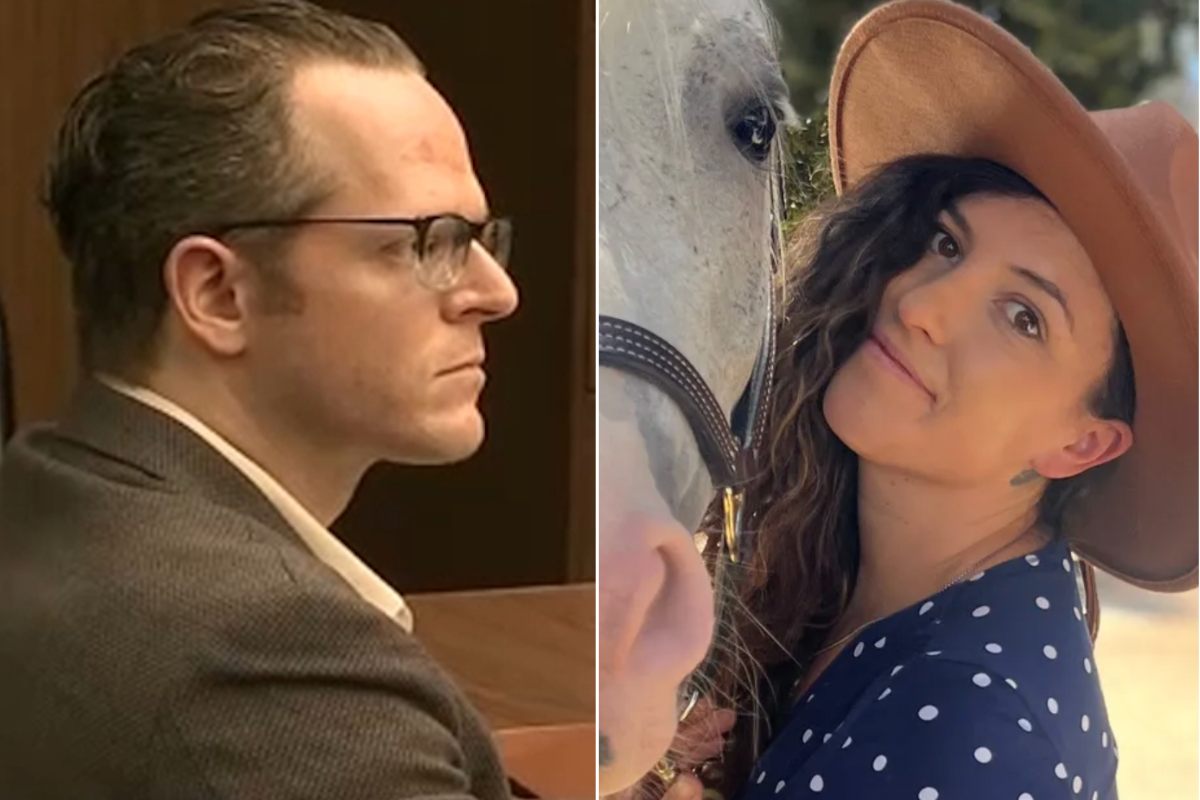
The air in a Los Angeles courtroom is unlike the air anywhere else. It is heavy, recycled, and smells faintly of floor wax and old paper. But on a Tuesday in late May, that air turned crystalline. It sharpened until it felt like it might draw blood just by being inhaled. Allie Shehorn sat in that room, her body a map of survival, waiting for the man who tried to erase her to look her in the eye.
Nick Pasqual, a man who once spent his days on the set of How I Met Your Mother, stood before a judge. He wasn't playing a bit part anymore. He wasn't the charming, aspiring actor or the boyfriend who brought coffee to the set. He was a man facing the reality of a life sentence for attempted murder.
The transition from a romantic partner to a predator doesn’t happen in a vacuum. It happens in the quiet spaces between the lines of a script.
The Anatomy of a Shadow
We often talk about domestic violence in terms of "red flags," as if they are bright neon signs blinking in a dark alley. But in the world of entertainment, where everyone is trained to project a specific image, those flags are often muted, woven into the fabric of a "passionate" or "artistic" temperament.
Allie was a makeup artist. Her entire career was built on the foundation of transformation. She knew how to hide bruises with concealer; she knew how to contour a face to highlight its strengths and shadow its weaknesses. There is a cruel irony in the fact that while she spent her days perfecting the appearance of others, her own life was being dismantled by a man who excelled at the most dangerous kind of acting: the kind that happens off-camera.
On May 23, the performance ended.
It wasn’t a slow fade. It was an explosion. Pasqual didn't just break into Allie’s Sunland home; he invaded the one place where she was supposed to be the director of her own safety. He didn’t just strike her. He stabbed her twenty times.
Think about that number. One. Two. Three. Each one is a conscious decision. Each one is a rejection of the humanity of the person screaming beneath you. By the time he reached twenty, he wasn't just trying to hurt her. He was trying to ensure there was nothing left of the person he claimed to love.
The Long Walk to the Stand
Allie survived. To call it a miracle is to simplify the grueling, agonizing work of medical science and the sheer stubbornness of the human spirit. She spent weeks in the hospital, tethered to tubes, her body fighting to knit itself back together. When she finally walked into that courtroom, she wasn't just a victim testifying in a case. She was a living, breathing rebuttal to the idea that Pasqual had won.
She used a walker. The metal clicked against the linoleum, a rhythmic, steady sound that filled the silence of the room. It was the sound of a woman reclaiming her space.
Pasqual sat at the defense table. He had tried to flee, of course. After the attack, he headed for the border, a classic cinematic escape that ended in a very uncinematic arrest at a checkpoint in Sierra Blanca, Texas. Now, he was trapped in a frame he couldn't escape.
The prosecution laid out the charges: attempted murder, first-degree residential burglary with a person present, and injuring a spouse, cohabitant, fiancé, boyfriend, girlfriend, or child’s parent. It sounds clinical when read by a court clerk. It sounds like paperwork. But when Allie spoke, the clinical fell away.
She didn't just talk about the night of the attack. She spoke to the court about the terror that precedes the blade. She spoke about the restraining order she had filed just days before, a piece of paper that is meant to act as a shield but often feels like a target. It is a terrifying paradox: to get protection, you must provoke the person you fear by officially declaring your fear.
The Industry of Silence
There is a specific pressure in the Hollywood ecosystem to keep things "professional." Actors are told that their reputation is their currency. Makeup artists, crew members, and stylists are told that they are lucky to be in the room. This creates a culture where the private lives of "talent" are often shielded, and the people who work closest to them are conditioned to ignore the cracks in the facade.
Pasqual was a minor player in the grand scheme of the industry, but he operated within that same culture of entitlement. He believed he could command the narrative. He believed he could script Allie's end.
But the narrative shifted. The "How I Met Your Mother" actor—a credit that now serves as a grim footnote rather than a badge of honor—was found guilty. The jury didn't see a star. They saw a man who had used a knife to try and resolve a conflict of his own making.
The sentencing wasn't just about punishment. It was about the validation of a survivor's reality. When the judge handed down the conviction, it wasn't just a legal victory; it was a public declaration that the mask had finally slipped for good.
The Scars That Remain
We like to think that when the gavel falls, the story is over. The credits roll, and we move on to the next headline. But for Allie, the end of the trial is just the beginning of a different kind of endurance.
The physical wounds heal into scars, silver lines that trace the history of a night she can never forget. The psychological wounds are deeper. They are the shadows in the corner of a room, the sudden jump at a door closing too loudly, the long process of learning to trust the air in a room again.
She is back at work now, or trying to be. She is back to using her hands to create beauty, to transform faces, to tell stories that aren't her own. But she carries the weight of this story with her.
As she left the court that day, the sun was bright over Los Angeles, a city built on the art of pretending. She didn't have to pretend anymore. She had looked into the eyes of her monster and watched him be led away in chains.
The metal walker moved forward, one click at a time, toward a world where she was no longer a character in someone else’s tragedy, but the sole author of her own survival.


