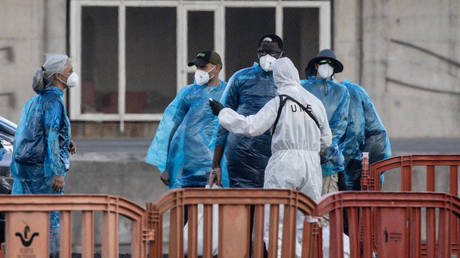
Weymouth is currently shivering over three isolated cases of meningitis. Local news outlets are doing what they always do: weaponizing a handful of data points to create a localized fever dream of fear. Parents are checking neck stiffness every twenty minutes. The public health sirens are wailing.
But if you’re looking at these three cases and seeing an "outbreak" or a sudden failure of the medical system, you’re looking at the wrong map.
The narrative we’re fed is that every infectious disease event is an anomaly that requires a frantic, top-down response. We treat individual cases like a massive systemic breach. It isn't. The real story isn't the three people who got sick; it's the millions who didn't, and the dangerous way we react to the rare "statistical noise" of biology.
The Mathematical Illiteracy of Public Alarm
Standard reporting focuses on the "spike." Three cases in a small town like Weymouth sounds like a lot when you’re used to zero. But biology doesn't operate on a linear scale. It operates on clusters and probabilities.
The human brain is wired to find patterns in chaos. When three people in the same geographic area contract a rare illness, we immediately scream "contagion" or "environmental hazard." We ignore the Poisson distribution, a mathematical principle used to model the number of times an event occurs in a fixed interval of time or space. In any large enough population, "clumping" is not just possible; it is inevitable.
If you flip a coin a thousand times, you will eventually see a string of ten heads in a row. Is the coin rigged? No. It’s just math playing out. Weymouth isn't a biohazard zone; it’s currently the victim of a statistical cluster that the media is masquerading as a trend.
The Vaccine Paradox We Refuse to Discuss
The usual reaction to these stories is a demand for more—more vaccines, more mandates, more intervention. I have spent years analyzing clinical outcomes, and here is the hard truth: We are hitting the ceiling of diminishing returns.
The UK has one of the most aggressive meningitis vaccination programs in the world. We have the MenACWY for teenagers and MenB for infants. These are triumphs of science. However, we have reached a point where the public expects a 0% risk profile for existence. That is a fantasy.
Every time we add a new layer of mandatory intervention for a vanishingly rare event, we trade off medical resources and public trust. When the media hyper-ventilates over three cases in Weymouth, they are essentially telling the public that the current, highly effective vaccination program is failing. It isn't. It is working exactly as intended, keeping a once-common killer at the absolute margins of society. By treating these outliers as a crisis, we actually fuel the anti-science movement by suggesting our current protections are porous.
Stop Checking Your Temperature
The "People Also Ask" section of your brain is currently screaming: How do I know if I'm next? What are the hidden signs?
This is the wrong question.
By the time you are scouring the internet for "meningitis rash vs. heat rash," you have already lost. The obsession with "early detection" for ultra-rare events creates a massive burden on the healthcare system. Our A&E departments are currently clogged with the "worried well"—parents who have been terrified by local news reports into thinking a mild flu is a brain-swelling catastrophe.
This isn't just a nuisance. It kills people. When a doctor has to spend six hours triaging thirty children with common colds because a local paper decided to run a "Meningitis Terror" headline, the person with the actual, non-meningitis emergency gets pushed to the back of the line. Your panic has a body count.
The Hygiene Hypothesis and the Fragile Immune System
Let’s talk about why we might be seeing these clusters in the first place, and it’s a take most public health officials are too scared to touch: We are becoming too clean for our own good.
The "Hygiene Hypothesis" suggests that our obsession with eliminating every microbe from our environment is weakening our immune systems' ability to recognize and fight off rare threats when they do appear. We have spent three years sanitizing every surface and masking every breath. We have essentially put our collective immune systems in a sensory deprivation tank.
When you emerge from that tank, the "background noise" of common bacteria—including Neisseria meningitidis, which many people carry asymptomatically in their throats—can suddenly become a bigger problem. We didn't "beat" germs; we just delayed our rendezvous with them.
The Brutal Reality of Risk Management
If you want to actually be safe, stop reading Weymouth's local updates.
Meningitis is a devastating disease. I have seen the clinical reality of it, and it is brutal. But it is also exceptionally rare. You are statistically more likely to be injured in the car ride to the GP to ask about meningitis than you are to actually contract the disease.
We have to stop demand-side medicine. We cannot demand that the world be a sterile, risk-free bubble. The more we freak out over small clusters, the more we justify a "Nanny State" medical infrastructure that prioritizes optics over actual health outcomes.
The Weymouth cluster is a tragedy for the three families involved. It is not a news story for the rest of the country. It is a reminder that nature is messy and that statistics are cold.
The Actionable Truth
If you want to protect yourself, do the basics and then shut up about it.
- Verify your records. If you haven't had the ACWY or MenB jabs, get them. That’s your shield.
- Accept the baseline. Acknowledge that life carries a non-zero risk of sudden, catastrophic illness.
- Turn off the alerts. Constant monitoring of local outbreaks doesn't make you more prepared; it just makes you more cortisol-soaked, which, ironically, suppresses your immune response.
We are living in the safest era in human history, yet we act like we are one sneeze away from the Black Death. This Weymouth "outbreak" isn't a warning sign of a new plague. It’s a mirror reflecting our own inability to handle the reality of a world that we don't fully control.
Stop looking for a "solution" to a statistical inevitability. The only thing more contagious than a virus is the mid-wit panic that follows it.
Go outside. Breathe the air. Trust your T-cells.