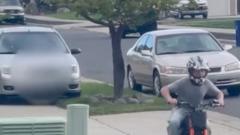
The recent arrest of a motorist who used their vehicle to hunt down a child on a bicycle is more than a localized police blotter entry. It represents a terrifying escalation in the fraying social contract that governs our shared public spaces. When a two-ton machine leaves the roadway to pursue a minor on a footpath, we are no longer discussing a traffic violation or a momentary lapse in judgment. We are looking at the normalization of vehicular violence, fueled by a culture of road rage that has finally jumped the curb.
Law enforcement officials confirmed that the driver intentionally steered onto the pedestrian walkway after a perceived slight or minor interaction with the young cyclist. The child was forced to abandon their bike to avoid a direct collision. This isn't just a story about a "bad driver." It is a story about the psychological transformation of a car from a transport tool into a tactical asset used for intimidation.
The Psychological Drift Toward Curb Jumping
To understand how a person reaches the point of chasing a child through a residential area, we have to examine the shift in driver psychology over the last decade. Modern vehicles are designed to insulate the occupant from the outside world. Soundproofing, climate control, and advanced infotainment systems create a digital bubble that dehumanizes everyone outside the glass.
When that bubble is "threatened" by a cyclist or a pedestrian, the response from a certain segment of the population is disproportionate. The car provides a sense of omnipotence. Behind the wheel, a person who might never engage in a physical confrontation feels empowered to use the mass and speed of their vehicle as an extension of their ego.
The transition from yelling out a window to actually mounting a curb is a rubicon that more drivers are crossing. Data from pedestrian safety advocacy groups shows a marked increase in "intentional encroachment" incidents. This is where drivers use their vehicles to crowd, nudge, or actively block non-motorized road users. The step from crowding a bike in a lane to chasing a child on a sidewalk is a matter of degree, not of kind.
Infrastructure as an Enabler of Violence
We often blame "human error" for these incidents, but the way we build our neighborhoods plays a silent, supporting role. Many suburban layouts prioritize high-speed thoroughfares with minimal physical separation between the asphalt and the sidewalk.
A painted white line is a suggestion, not a barrier. When roads are wide and visibility is high, drivers feel a sense of ownership over the entire corridor. In the mind of an aggressive motorist, the sidewalk isn't a sanctuary for pedestrians; it is simply unpaved overflow for their frustration.
Physical bollards and protected lanes are frequently dismissed as "war on cars" measures. However, in the context of the recent arrest, these structures take on a different meaning. They are protective hardware. If that footpath had been protected by concrete planters or steel posts, the chase would have ended before it started. The lack of physical defense on our sidewalks essentially invites the most volatile members of society to use them as bypasses or, in this case, hunting grounds.
The Legal System and the Myth of the Accident
One of the most significant hurdles in addressing these incidents is the linguistic and legal shielding provided by the word "accident." For decades, vehicular assaults have been minimized by a legal framework that views cars as inherently benign objects.
When a driver uses a baseball bat to threaten a child, the charges are immediate and severe. When that same driver uses a SUV, the defense often pivots toward "loss of control" or "temporary emotional distress." This creates a vacuum of accountability.
In this specific case, the arrest is a necessary first step, but it faces a judicial system that historically treats driving as a right rather than a privilege. To truly deter this behavior, the legal threshold for "assault with a deadly weapon" must be applied to vehicles without the usual leniency granted to motorists. We need to stop viewing these events as outliers and start seeing them as predictable outcomes of a system that refuses to penalize aggressive driving with the same weight as other violent crimes.
The Vulnerability of the Youngest Road Users
Children on bicycles occupy a unique and precarious position in our transit ecosystem. They are often told to stay off the roads for their own safety, yet as this incident proves, the sidewalk offers no guaranteed protection against a determined aggressor.
The trauma of being hunted by a motor vehicle is not something a child simply "gets over." It reshapes their relationship with their community and their sense of autonomy. If a child cannot ride a bike 50 yards from their home without fearing a vehicular incursion, the community has failed its most basic duty of protection.
We are seeing a generation of parents who are increasingly terrified to let their children navigate their own neighborhoods. This isn't "helicopter parenting." It is a rational response to a reality where drivers feel entitled to use every square inch of the map to vent their rage.
Redefining Public Safety Beyond Policing
While the arrest provides a sense of immediate justice, it does nothing to prevent the next incident. Relying solely on the police to catch drivers after they have already mounted a sidewalk is a reactive and inefficient strategy.
Real safety comes from a combination of strict licensing and radical redesign. We need to examine the ease with which individuals with a history of violent outbursts maintain their driving privileges. Currently, it is harder to lose a driver's license than it is to lose a professional certification.
Furthermore, we must demand "self-enforcing" streets. If a driver decides to chase a cyclist, the environment should make that physically impossible. Narrower entries, elevated curbs, and mid-block barriers are not just aesthetic choices. They are the only things standing between a vulnerable child and a driver who has lost their grip on reality.
The Role of Technology in Accountability
Dashcam and doorbell camera footage were instrumental in this arrest. In the past, these incidents often devolved into a "he-said, she-said" scenario where the driver’s version of events—usually claiming the cyclist was being "erratic"—was given more weight.
The democratization of surveillance has stripped away the anonymity that used to protect aggressive drivers. Every person on a bike or on foot is now a potential witness with a high-definition recording device. This shift is vital because it forces the public to confront the visceral reality of vehicular bullying. Seeing a car lurch onto a curb in a video is far more impactful than reading a dry police report about a "collision."
The Escalating Cost of Inaction
If we continue to treat these events as isolated bursts of "road rage," we ignore the systemic rot at the heart of our transit culture. The car is the most dangerous object the average citizen will ever operate. Yet, we have allowed its use to become so casual that some people feel comfortable using it to terrorize children.
Every time a driver escapes serious consequences for "brushing" a cyclist or "scaring" a pedestrian, the message is clear: the convenience and emotional whims of the motorist outweigh the lives of those outside the vehicle. The arrest in this case should not be the end of the conversation. It should be the catalyst for a total reevaluation of how we protect our most vulnerable citizens from those who have turned their commute into a combat zone.
The standard for holding a license must be elevated to reflect the lethal potential of the machine. We need a zero-tolerance policy for intentional sidewalk incursions that carries mandatory license revocation and significant prison time. Anything less is an admission that our sidewalks are merely suggestions, and our children are acceptable collateral in a culture of unchecked motorized aggression.
The sidewalk must be reclaimed as a sanctuary. This requires more than just an arrest; it requires a physical and legal barricade that ensures no driver ever feels the sidewalk is an extension of the road. If we cannot guarantee that a child can ride a bike on a footpath without being hunted, we have no right to call our streets civilized.
The next time a driver looks at a curb as a shortcut for their anger, the environment itself should be the first thing to stop them. Concrete does not care about your rage, and it doesn't accept excuses. We need more concrete and less "understanding" for the violent impulses of the modern motorist.