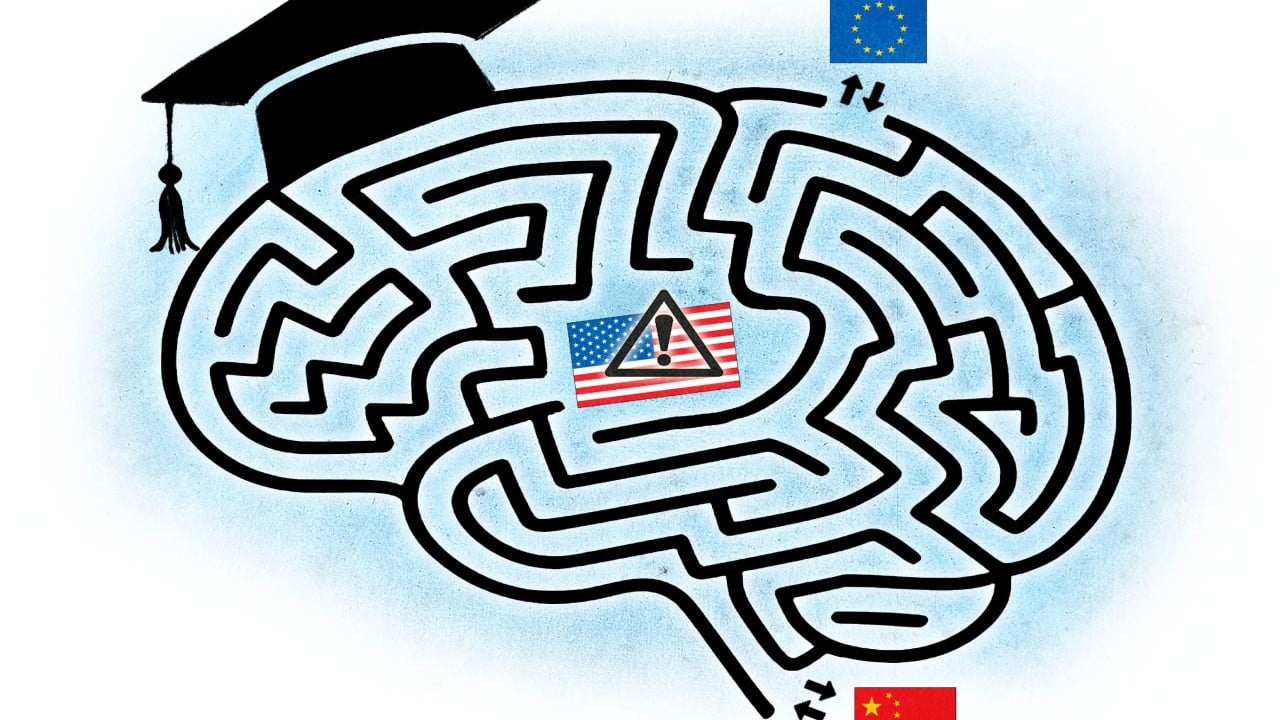
Western research networks are undergoing a profound structural realignment, but the narrative that Europe is simply replacing the United States with China as its primary scientific partner is fundamentally flawed. Geopolitical fractures have ended the era of borderless academic collaboration. While strict American immigration policies and domestic political pressures have sparked fears of a domestic brain drain, European research institutions are not rushing unthinkingly into Beijing’s embrace. Instead, European authorities are actively cutting ties with Chinese institutions, caught between the economic reality of China’s massive research spending and growing national security warnings about intellectual property theft and dual-use military technology.
The global scientific ecosystem, once envisioned as a frictionless network of global talent, has fractured into defensive, heavily policed blocs.
The Fortress Europe Reality Check
Washington has spent years warning its allies about the risks of unchecked scientific collaboration with Chinese state-run universities. Those warnings have altered European policy. In late 2025, the European Union excluded Chinese universities from roughly half of its flagship €93.5 billion Horizon Europe research programme. This aggressive move followed a 2023 directive that blocked Chinese entities from participating in close-to-market innovation projects.
Today, European collaboration with China is strictly limited to non-sensitive environmental initiatives and agricultural projects. The idea of a flourishing Euro-Chinese tech alliance is a corporate and diplomatic fiction.
Horizon Europe Funding Access for Chinese Institutions
┌──────────────────────────────────────────────────────────┐
│ [████████████████████] 50% Allowed (Climate, Agri)       │
├──────────────────────────────────────────────────────────┤
│ [░░░░░░░░░░░░░░░░░░░░] 50% Blocked (AI, Quantum, Tech)   │
└──────────────────────────────────────────────────────────┘
European research ministers are demanding a level playing field regarding intellectual property and public procurement before any deeper scientific agreements are signed. Brussels has shifted from a philosophy of open collaboration to one of defensive independence. European security agencies are enforcing stricter export controls on dual-use research. European universities, long accustomed to treating academic inquiry as a borderless endeavor, now operate under strict regulatory scrutiny.
The Transatlantic Fractures and Beijing’s Diplomatic Push
Despite Europe’s regulatory clampdown, diplomatic tensions between European capitals and Washington have created a volatile environment. Radical shifts in American foreign policy have shaken Europe's trust in its traditional transatlantic ally. This diplomatic volatility has provided Beijing with an opening. Chinese science diplomats are actively lobbying European research centers, presenting China as a stable, predictable, and heavily funded alternative to the shifting political priorities of the United States.
Academic delegations from major European economies continue to visit technology hubs like Shenzhen and Hong Kong to explore collaborative boundaries. Some European policymakers argue that a clean break with China is impossible. China now accounts for roughly 28% of global scientific publications, compared to the European Union’s 22% and the United States’ 17%. Forcing a complete separation from the world's largest producer of scientific literature risks leaving Western scientists isolated from major advancements in battery chemistry, materials science, and renewable energy infrastructure.
The Asymmetric Nature of Modern Scientific Exchange
The central vulnerability for Western institutions is not a lack of awareness, but an asymmetry in how research is funded and applied. The United States and China excel at converting public research funding into commercialized, private-sector technologies. Europe regularly falls behind in this commercialization pipeline. European research remains heavily dependent on public funding, which is primarily distributed to higher education institutions rather than private enterprises.
Furthermore, China's research system focuses heavily on experimental development and immediate industrial applications. European research programs emphasize basic and applied research. When European universities partner with Chinese entities, European breakthroughs are frequently commercialized within China’s state-supported industrial ecosystem rather than Europe's. This dynamic turns collaborative research into an unintended transfer of intellectual property, helping China build a competitive advantage in critical technologies.
The Rise of Scientific Middle Powers
The emerging global scientific landscape is not a simple choice between Washington and Beijing. Frustrated by the geopolitical volatility of the United States and the systemic security risks of China, European research strategists are shifting focus toward a third option. Europe is actively diversifying its research partnerships by building deeper ties with reliable middle powers.
- East Asian Tech Alliances: Increased funding and joint research initiatives with Japan and South Korea, focusing on semiconductor development and advanced computing.
- Commonwealth Integration: Deeper institutional links with Canada and Australia to offset the decline in joint US-China projects.
- Emerging Research Markets: Expansion of the Horizon Europe framework to include technical hubs in India and South America, creating new avenues for talent acquisition.
This diversification strategy acknowledges that the old, bipolar scientific order is broken. By spreading its risk across multiple stable democracies, Europe hopes to preserve its global scientific standing without exposing its critical industries to espionage or sudden geopolitical shifts.
The Real Intellectual Property Battleground
The primary risk to Western scientific preeminence is not a mass migration of talent to Beijing. The real crisis is the systemic vulnerability of open academic institutions to targeted knowledge extraction. While the United States relies on aggressive visual policing and criminal indictments to protect its academic borders, Europe is relying on bureaucratic restrictions and strict disclosure requirements.
Neither approach has solved the core issue. Modern scientific breakthroughs rarely occur through dramatic, high-profile thefts. They are lost through the steady accumulation of small, unmonitored collaborations in basic research that seem harmless on paper but carry massive dual-use implications when scaled. The challenge for Western policy is to protect scientific integrity without shutting down the international exchange of ideas that drives real innovation.
The era of borderless, unmonitored scientific collaboration is over, replaced by a defensive landscape where every research grant, international partnership, and academic paper is viewed through the lens of national security. Europe is not replacing America with China. It is discovering that in the modern global economy, a middle ground no longer exists.