The threat is no longer a rhetorical flourish used to squeeze concessions out of Brussels. It has become the central friction point of a presidency defined by a "war of choice" in the Middle East and a darkening rift with the continent that has been America's primary security partner for 77 years.
Donald Trump has spent the last several weeks signaling that the North Atlantic Treaty is, in his words, a paper tiger. This isn't just about the 2% defense spending targets of the past. It is about a fundamental breakdown in trust following the closure of the Strait of Hormuz by Iran. When European allies refused to join a high-risk naval mission to "just take the oil," as the President demanded, the response from the White House was swift and scorched-earth. Learn more on a connected issue: this related article.
The public needs to understand a cold reality: the legal barriers preventing a formal U.S. exit are robust, but they are also largely irrelevant to the actual function of a military alliance. Whether the U.S. stays on paper is a question for lawyers; whether the U.S. stays in the foxhole is a question of political will.
The Legislative Iron Dome
In late 2023, a bipartisan coalition in Congress—led by current Secretary of State Marco Rubio and Senator Tim Kaine—baked a poison pill into the National Defense Authorization Act (NDAA). Section 1250A explicitly prohibits any president from suspending, terminating, or withdrawing from the North Atlantic Treaty without a two-thirds Senate majority or an act of Congress. More analysis by NPR delves into comparable perspectives on the subject.
This law was designed specifically for this moment. It ensures that any attempt to file a formal "notice of withdrawal" would be tied up in the courts for years. The Supreme Court has historically been hesitant to intervene in "political questions" involving foreign policy, but the 2024 NDAA provides a statutory hook that didn't exist during the first Trump administration.
Even if the President ignores the law, the power of the purse remains with the House. Congress has forbidden the use of federal funds to facilitate a withdrawal. In a technical sense, the U.S. is locked in the room. The door is barred from the outside by a law that the President’s own Secretary of State helped write.
Functional Obsolescence
The mistake many analysts make is equating a legal treaty with a functional alliance. A treaty is a piece of parchment; an alliance is a credible promise.
If the Commander-in-Chief decides that American troops in Naples or Ramstein will not move to defend a Baltic state, the treaty is dead. Article 5—the "one for all" clause—is not self-executing. It requires the President to order the military into action. If the White House refuses to share intelligence, suspends joint exercises, or pulls back the nuclear umbrella, the "legal" membership of the U.S. in NATO becomes a ghost.
This is the "hollow out" strategy. It avoids a messy constitutional crisis while achieving the same result: the end of the American security guarantee. We are already seeing the precursors. The U.S. has reportedly begun weighing whether to relinquish its command of NATO forces in Naples, signaling a retreat from the Mediterranean at the very moment the Iran conflict is boiling over.
The Greenland and Denmark Friction
The current animosity is being fueled by more than just defense spending. The administration's renewed interest in Greenland—a semi-autonomous territory of NATO ally Denmark—has turned a geopolitical curiosity into a diplomatic flashpoint.
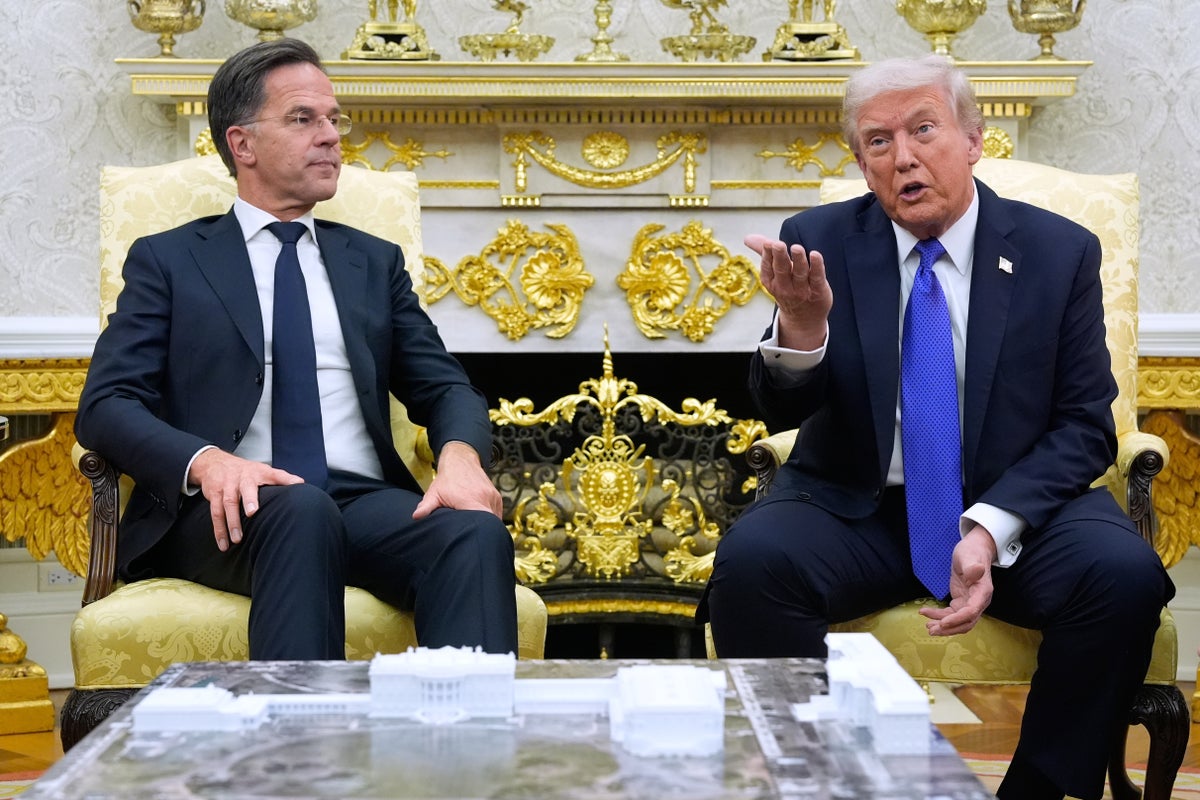
During recent meetings with Secretary-General Mark Rutte, the President reportedly linked American participation in NATO to "cooperation" on Greenland's status and resource rights. By treating a fellow member's sovereign territory as a bargaining chip, the administration is effectively dismantling the "mutual respect" component of the alliance. When you combine this with the refusal of Spain and France to allow the use of their airspace for the current Middle East operations, the relationship has moved from "tense" to "adversarial."
The 5 Percent GDP Ultimatum
The old 2% goal is dead. The White House is now demanding a 5% GDP commitment from all members. For context, Poland is currently the only European nation approaching that level, while Germany—the continent's economic engine—struggles to consistently hit 2%.
Asking for 5% is a "poison pill" demand. It is an amount that most European parliaments cannot authorize without dismantling their social safety nets, which would trigger massive domestic unrest. By setting the bar at an impossible height, the administration creates a permanent justification for American disengagement.
The Rearmament Bill
Europe is finally waking up to the fact that the American shield is no longer a given. Defence budgets across the continent have doubled since 2022, reaching over $450 billion annually.
- Germany has bypassed its own debt brakes to fund military expansion.
- Poland is transforming into the primary land power of the European pillar.
- France and the UK are in quiet discussions regarding an independent nuclear deterrent for the continent.
These moves are not being made out of "synergy" with Washington. They are being made out of fear.
The Economic Aftershocks
A functional U.S. withdrawal would not just be a military event. It would be a global financial reset. The dollar’s status as the world’s reserve currency is tied, in part, to the fact that the U.S. is the ultimate guarantor of the global rules-based order.
If that guarantee is revoked, the "safe haven" status of the dollar weakens. We are already seeing gold hit record highs and the dollar soften against the Swiss franc as markets begin to price in the end of the Transatlantic era. The rearmament of Europe will require trillions in capital, crowding out private investment and sending sovereign debt levels into a tailspin.
The Silent Beneficiaries
While Washington and Brussels trade insults, the strategic vacuum is being filled. A U.S. that is bogged down in an unpopular war with Iran and alienated from its Pacific and European allies is a U.S. that cannot effectively project power elsewhere.
For Beijing, the breakdown of NATO is the ultimate proof of their "American decline" narrative. It creates a blueprint for how the U.S. might treat its Pacific partners—Japan, South Korea, and Australia—if the political winds shift. The credibility of a security guarantee is binary: it either exists or it doesn't. You cannot be "half-committed" to a military alliance.
The U.S. won't leave NATO because the law won't let it. But the U.S. might make NATO so irrelevant that leaving is just a formality. The alliance isn't ending with a bang or a signed document; it is ending with a social media post and a refusal to answer the phone when a fellow member is under fire.
Europe is on its own. The sooner they stop looking toward Washington for a rescue that isn't coming, the sooner they can begin the painful process of building a defense that actually works for them.
The era of the American guarantor is over. Whatever replaces it will be more expensive, less stable, and entirely unrecognizable.