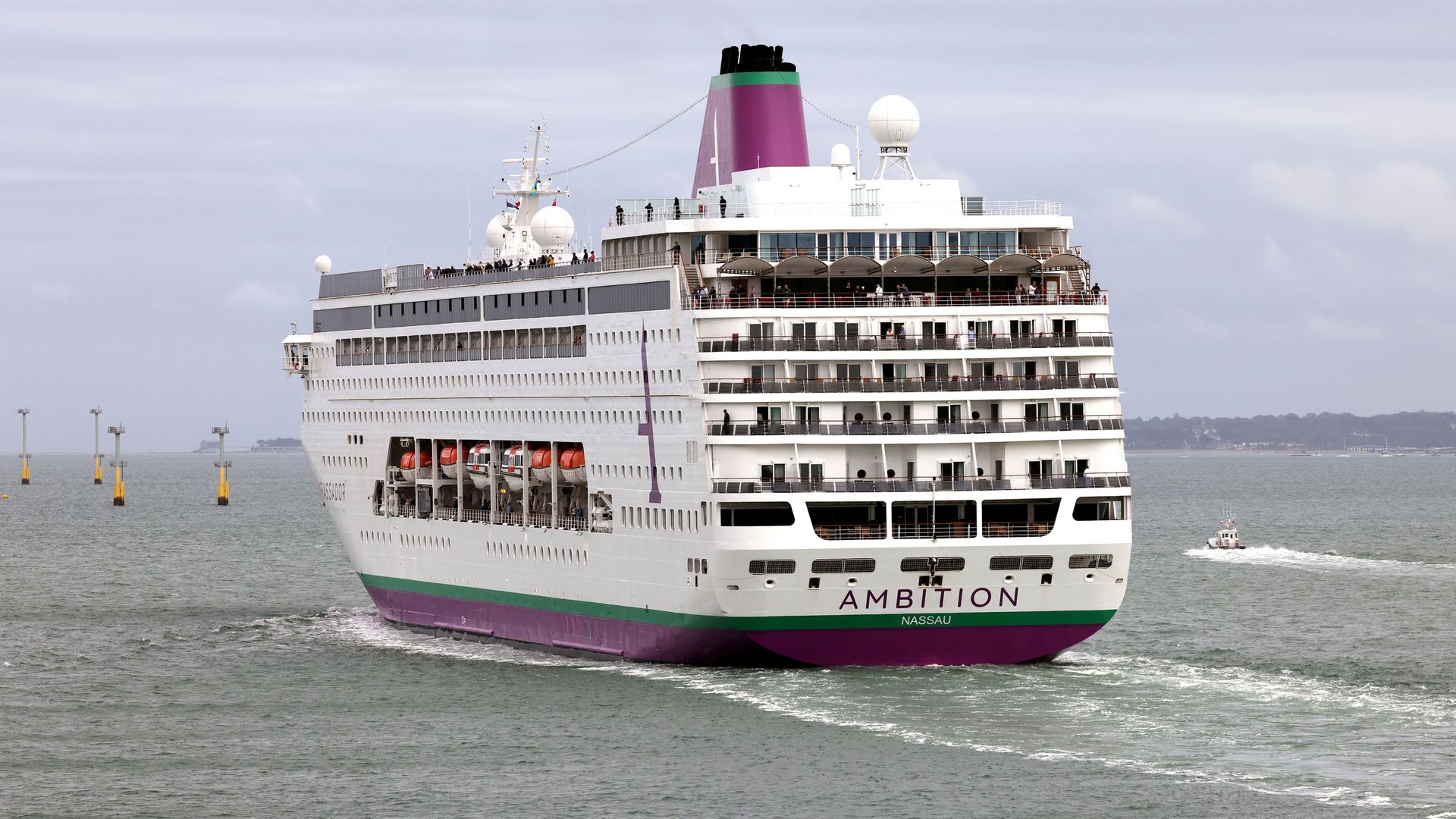
The confinement of 1,700 passengers and crew aboard a British cruise ship due to a gastrointestinal outbreak exposes the structural vulnerability of the modern cruise industry’s "closed-loop" operational model. When a highly contagious pathogen like Norovirus enters a vessel, the ship ceases to be a leisure vehicle and transforms into a biological pressure cooker. The primary failure in these scenarios is rarely the medical response itself, but rather the inability of the ship's physical architecture and social engineering to decouple human density from transmission velocity.
The Transmission Calculus of Maritime Outbreaks
To understand why a cruise ship becomes a flashpoint for stomach flu—predominantly Norovirus—one must look at the Transmission Probability Function. The rate of infection on a vessel is governed by three specific variables:
- Surface Persistence: Norovirus can survive on hard surfaces (fomites) for weeks. In a cruise environment, high-touch points such as buffet ladles, elevator buttons, and handrails serve as static vectors that bypass traditional social distancing.
- Inoculum Size: Norovirus requires a microscopic dose—as few as 18 viral particles—to trigger a full-scale infection. This low threshold means that standard cleaning protocols often miss the "residual load" necessary to halt the spread.
- The Asymptomatic Lag: Passengers often shed the virus before they feel ill and continue to shed it for days after symptoms resolve. This creates a "shadow phase" where the virus moves through the population undetected by thermal scanners or self-reporting.
The interaction of these variables creates a feedback loop. As more individuals become symptomatic, the volume of environmental contamination increases exponentially, overwhelming the ship's housekeeping capacity and leading to the mandatory "banning" or quarantine of the entire manifest.
Structural Bottlenecks in Quarantine Protocols
The decision to prevent 1,700 people from disembarking is a blunt-force regulatory tool designed to protect land-based populations, yet it creates a secondary crisis within the vessel. The maritime "Containment Paradox" dictates that by keeping the population on board to prevent external spread, the risk to the healthy individuals inside the ship increases significantly.
The Sanitation Ceiling
Once a ship reaches a certain threshold of infection—typically 2-3% of the manifest—standard sanitation reaches a breaking point. The crew, who live in even higher density quarters than passengers, often become infected early in the cycle. This creates a labor shortage at the exact moment when labor-intensive deep cleaning is required. If the "Clean-to-Contagious" ratio of the crew falls below a specific level, the ship loses its ability to self-sanitize.
HVAC and Aerosolization Risks
While Norovirus is primarily fecal-oral, vomiting episodes create localized aerosolized droplets. Modern cruise ships use sophisticated HVAC systems, but these are often designed for thermal efficiency rather than medical-grade filtration. If the air exchange rates are not increased during an outbreak, or if humidity levels fall too low, the risk of short-range aerosol transmission rises.
The Economic Cost of Bio-Security Failure
For a cruise operator, an outbreak is not merely a health crisis; it is a catastrophic failure of the asset's utility. The costs are categorized into three distinct buckets of loss:
- The Operational Burn Rate: This includes the cost of specialized bio-hazard cleaning teams, refunds for the current voyage, and the cancellation of the subsequent "turnaround" cruise.
- Regulatory Friction: Local port authorities, particularly in the UK and EU, have the power to deny docking rights or impose "quarantine-at-anchor" orders. This turns the ship from a revenue-generating asset into a liability that incurs daily port and fuel fees without income.
- Brand Equity Erosion: While individual outbreaks are often forgotten, a pattern of "sick ship" headlines leads to a "risk premium" in consumer pricing, where the operator must discount heavily to fill berths.
Quantifying the Threshold of Disembarkation Denial
Regulatory bodies like the CDC or the UK’s health agencies do not trigger mass bans on a whim. The logic follows a Binary Risk Assessment:
If $R_0$ (the basic reproduction number) of the virus on the ship is significantly higher than the capacity of the destination port’s healthcare infrastructure to manage a surge, the ship is denied entry. This is a cold calculation of resource management. A single ship carrying 1,700 people could theoretically dump 300+ acute cases into a local hospital system in a single afternoon. To prevent a "systemic shock" to land-based clinics, the ship is forced to remain a self-contained medical unit.
Strategic Mitigation and the Path to Resilience
The current maritime response to Norovirus is reactive. To move toward a resilient model, operators must transition from Cleaning-for-Appearance to Engineering-for-Exclusion.
The first step is the integration of non-porous antimicrobial materials into all high-traffic areas during dry-dock refits. Copper alloys and specialized polymers that actively degrade viral RNA can reduce the surface persistence variable.
The second step is the deployment of Real-Time Bio-Surveillance. Using wastewater testing—a technique refined during the 2020-2022 period—ships can detect the presence of Norovirus or Influenza in the vessel's sewage systems days before the first passenger reports to the infirmary. This allows for a "pre-emptive strike" in cleaning protocols, potentially stopping an outbreak before it hits the 1% threshold.
Finally, the industry must address the Incentive Gap for Self-Reporting. Passengers who have spent thousands of dollars on a vacation are incentivized to hide their symptoms to avoid being confined to a cabin. A structural shift toward "Guaranteed Re-booking" for any passenger who reports gastrointestinal symptoms would align passenger behavior with the ship's safety goals. Without this alignment, the ship’s manifest will always contain a "hidden reservoir" of infection.
The 1,700 people currently held on the British vessel are the result of a system that prioritizes throughput over biological safety. The transition from a luxury transport to a floating quarantine zone is a predictable outcome of high-density maritime logistics when faced with high-velocity pathogens. Until the industry moves toward automated detection and material-science-based prevention, the "Stomach Flu Outbreak" will remain an inherent, un-hedgeable risk of the cruise business model.
The strategic play for operators is the decoupling of "Guest Experience" from "Shared Touch-Points." This means the total elimination of buffets, the implementation of gesture-controlled or mobile-app-based elevator and door interfaces, and the use of UVC-light disinfection integrated into the ship's ventilation during sleeping hours. Failure to modernize the physical infrastructure ensures that the next outbreak is a matter of "when," not "if," and the next 1,700-person ban is already on the horizon.